


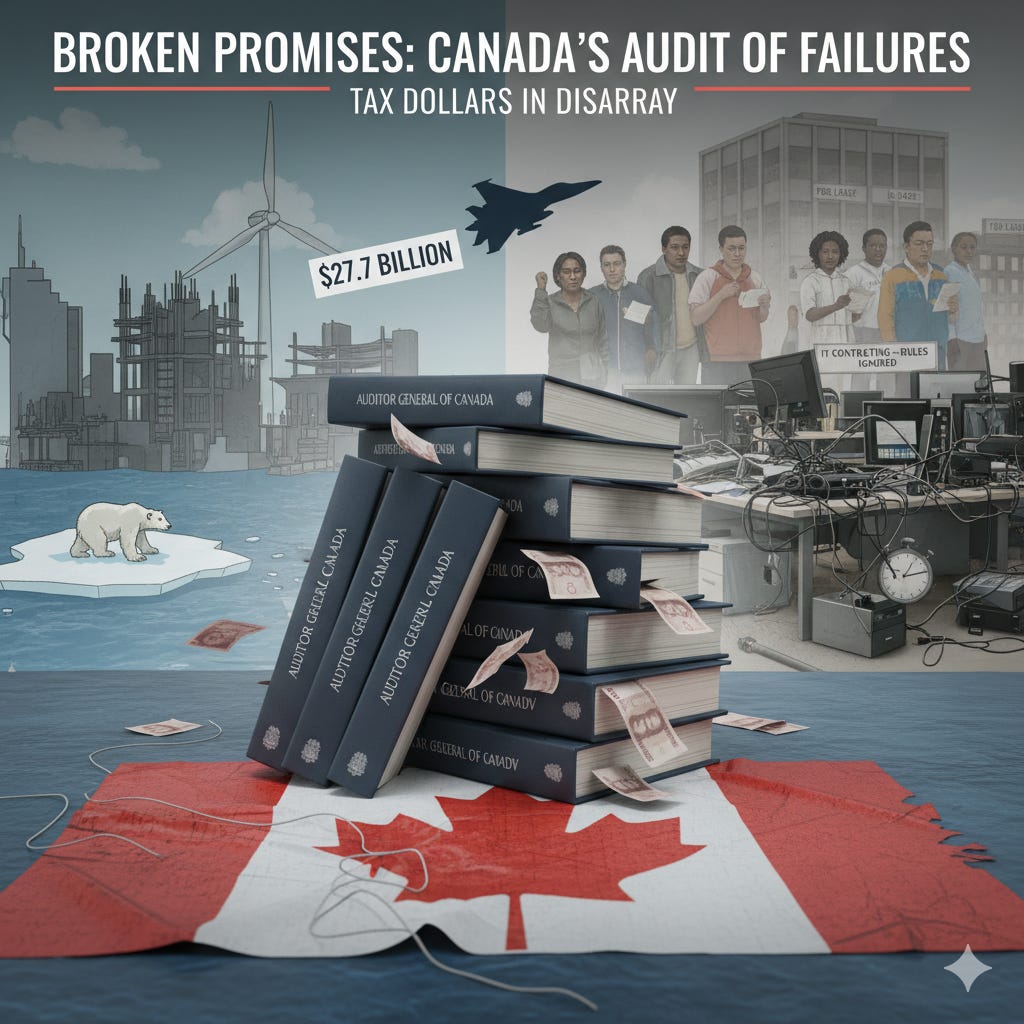
You expect the government to manage your tax dollars efficiently and deliver essential services without needless delays. Recent audits from the Auditor General of Canada paint a different picture. They reveal persistent problems in how federal departments handle everything from major military purchases to environmental protection and support for Indigenous communities.
These reports are not just about numbers on a spreadsheet. They highlight systemic issues that lead to ballooning costs, stalled progress on critical files, and a failure to follow fundamental rules. The findings show a pattern of weak oversight and poor planning that affects national security, climate readiness, and basic fairness for Canadians. Understanding these failures is the first step toward demanding better performance and accountability from public institutions.
1. IT Contracting Rules Are Routinely Ignored
Federal organizations frequently sidestepped procurement rules when awarding contracts for information technology staffing. An audit focused on contracts given to the firm GC Strategies found that departments often failed to ensure fairness, transparency, and value for money.
In many cases, officials could not prove they had verified security clearances for contractors. They also lacked documentation to show that the people performing the work had the required qualifications or even what work was done. This lack of basic oversight was not isolated to one department, with 31 different federal organizations awarding 106 contracts to the single firm between 2015 and 2024. The Auditor General noted that the government does not need more procurement rules, it needs public servants to understand and follow the existing ones. This pattern suggests a widespread disregard for processes designed to protect taxpayer dollars.
They weren't willing to support a motion in the House of Commons that banned GC Strategies for life; they supported, rather, a paltry seven-year ban. You yourself said in your own words that the rules are clear: that no more policies are needed, that no recommendations are needed here, that the government need only follow and enforce the rules.
Stephanie Kusie, Member of Parliament for Calgary Midnapore (CPC)
2. Climate Adaptation Strategy Is Years Behind Schedule
The federal government released a national strategy to adapt to climate change, but it arrived nearly 20 years after the Auditor General’s office first recommended one. The strategy still has significant weaknesses.
Key elements are missing, including a prioritization of Canada’s most pressing climate change risks. The plan also lacks comprehensive details for action. Two major components, bilateral action plans with provinces and territories and the Indigenous Climate Leadership Agenda, were still in development at the time of the audit. These delays leave communities exposed to growing threats like floods and wildfires without a coordinated national response. Urgent action is needed to produce meaningful results for the health, safety, and livelihoods of Canadians.
Urgent action is still needed to deliver meaningful results for Canadians’ health, safety and livelihoods.
Jerry V. DeMarco, Commissioner of the Environment and Sustainable Development, Office of the Auditor General
3. Fighter Jet Replacement Costs Have Soared
The project to replace Canada’s aging CF-18 fleet with new CF-35A fighter jets faces major cost increases and delays. The Department of National Defence’s original cost estimate of $19 billion was based on outdated information.
By 2024, the projected cost had jumped by almost 50% to $27.7 billion. This new total still does not include essential elements like certain infrastructure upgrades and advanced weapons, which would add at least another $5.5 billion. The project also faces risks from a potential shortage of qualified pilots and construction delays of over three years for new squadron facilities. Active management is required to control costs and ensure the new fleet is rolled out in a timely manner to maintain national security.
4. Indigenous Peoples Face Long Waits for Essential Services
First Nations people are waiting far too long for decisions on their registration under the Indian Act, which gives them access to vital services like housing, education support, and health benefits.
Indigenous Services Canada took an average of almost 16 months to process complex applications, far exceeding its six-month service standard. Even applications prioritized for medical emergencies took an average of 10 months. The audit also found that funding for community-based administrators who help people apply has not changed since 1994 and is unstable. These delays leave families in limbo and prevent them from accessing rights they are entitled to under Canadian law.
5. Government Is Failing to Shrink Its Underused Office Space
Public Services and Procurement Canada has made little progress on its plan to reduce underused federal office space, missing a key opportunity to save money and free up properties for affordable housing.
In 2017, the department estimated half of its office space was underused and planned a 50% reduction by 2034, which was projected to save about $3.9 billion. From 2019 to 2024, the department achieved less than a 2% reduction, mainly due to a lack of funding. While the federal lands initiative is supposed to convert surplus properties into housing, only about half of the 4,000 committed units are expected to be ready for occupation by the 2028 target date. This slow progress means taxpayers continue to pay for empty buildings while the housing crisis worsens.
6. Protection for Species at Risk Is Hindered by Delays
Federal departments are too slow in gathering information needed to protect and recover species at risk. The loss and degradation of habitat is the main threat to most of these species.
While Environment and Climate Change Canada, Fisheries and Oceans Canada, and Parks Canada use the best available information to identify critical habitats, their efforts to gather additional data are slow. Monitoring on federal land is also limited, making it hard to know if protection measures are working. These gaps hinder the recovery of vulnerable wildlife and put Canada at risk of failing to meet its biodiversity commitments. Improved data collection is necessary to prevent further species loss.
7. Canada Lags Other G7 Nations on Sustainable Development
Despite more than 30 years of federal commitments, Canada has made the least improvement among all G7 nations in meeting the United Nations Sustainable Development Goals.
Progress has been slow because social, economic, and environmental factors are rarely integrated into government decisions, policies, and programs. The audit report identifies a need for stronger national leadership and deeper collaboration, especially with Indigenous governments and peoples. Without a more integrated approach, Canada will continue to struggle to build a sustainable future.
Implementing sustainable development is proving to be an immense challenge in Canada.
Jerry V. DeMarco, Commissioner of the Environment and Sustainable Development, Office of the Auditor General
8. Ocean Management Plans Lack Concrete Action
Fisheries and Oceans Canada has collaborated with partners to develop plans for managing marine resources, but these plans are often high-level and do not lead to concrete actions.
Nearly 30 years after integrated ocean planning became law, meaningful implementation is still missing. A newer planning process adopted in 2018 to coordinate human activities in the oceans has also seen limited progress. With climate change and other pressures on marine resources increasing, the department needs to show stronger leadership to protect ocean ecosystems and coastal economies.
These audit findings reveal a troubling pattern of inefficiency and a failure to follow established rules across the federal government. From procurement scandals to stalled environmental action, the consequences include wasted money, missed opportunities, and eroded public trust. Stronger oversight and a commitment to basic principles of accountability are necessary to ensure your tax dollars are managed responsibly. What is one area where you believe improved government performance is most urgently needed?
Sources:
Standing Committee on Public Accounts. (2025). Evidence, Number 002 [Transcript]. House of Commons, Canada.