


Good morning.
While the Parliamentary Budget Officer delivered another dose of sobering news on housing affordability, a deeper look into recent committee testimony reveals a government grappling with its own regulations. The testimony suggests some policies, like the federal EV mandate, are producing surprising and costly outcomes for Canadian industry. This briefing will take approximately 6 minutes to read.
BUSINESS & TECHNOLOGY
The Unintended Cost of Canada’s EV Mandate
Driving the news: Testimony before the Standing Committee on International Trade revealed the federal government’s Electric Vehicle (EV) sales mandate is compelling Canadian auto manufacturers to purchase billions in regulatory credits from competitors, primarily Tesla, which has no manufacturing footprint in Canada.
Catch-up:
The federal Electric Vehicle Availability Standard mandates that a growing percentage of new vehicles sold must be zero-emission, reaching 60% by 2030.
Brian Kingston, President of the Canadian Vehicle Manufacturers’ Association (CVMA), testified that there is a projected deficit of 550,000 EV sales between now and 2030 compared to the mandated targets. Automakers who cannot meet their sales targets must purchase credits from companies with a surplus, like Tesla.
Why it matters: According to CVMA estimates, over $1 billion has already been committed by the auto sector to purchase these credits to manage the sales gap. This policy effectively transfers significant capital from companies with deep manufacturing roots and investments in Canada to a foreign competitor. The CVMA argues this prioritizes “arbitrary EV sales targets over the development of the North American supply chain” and has recommended the mandate be scrapped.
GOVERNANCE & INFRASTRUCTURE
Building Canada, Bypassing Consultation?
Driving the news: First Nations leaders are raising alarms over Bill C-5, the Building Canada Act, arguing the legislation was drafted without proper consultation and grants the federal cabinet sweeping powers to override key laws, including the Indian Act, to fast-track major projects.
Catch-up:
Bill C-5 aims to accelerate the approval of “projects of national interest” by creating a centralized process and allowing the federal cabinet to exempt these projects from the normal application of various federal laws listed in the bill’s schedule.
Appearing before the transport committee, Assembly of First Nations (AFN) National Chief Cindy Woodhouse Nepinak stated that First Nations leaders were given only seven days to respond to the bill’s details and that the process fails to meet the Crown’s obligation for deep consultation and consent.
Why it matters: The National Chief warned that the bill allows for “project approval by executive decree” and is one of the most significant federal bills affecting First Nations in years. The ability for cabinet to unilaterally vary or exempt parts of the Indian Act is a primary concern, and the AFN has called for its removal from the bill’s schedule. Legal experts also testified that the bill’s broad definition of “national interest” and its override powers create significant constitutional risks and could be challenged in court, potentially defeating the goal of expediting projects.
ECONOMY & HOUSING
PBO Report: Housing ‘Affordability Gap’ Narrows, But Relief Remains Out of Reach
Driving the news: A new report from the Office of the Parliamentary Budget Officer (PBO) shows that while the gap between house prices and what an average household can afford has narrowed since early 2022, prices in cities like Toronto and Hamilton remain significantly overvalued.
Catch-up:
The PBO’s “affordability gap” measures the percentage difference between the average house price and the price an average-income household could afford based on normal borrowing capacity.
Nationally, this gap fell from a peak of 80% in September 2023 to 34% in August 2025, driven by falling home prices from their 2022 peak and recovering household incomes.
Why it matters: Despite the national trend, affordability has worsened in Calgary, Montréal, and Québec since early 2022. In Hamilton, the average house price in August 2025 was 52% above the affordable level, while in Toronto it was 36% above. This indicates that even with recent market cooling, households in these expensive markets must still stretch their finances significantly, increasing their vulnerability to income or interest rate shocks.
On The Docket
EV Mandate Paused: Environment and Climate Change Canada officials confirmed the government has paused the 2026 target for its EV mandate and is conducting a 60-day review of the regulation to ensure affordability for consumers and achievable goals for the industry.
Pork Exports Stalled: The Canadian Pork Council testified that despite the Canada-European Union Comprehensive Economic and Trade Agreement (CETA), non-scientific technical barriers to trade prevent Canadian producers from accessing the market, representing a lost opportunity of about $400 million annually.
Parliamentary Priorities: Parliamentary committees are launching several new studies this fall, including a review of a potential defence industrial strategy, the economic and social impacts of Artificial Intelligence, and the growing threat of financial fraud and scams in Canada.
In Their Own Words
AFN National Chief Cindy Woodhouse Nepinak on Bill C-5
“Split this bill. Send the bill back for further study and allow first nations rights holders to attend these hearings so that you can hear directly from them about their rights, titles, communities and ways of life... Let’s start it off a better way by respecting each other and working together more closely rather than dividing and having a very divided Canada in a moment when we need to be together.”
Why it matters: The National Chief’s testimony before the Standing Committee on Transport, Infrastructure and Communities framed the debate over Bill C-5 not just as a matter of legislative process, but as a critical test of the government’s commitment to reconciliation and the principle of free, prior, and informed consent. Her direct plea to split the bill and hold it for proper consultation highlights the deep concerns that the legislation, in its current form and rushed timeline, risks repeating a colonial approach by prioritizing development without the meaningful partnership of First Nations.
Also Noteworthy
The oil and gas sector is Canada’s largest source of emissions, accounting for 30% of the national total, according to officials from Environment and Climate Change Canada.
Electricity Canada estimates that $1.7 trillion in investment will be needed by 2050 to meet Canada’s future electricity demands.
The Public Policy Forum reports that over $600 billion in proposed major projects could add $1.1 trillion to Canada’s GDP by 2035 if built.
The government’s proposed oil and gas emissions cap, which is currently under review, was projected to contribute 13 megatonnes of reductions between 2030 and 2032.
The Standing Committee on Agriculture and Agri-Food has agreed to undertake a study of the new grocery code of conduct and its effectiveness in addressing retailer practices.
The Data Brief
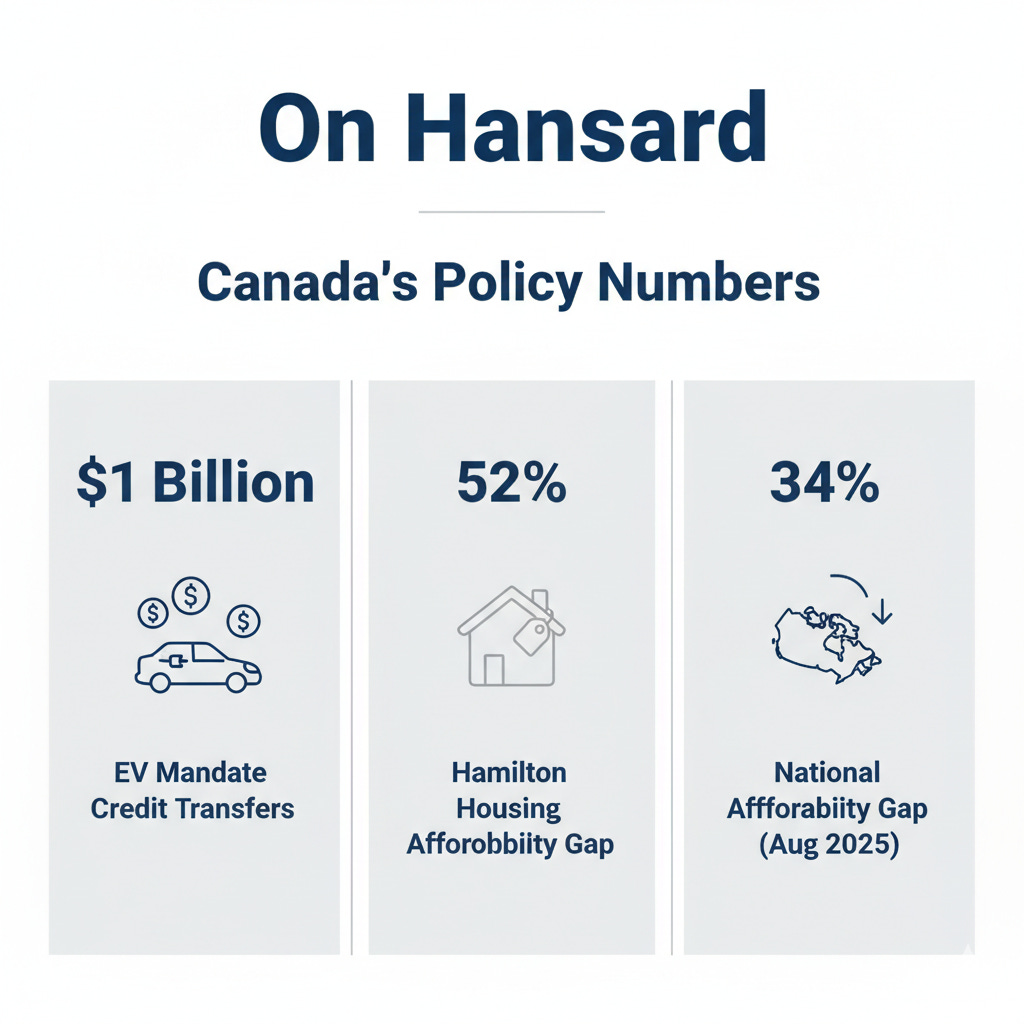
$1 Billion: The estimated amount Canadian automakers have committed to purchasing EV credits, largely from Tesla, to comply with federal sales mandates. This represents a significant capital transfer to a competitor without a Canadian manufacturing presence.
52%: The housing affordability gap in Hamilton as of August 2025. This means the average house price is 52% higher than what a household with an average income can sustainably afford.
34%: The national housing affordability gap as of August 2025, a significant drop from its peak of 80% in September 2023. This shows a national cooling trend, though major regional disparities persist.
In Other News...
Beyond this deep dive, you can find more analysis and commentary on the On Hansard site.


Sources:
House of Commons. (2025, September 18). Standing Committee on Agriculture and Agri-Food, Evidence, Number 002, 45th Parliament, 1st Session.
House of Commons. (2025, September 22). Standing Committee on Environment and Sustainable Development, Evidence, Number 003, 45th Parliament, 1st Session.
House of Commons. (2025, September 22). Standing Committee on Industry and Technology, Evidence, Number 003, 45th Parliament, 1st Session.
House of Commons. (2025, September 18). Standing Committee on International Trade, Evidence, Number 002, 45th Parliament, 1st Session.
House of Commons. (2025, June 17). Standing Committee on Transport, Infrastructure and Communities, Evidence, Number 002, 45th Parliament, 1st Session.
Office of the Parliamentary Budget Officer. (2025, October 2). House Price Assessment Update.