


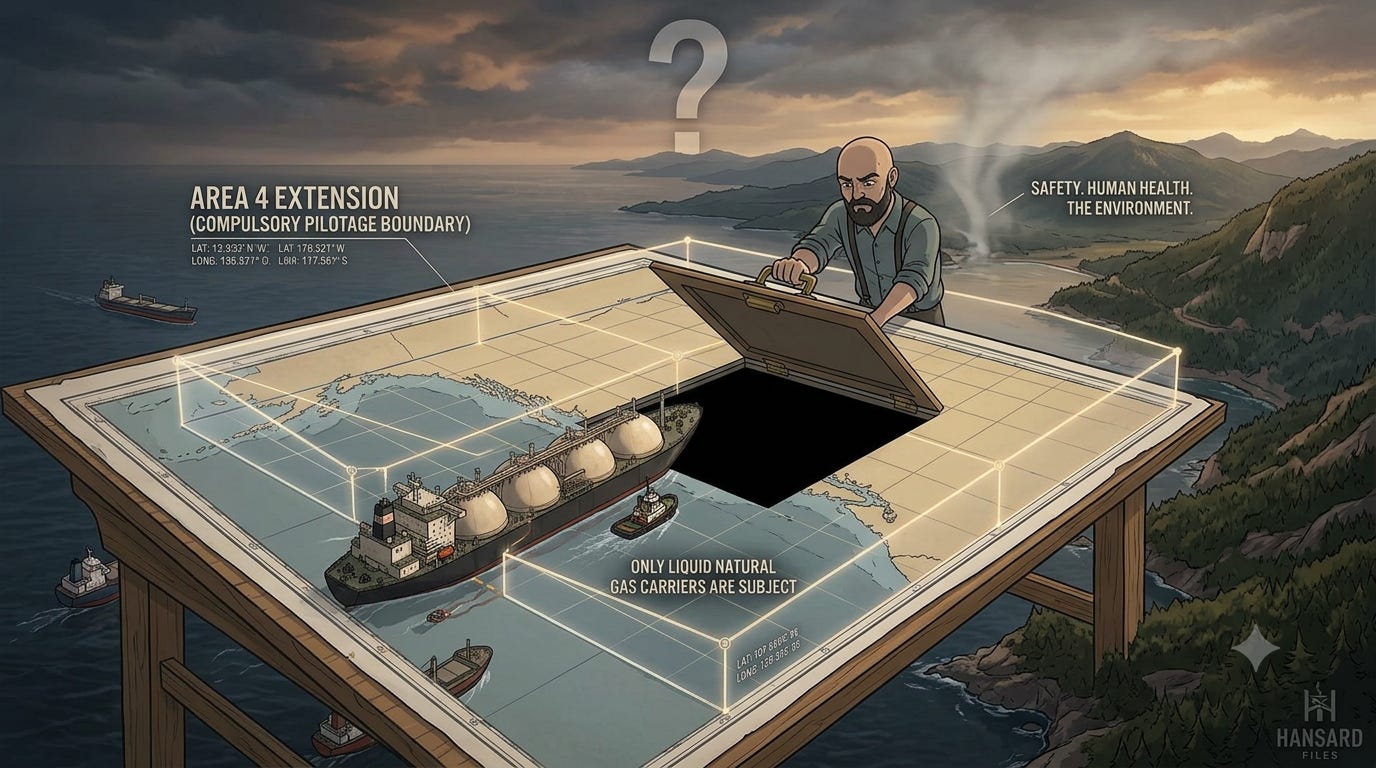
A liquid natural gas carrier crossing into a seven-point section of the Pacific Pilotage Authority region meets a rule written for that class of ship alone under the new order.
It must be under compulsory pilotage.
The boundary is exact. It begins at latitude 54°35.25′ north and longitude 131°16.75′ west, then runs through six more positions. The reason for drawing it is much less specific.
In Interim Order No. 2 Respecting Area 4 of the Pacific Pilotage Authority Region, Transport Minister Steven MacKinnon states that an urgent issue involving pilotage services poses “a significant risk to safety, human health or the environment.”
The order does not identify the issue.
It does not describe an incident, name a vessel or state which of the three possible harms is at risk. Instead, it moves directly from the minister’s finding to the legal boundary and the ships caught by it.
Only liquid natural gas carriers.
Seven points and one class of ship
The order was made in Ottawa on July 29, 2026, under subsection 52.2(1) of the Pilotage Act. Its opening says the minister believes the measure is required to address the urgent issue. It also says the same provisions could be placed in a regulation under the Act.
What follows is compact.
Section 1 defines “Regulations” as the General Pilotage Regulations. Section 2 extends Area 4 of the Pacific Pilotage Authority region by enclosing waters within a line drawn through seven latitude and longitude positions.
Section 3 narrows the effect. Despite subsection 25.9(1) of the General Pilotage Regulations, “only liquid natural gas carriers are subject to compulsory pilotage” inside the extended area.
That word matters: only.
The order does not create a general compulsory pilotage rule for every ship moving through the added waters. It attaches the special requirement to one class of carrier. Yet the text does not explain why that class was selected, what pilotage problem required the extension, or how the new boundary responds to the risk the minister identified.
The document is precise where a navigator would need precision. Every turn in the boundary has coordinates. Its legal target is equally clear. A reader can determine where the extended area lies and which ships are subject to the order.
The public rationale remains one sentence.
An urgent issue exists. It concerns the provision of pilotage services. It poses a significant risk to safety, human health or the environment.
No further particulars appear in the order.
Emergency order, second edition
The title carries another detail: this is Interim Order No. 2.
Section 4 repeals an earlier Interim Order Respecting Area 4 of the Pacific Pilotage Authority Region, made on July 31, 2025. The new order was made on July 29, 2026, 363 days later.
The Gazette does not describe what happened during that interval. It does not say whether the risk changed, whether the first order solved part of the problem, or why a second interim order was chosen instead of a regulation.
It records the replacement.
The sequence is therefore visible even when the underlying explanation is not. A first interim order was made in July 2025. Almost a year later, the minister made Interim Order No. 2. The second measure repeals the first, extends Area 4 through a specified set of coordinates and isolates liquid natural gas carriers for compulsory pilotage within that extension.
This is not a consultation document. The order does not invite comments, present options or include a regulatory impact analysis. It states the minister’s belief, establishes the rule and repeals its predecessor.
For the affected carrier, the consequence is direct. Enter the extended waters and compulsory pilotage applies.
For anyone trying to understand why, the record stops one step earlier. It provides the conclusion that justified emergency action, but not the facts behind that conclusion.
The part the coordinates cannot show
Government orders sometimes make their purpose legible through operational detail. This one supplies operational detail without a narrative account.
The seven positions show the perimeter. The ship-class clause shows the scope. The repeal clause shows that the measure has a predecessor. The opening recital shows the statutory threshold the minister says has been met.
None identifies the urgent issue itself.
That omission does not make the order uncertain in its legal direction. The instruction is concise: within the extended part of Area 4, only liquid natural gas carriers are subject to compulsory pilotage under this interim measure.
It does make the public explanation incomplete on the face of the document.
The order asks the reader to accept two different levels of detail at once. On the map, it goes to minutes and hundredths of minutes. On the reason for acting, it offers three broad categories of possible harm.
Safety. Human health. The environment.
Which one drove the decision is not stated. Neither is the condition that made the provision of pilotage services an urgent issue.
Interim Order No. 2 leaves a clear legal trail. It names the authority, dates the minister’s action, draws the boundary, selects the vessels and removes the prior order.
The trail ends before the risk is described.
Hansard Files reads the orders behind federal action, including the details they settle and the explanations they leave out.
Source Documents
Department of Transport. (2026, July 29). Interim Order No. 2 Respecting Area 4 of the Pacific Pilotage Authority Region. In Canada Gazette, Part I, Vol. 160, No. 32, pp. 2179–2180.
Vague and unexplained restrictions by government on any file are not in the public interest. Thanks Mike. The devil as always is in the details. Keep up the good work.
Dear Mike,
On another grave concern is Canada's finances. The Bank of Canada website was frustrating. So much scrolling and found no news. I continue to visit the PM of Canada website for news releases, but... again nothing.
Financial wizards south of the border have been raising concerns / alarms. The link provided here is for your interest [and mine].
https://substack.com/home/post/p-209688636
If you find any details on what the Bank of Canada and the PM (aka financial wizard) are doing to protect our fiscal resilience that would be great.
Many thanks!