


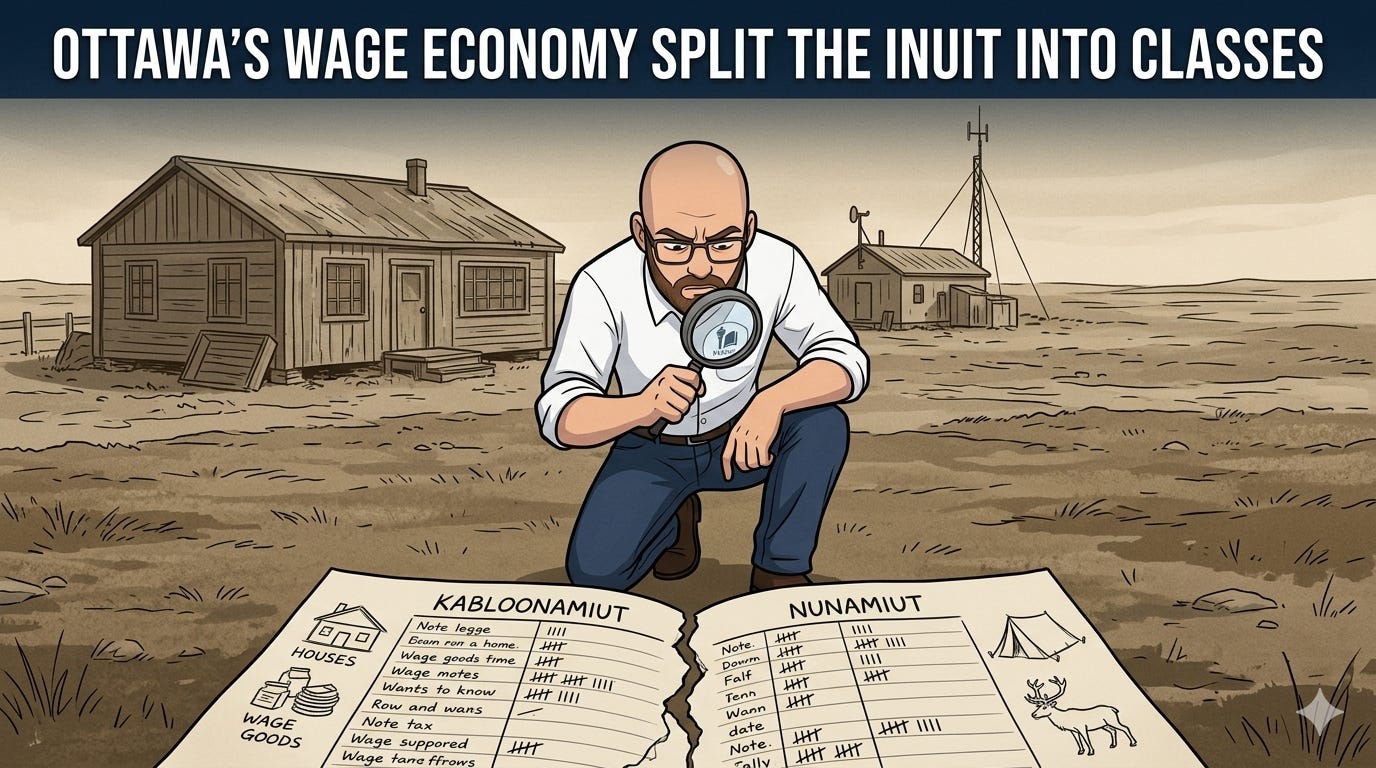
In the vast, wind-scoured expanse of the Keewatin District, a profound fracture was opening in the ice during the early 1960s, though it had nothing to do with the spring thaw. While Ottawa bureaucrats drew administrative maps of the North, sociologist F.G. Vallee was on the ground in Baker Lake documenting a quieter, more permanent shifting of tectonic plates: the emergence of Arctic social classes. For centuries, survival in the Canadian Arctic had been a great equalizer, dependent on the skill of the hunter and the solidarity of the camp. But by 1962, a new hierarchy was crystallizing in the shadow of the wireless stations and trading posts, dividing a once-unified people into the “haves” and the “have-nots”. The arrival of the wage economy did not just bring material goods; it brought a tiered society that threatened to separate the Inuit from one another as sharply as it separated them from the land.
The Rise of the Kabloonamiut
For generations, the social organization of the Canadian Arctic was dictated by the caribou and the seal. Families moved in bands or camps, small units of twelve to fifteen people in the interior or up to sixty on the coast, bound by kinship and the necessity of cooperation. There were no tribes in the political sense, only regional groupings sharing dialects and customs. But the establishment of permanent institutions—the Hudson’s Bay Company, the RCMP, the missions, and later the Department of Northern Affairs—created a magnetic pull that began to reorder this world.
Vallee’s research identified a stark new dichotomy. On one side were the Nunamiut, the “people of the land,” who continued to rely on hunting, trapping, and traditional conventions. On the other emerged a new social strata: the Kabloonamiut, or “people of the White Man”.
The Kabloonamiut were not simply those who lived in settlements. They were defined by a rejection of the life that required acute dependence on the land and a conscious choice to imitate “Kabloona” (white) customs. In Baker Lake, Vallee classified 14 percent of household heads as confirmed Kabloonamiut, with another 31 percent drifting toward this status. These were the mediators, the interpreters, and the wage-earners who had gained command over the “facilities” of the new world: English literacy, technical skills, and the ability to navigate the complex bureaucracy of the south.
This was not a transition made at random. Vallee uncovered a fascinating, somewhat counter-intuitive pattern in the recruitment of this new elite. Often, those selected for training in mechanics or vehicle handling were not the successful hunters or community leaders, but the “misfits”—youths who were deviant in the traditional setting, troublesome to their elders, or who had spent long periods in southern institutions due to illness. These individuals, once marginalized by the rigors of the hunt, were now becoming the gatekeepers of the new economy.
The Economics of a New Aristocracy
The fissure between the settlement dweller and the camp dweller was cemented by cold, hard cash. In the traditional system, a wealthy man was one with the best equipment and the most food, but the gap between the most and least successful was naturally limited by the environment. The wage economy shattered this ceiling.
In Baker Lake, the disparity was becoming mathematically stark. Vallee found that nearly half of the total cash income flowing into the community’s eighty households was captured by just fifteen families. Ten of those fifteen households were Kabloonamiut. If full-time employment was the new scarce resource, this emerging class had secured a monopoly on it.
This economic leverage translated into immediate lifestyle differences that were previously unknown. In Port Harrison and Baker Lake, the settlement families dressed differently, owned luxury goods, and consumed a diet radically different from their kin on the land. Perhaps most critical for the future was the disparity in education. While settlement children attended federal schools full-time, the children of the Nunamiut were often excluded due to lack of space or accommodation, effectively locking the class divide in place for the next generation.
The consolidation of this class was not accidental. It was reinforced by a web of kinship and marriage that was turning inward. The Kabloonamiut were beginning to arrange marriages for their children almost exclusively with other settlement families, or even with similar families in distant settlements like Rankin Inlet or Chesterfield Inlet. Vallee noted nine pairs of children from the elite Baker Lake families who were betrothed to one another, ensuring that wealth and status would remain concentrated.
Innovation and Authority in the Workplace
The transformation of the Arctic was not merely about passive assimilation; it involved radical experiments in work organization. Vallee observed the rise of cooperatives, particularly the “artistic” units producing carvings and prints, which offered a unique alternative to the standard employer-employee relationship.
In a moment of historic significance, Vallee recorded what was likely the first instance of Eskimos firing a white manager. This occurred within a cooperative where the artisans, theoretically a society of equals, exercised command over their output and marketing policies. This signaled that the new work organizations were not just economic units but incubators for political agency.
However, outside the cooperatives, the “patron-client” relationship dominated. This was a diffuse, paternalistic bond where the white employer—whether a missionary or an RCMP officer—took an intrusive interest in the private life of the Inuit employee. This dynamic served as the primary conduit for acculturation. The Inuit client, sponsored by their powerful white patron, became the mediator between the two worlds, translating not just language but cultural expectations.
The Darker Side of Differentiation
As the class structure solidified, it brought with it new forms of prejudice. The egalitarian ethos of the band was being replaced by a complex status hierarchy. Settlement dwellers began to view the land people with a mixture of pity and disdain, regarding them as “backward” or “behind the times,” much like urbanites dismissing rural populations. Conversely, some confirmed Nunamiut looked upon the wage-earners with distaste, preferring the autonomy of the trap-line to the dependence of the settlement.
Even more troubling was the emergence of ethnic chauvinism within the settlements. As groups from different regions were forced together, ancient distinctions were weaponized to explain social status. At Rankin Inlet, established residents from Chesterfield Inlet looked down on immigrants from Eskimo Point, describing them as “dirty”. When a group of famine survivors from the interior—the Ahialmiut—were relocated to the settlement, they were dismissed by prominent locals as being inherently “backward and stupid”. Vallee observed that high status was rarely attributed to ethnicity, but low status was frequently explained away by a person’s tribal origin.
The Pan-Eskimo Future
Vallee concluded his 1962 report with a prescient observation about the trajectory of Inuit society. The localized, mechanical solidarity of the traditional band was dissolving. In its place, he foresaw the rise of “Pan-Eskimoism”.
The very class system that was dividing the communities internally was simultaneously creating a network of elite families that cut across the Arctic. Through inter-settlement marriages and shared educational experiences, the Kabloonamiut were forming a stratum that transcended specific localities. These articulate, acculturated leaders were already beginning to claim the right to speak for all Eskimos vis-à-vis the government.
Vallee warned that the Eskimos would not simply “pass” into the Canadian class system. The barriers between the white and Inuit sub-systems were too high. Instead, he predicted a future where the Inuit would remain distinct, but stratified—a society permanently altered by the intervention of the south, led by a new class of mediators who, while closest to the white man in culture, were identifying with their own people with increasing intensity. The silence of the tundra had been broken, replaced by the complex, noisy friction of a society in rapid, irreversible flux.
Hansard Files is an independent investigative project dedicated to excavating lost chapters of political and social history from the archives. We rely on readers like you to keep these stories from fading into the static. Please consider subscribing to support this work.
Source Documents
Vallee, F.G. (1962). Sociological Research in the Arctic. Department of Northern Affairs and National Resources, Northern Co-ordination and Research Centre.
Fascinating account of a modern, western culturr and a primitive, nomadic culture colliding.