


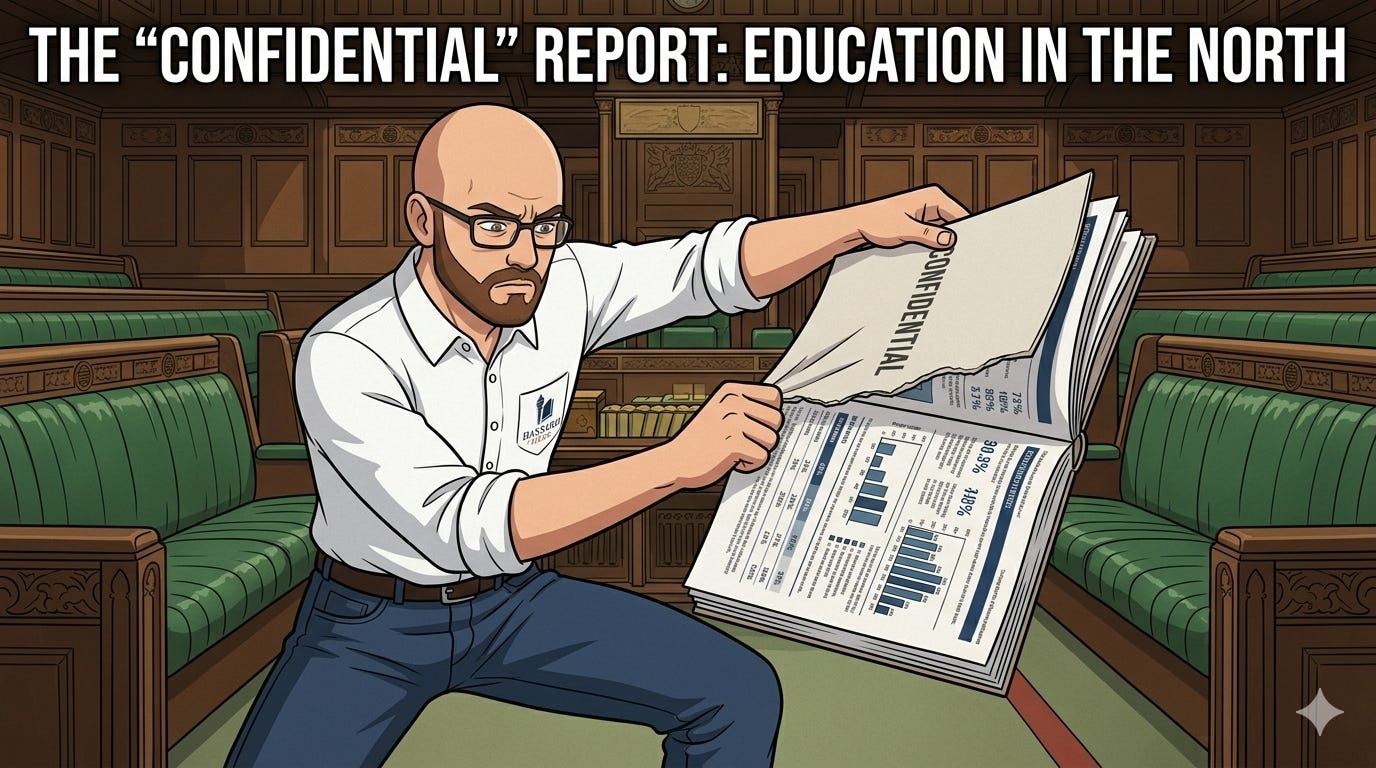
October 24, 1961. A typed report lands on a desk in the Northern Administration Branch of the Department of Northern Affairs in Ottawa. It is bound in a cover that its creator, likely an administrator named Alex Martin, would later apologize for as a “little effort.” But the warning stamped on the very first page was anything but casual.
“NOTE: THIS BOOK WAS ASSEMBLED FOR INFORMATION OF DEPARTMENTAL EMPLOYEES ONLY and should not be quoted verbatum.”
This was not a press release. It was a mirror the government was holding up to itself—a compendium of statistics, charts, and self-congratulatory milestones titled Education in the North.
For historians and citizens today, this document offers something far more valuable than a public statement: it provides a raw, unvarnished look at the bureaucratic machinery during a pivotal moment in Canadian history. This was the era when the federal government definitively wrested control of Indigenous education from the churches, consolidating power into a single, centralized, and rapidly expanding system. The report frames this takeover not as a cultural intervention, but as a logistical triumph—a “Ten Years of Progress” narrative that celebrates a 1,000% increase in Inuit enrollment while quietly revealing the rigid vocational pathways designed for Northern youth.
The “Departmental Eyes Only” Directive
The report captures the Department of Northern Affairs and National Resources at the height of its expansionist confidence. By 1961, the government was pouring millions into the North. In just four years, federal operational expenditures on education had more than doubled, rising from $1.9 million in 1957-58 to an estimated $5.3 million for 1961-62.
The document was designed to arm departmental employees with “selected information” to justify these costs. It served as an internal cheat sheet for bureaucrats who needed to prove that the immense logistical effort of building schools in the Arctic was bearing fruit.
The tone is defensive yet triumphant. A handwritten note attached to the file, dated March 1962, hints at the political sensitivity of the data: “The information concerning costs may not have been made by the Minister yet”. This wasn’t just data; it was political ammunition, carefully curated to show that Ottawa’s experiment in the North was working.
The “Ten Years of Progress” Pitch
The core of the report is a section titled “Ten Years of Progress,” a retrospective looking back to 1949. The government’s narrative is clear: before us, there was chaos; now, there is order.
In 1949, the report notes, “eight different authorities operated schools in the north,” including various religious missions. By 1960, that number was ruthlessly slashed to two: Federal and Municipal. This consolidation was total. The report dryly notes that on April 1, 1956, “Mission School teachers became Federal employees,” effectively nationalizing the workforce of the residential and day school systems.
The statistical “wins” are presented with staggering percentages. The report boasts that the number of “Eskimos” (Inuit) in schools had increased by “over 1,000%,” rising from a mere 117 pupils in 1949 to 1,165 in 1959.
However, the raw population data reveals the gap that still remained. As of December 1960, the government counted 10,751 Inuit and 5,124 First Nations people (”Indians”) in the Northwest Territories and Arctic Quebec. Yet, despite the self-celebrated “progress,” only 56% of school-age Inuit children were enrolled in 1960-61. In stark contrast, 93% of children classified as “Other” (largely non-Indigenous staff families and settlers) were in school.
The government knew these numbers. They knew that nearly half of the Inuit school-age population was still outside their system. Yet, the internal narrative remained one of unblemished success.
The Vocational Ceiling: Training for the Margins
Perhaps the most revealing section of the document is the detailed breakdown of vocational training. If the academic schools were about “civilizing” the North, the vocational programs were about building a workforce to service it.
Between 1954 and 1959, the government trained 677 individuals in vocational skills. The breakdown of these trades provides a stark map of the economic hierarchy the government envisioned for Indigenous Northerners.
The largest category by far was Construction (278 trainees), followed by Heavy Equipment (156). The system was training men to build the very infrastructure—schools, hostels, and government offices—that would house the federal administration.
Other training categories reinforce this service-role orientation:
Service (Nurses Aides, Laboratory Aides): 63 trainees.
Manufacturing & Mechanical: 57 trainees.
Clerical: 40 trainees.
Hairdressers: Listed, though numbers are small.
The “Professional” category listed only 2 trainees. In the government’s eyes, the “New North” needed hundreds of carpenters and heavy equipment operators, but apparently, it did not need Indigenous doctors, engineers, or senior administrators. The educational pipeline was designed to produce a support class for the southern administration, not leaders who would replace it.
The “Qualified” Teacher
One of the report’s proudest claims is the professionalization of the teaching staff. In 1949, under the mission system, 35% of teachers held no teaching certificates. By 1958, the report claims, 100% of northern teachers held at least a first-class teaching certificate.
The report goes so far as to claim that the Northwest Territories had “the highest standard of qualifications in Canada”. A chart compares the N.W.T. to the provinces, showing 0% of teachers with “less than Junior Matriculation,” a boast no other province could match.
But what did “qualified” mean in 1961? It meant southern credentials. It meant teachers imported from Ontario, the Prairies, and the Maritimes who had mastered the curriculum of the south. The report lists the “Province of Origin” for employees: 55 from Ontario, 45 from Saskatchewan, 30 from Alberta.
There is no metric in the report for cultural competency. There is no chart for fluency in Inuktitut or Dene languages. In fact, the “Curriculum Section” described in the report lists specialists for “Language Arts,” “Social Studies,” and “Audio-Visual Education,” but makes no explicit mention of Indigenous language preservation. The “progress” was measured entirely by how closely the Northern system could replicate the Southern model.
The Infrastructure of Assimilation
The physical footprint of this system was exploding. The report tracks the construction of “Hostels” (residences for students separated from their families). In 1956-57, there were “Nil.” By 1961-62, there were 8 large hostels with 1,180 beds.
This was the era of the “large type hostels”. The government was building vast dormitories to warehouse the children they were successfully enrolling. The report treats these beds as logistical units, indistinguishable from desks or textbooks. Each bed represented a child removed from the land, a statistic to be added to the “progress” column.
The financial data confirms the priority: Capital spending (construction) often rivaled or exceeded operating costs. In 1958-59, the federal government spent over $5 million on capital construction alone. The North was being built, quite literally, into a federal institution.
A Legacy in Typeface
The Education in the North report of 1961 ends with a “Record of Firsts”—a timeline of bureaucratic milestones. “First Summer Teacher Training Course” (1953). “First Vocational Survey” (1954). “First Government-owned Students Residence” (1958).
It reads like a victory lap. But for the thousands of children represented by the numbers “1,876 Eskimo” and “1,173 Indian”, these “firsts” marked the beginning of a profound loss.
This document, intended only for the eyes of departmental employees, lays bare the mechanism of colonization. It was not a chaotic or accidental process. It was measured, charted, funded, and celebrated as “progress” by the very people who designed it. They did not quote it verbatim then, but we must read it verbatim now to understand the calculated precision of the system they built.
Archive diving requires resources. If you value this kind of deep-dive into the documents that shaped our history, please consider subscribing to support the Hansard Files.
Source Documents
Education Division, Northern Administration Branch. (1961, October 24). Education in the North: Selected Information Including “Ten Years of Progress”. Department of Northern Affairs and National Resources.
Ironically I make more money doing less now in “construction” than I probably could as a “professional”.
It’s definitely a legacy, Mike. And a very poor and destructive one. For which Indigenous folks are still suffering from today. And based on the latest news of Montreal police racial profiling/actions, our country still has a long way to go.