


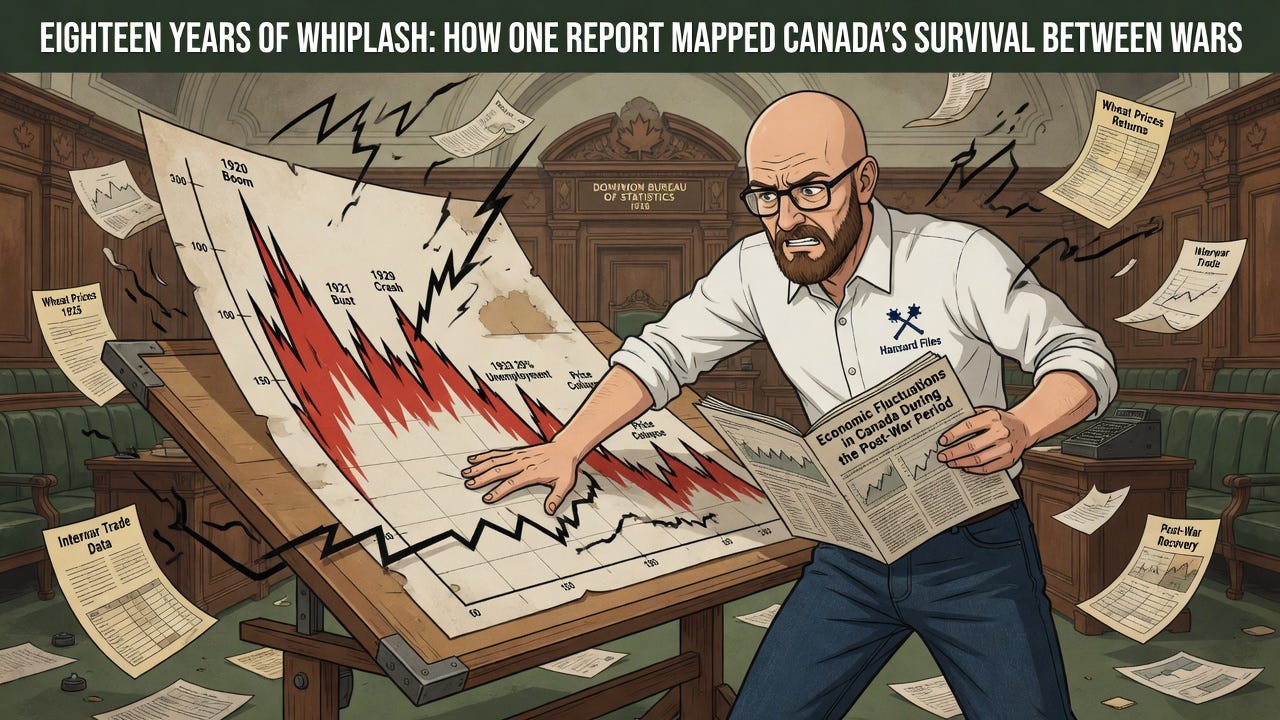
Ottawa, January 1938. The air in the capital was cold, but the mood inside the Dominion Bureau of Statistics was even chillier. A team of statisticians, led by Sydney B. Smith and R.A. Brown, had just completed a massive undertaking. They had aggregated eighteen years of data—from the end of the Great War in 1919 to the uncertain present of 1937—to answer a single, terrifying question: Was the Canadian economy actually working?
The resulting document, Economic Fluctuations in Canada During the Post-War Period, is a haunting snapshot of a nation holding its breath. The authors did not know that World War II was less than two years away. To them, “Post-War” referred to the chaos following 1918. They were looking backward at a period of unprecedented volatility, trying to find a pattern in the wreckage of two major depressions and a fragile recovery.
Their report reveals a country undergoing a violent transformation. It documents how economic fluctuations in Canada shattered the agricultural heartland, decimated the railway systems, and forced a quarter of the workforce into idleness. Yet, amidst the red ink and the ruin, it also captured the quiet rise of the industrial power that would soon become the “Arsenal of Democracy.” This is the story of those eighteen years of chaos, told through the dry, objective, and devastating numbers of the men who measured them.
The Price of Peace
The report begins not with the Roaring Twenties, but with the hangover of the First World War. The narrative of the 1920s is often painted in gold and jazz, but Smith and Brown’s data reveals a much grimier reality. The immediate aftermath of the war brought a “short-lived active period” followed by a sharp, brutal depression in 1920 and 1921.
The primary villain was price instability. The war had caused massive inflation, but peace brought a deflationary crash that broke the back of primary producers. The report notes that during the thirteen years ending in 1933, the trend of prices pointed sharply downward. The index declined from a high of 164 in May 1920 to a crushing low of 63.5 in February 1933. This was not a slow slide. It was a cliff.
For a nation of farmers and loggers, this was catastrophic. The authors observed that “primary producers were placed at a disadvantage by a marked curtailment in purchasing power.” While the price of manufactured goods remained relatively sticky, the price of raw materials—wheat, timber, ore—collapsed. Canada was selling its natural wealth for pennies on the dollar, trying to pay off debts incurred during the inflationary boom of the war.
The Industrial Pivot
As the rural economy bled, a new economy was being born in the rock and forests of the Canadian Shield. The statisticians identified a profound structural shift that occurred between the depressions. While progress in agriculture was described as merely “moderate,” with no bumper crops harvested in the final eight years of the study, other sectors were exploding.
Mining, paper, and power industries expanded rapidly, with their output gaining between four and nine percent annually. This was the era where Canada stopped being solely a breadbasket and started becoming a factory. The report highlights that “industrial capacity was greatly expanded,” particularly in the production of plant and equipment.
However, this shift came with a dangerous side effect. By moving away from the production of “immediate necessities of life” like food and clothing, and toward durable goods and heavy machinery, the economy became “more susceptible to wide fluctuations.” A family must buy bread even in a depression, but a factory does not need to buy a new turbine. The modernization of the Canadian economy made it more powerful, but also more brittle.
The 29 Percent
The most human element of the report lies in the section simply titled “Employment.” In the dry, bureaucratic language of the Dominion Bureau of Statistics, the authors laid bare the tragedy of the Great Depression.
They estimated that the number of wage earners in Canada peaked at 2.8 million in 1929. Four years later, that number had plummeted. The report calculates that in 1933, the worst year of the depression, “700,000 or 29 p.c. were out of work.”
Twenty-nine percent.
Almost one in three wage earners had no work. The report notes that any person out of work for at least twelve months was no longer even regarded as a wage earner, suggesting the true depth of long-term unemployment might have been even worse than the headline figure.
The recovery from this nadir was agonizingly slow. While the report notes a “marked increase” in employment from 1934 to 1936, the scars of the crash were still fresh. The authors observed that unemployment figures did not recover as quickly as production figures. Factories were becoming more efficient, producing more goods with fewer men. “Technological improvement,” they wrote, “has outstripped the growth in the number of wage earners.” The industrial machine was recovering, but the worker was being left behind.
The Railway Catastrophe
If the worker was the primary casualty of the depression, the railway was the primary institutional victim. The report dedicates a mournful section to the collapse of Canada’s transportation spine.
For decades, the railway had been the symbol of Canadian unity and economic might. But the period from 1921 to 1933 saw the industry decimated. Gross operating revenues for the two main systems—the Canadian National and the Canadian Pacific—dropped by more than 50 percent. Freight traffic on the Canadian National plunged 57 percent.
The authors pointed out a stark divergence: while the physical volume of general business had declined by less than one-third, railway factors had dropped by half. The railways were being eaten alive from two sides. On one side, the depression sapped the movement of grain and goods. On the other, the “extended use of truck, bus and private automobile” was stealing what little traffic remained. The report makes it clear that the golden age of the train had ended, not with a whimper, but with a financial crash that saw net operating revenues obliterated.
The Paradox of Real Income
Buried in the statistical analysis is a counter-intuitive finding that likely puzzled the average citizen in 1938. The statisticians calculated “Real Income”—the national income adjusted for the cost of living. Because prices had fallen so dramatically, the purchasing power of the dollar had skyrocketed.
The report states that “$66.70 bought on the average as much in commodities in 1932 as $95.60 purchased in 1929.” This created a cruel paradox. If a Canadian was lucky enough to be among the 71 percent who kept their job, their standard of living might have actually increased during the depression.
Real income was “slightly above normal in 1923,” even as the nominal national income looked weak. For the wealthy and the securely employed, the deflationary spiral was a bonanza of cheap goods. For the unemployed and the indebted farmer, it was a death sentence. The report notes that while money value fluctuated wildly, “real income has shown an annual increment of nearly 1.6 p.c.” over the post-war period. It was a statistical victory that likely offered little comfort to the soup lines.
A Warning from 1938
The report concludes with a tentative optimism that is heartbreaking in hindsight. By 1936 and 1937, the indicators were pointing up. Exports were recovering, with Canada reaching fourth place among exporting nations, surpassed only by Great Britain, the United States, and Germany. The “automatic adjustments” of international trade seemed to be working again.
The authors wrote that “signs were not lacking in the last two or three years, that many countries were returning to the world wide trading system.” They believed the worst was over. They saw the fluctuations of the past eighteen years as a storm that had finally broken.
They could not see the new storm gathering in Europe. The industrial capacity that they meticulously tracked—the expanded mines, the efficient factories, the hydro-electric power—would not be used to build the prosperity of the 1940s they envisioned. Instead, it would be turned entirely toward the production of war. The “Post-War Period” they analyzed was merely the intermission. The “Eighteen Years of Chaos” were simply the prologue.
If you value deep dives into the forgotten files that shaped our history, consider subscribing to Hansard Files. We dig through the archives so you don’t have to.
Source Documents
Dominion Bureau of Statistics. (1938, January). Economic Fluctuations in Canada During the Post-War Period. Department of Trade and Commerce.
"For a nation of farmers and loggers, this was catastrophic."
Ergo, the Co-operative Commonwealth Federation.