


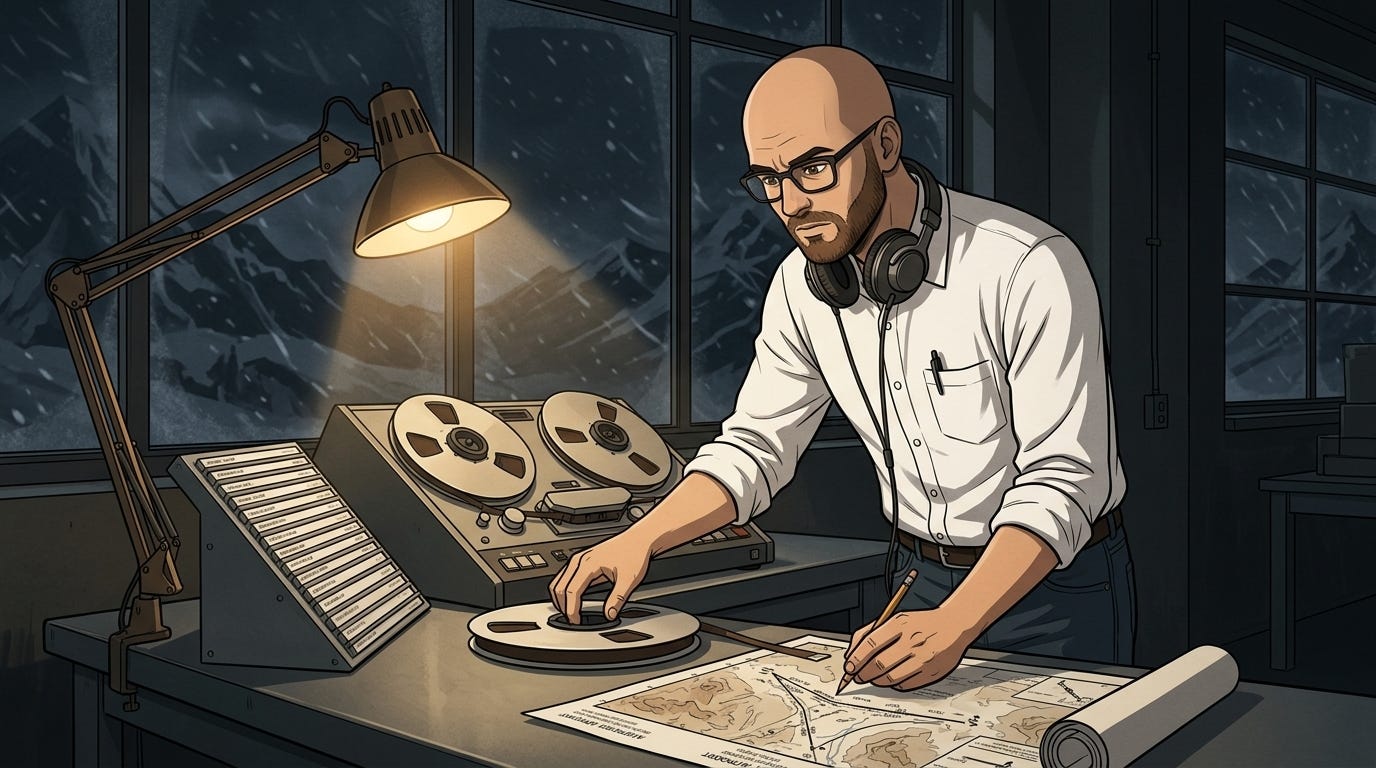
At 12:55 p.m. Mountain time on February 11, 1978, Pacific Western Airlines Flight 314 broke out of low cloud into driving snow over Cranbrook, British Columbia, touching down directly behind a snowplow sweeping the centre line. When the Boeing 737 tried to climb away, skimmed fifty feet over the vehicle, and cartwheeled into the snow in a fatal fireball, the Department of Transport took control of the wreckage. In May 1981, Justice Charles L. Dubin tabled Volume 1 of his Report of the Commission of Inquiry on Aviation Safety, revealing that federal crash investigators had suppressed cockpit discipline failures, defied Department of Justice subpoenas, and fed a fifteen-inch stack of witness statements, medical files, and autopsy records into an office shredder under the doctrine that “you cannot subpoena what does not exist.”
Forty-two people died at Cranbrook: four crew members and thirty-eight passengers. Five passengers were dragged alive from the burning fuselage with severe injuries. Only one flight attendant and one passenger escaped unhurt.
The disaster at Cranbrook was catastrophic on its own terms. But the administrative scandal that unfolded behind closed doors inside the Canadian Air Transportation Administration was worse. For more than two years, the federal government had concealed the fact that its own aviation safety officers were locked in open rebellion against the Department of Justice, hiding evidence in locked safes, altering official findings to protect airline relationships, and destroying primary records to prevent the Crown and grieving families from learning what had happened in the cockpit.
Ten Minutes Ahead of the Snowplow
Cranbrook Airport sat in a mountain valley, leased by the federal transport department to the municipal city government. It operated without a control tower. Aircraft relied on advisory communications from an aeradio station staffed by federal flight service specialists, while primary air traffic control was exercised hundreds of miles away by the Calgary Area Control Centre.
On the afternoon of February 11, Flight 314 was operating a multi-leg route from Edmonton to Castlegar, with stops in Fort McMurray, Edmonton, and Calgary. When the twin-engine jet took off from Calgary for Cranbrook, the carrier estimated the enroute flight time at twenty-three minutes, giving an estimated arrival time of 12:55 p.m. (1955 Greenwich Mean Time). Pacific Western passed that accurate estimate to its local station agent at the terminal.
Calgary air traffic control calculated the flight differently. A federal controller radioed the Cranbrook aeradio station and passed an estimated enroute time of thirty-three minutes, setting the aircraft’s arrival at 1:05 p.m. (2005Z). The controller was ten minutes late.
At Cranbrook, snow was falling heavily and visibility had dropped to three-quarters of a mile. On the runway, airport employee Terry driving a radio-equipped snow sweeper was working back and forth to keep the tarmac clear. At 12:35 p.m., Ernie, the flight service specialist in the aeradio cab, called Terry on the ground frequency.
“Five past the hour, Terry,” Ernie said, relaying the Calgary control estimate.
“OK,” Terry replied. “What’s the time now, Ernie?”
“Half an hour from now. Thirty just coming up to thirty-five.”
“OK. Thank you. Everything’s working good out here.”
Both men assumed the jet would follow standard operating practice and report its position inbound over the Skookum radio beacon, seven miles northeast of the runway. That report would give Terry at least seven minutes to pull his sweeper off the asphalt.
At 12:46 p.m., Flight 314 checked in on the Cranbrook aeradio frequency. First Officer Peter Van Oort was working the radios. Captain Christopher Miles was at the controls.
“Three one four, Cranbrook, go ahead,” Ernie transmitted.
“Yes, sir. We have the approach. You can go ahead with your numbers.”
Ernie gave the wind, the altimeter setting, and the advisory: “And three one four. The sweeper on the runway has been for some time trying to keep the snow back for you. I’ll let you know what it’s like as soon as I get a progress from him. And the visibility, not much change in the weather, maybe visibility about three-quarters of a mile in snow.”
“Three fourteen checks,” Van Oort replied.
It was the last transmission the aircraft ever made.
Stock Tips and a Beautiful Dispatcher
Seven minutes passed in complete silence. In the aeradio office, Ernie waited for the expected position report over the Skookum beacon. Because Calgary had promised the aircraft at 1:05 p.m., Ernie saw no immediate urgency to order the sweeper off the runway.
Inside the cockpit of Flight 314, a fatal division of attention was underway. While First Officer Van Oort had two-way communication open to Cranbrook Aeradio, Captain Miles had his primary VHF transceiver switched to the private company frequency.
Another Pacific Western flight, piloted by Captain Bud Husband, had departed Calgary right behind them. As Flight 314 began its instrument descent through the mountain snowstorm, Captain Miles engaged Husband in casual conversation over the company radio. The two captains chitchatted about a woman dispatcher in Calgary whom they described as beautiful, and Husband asked Miles for advice on stock market investments, a subject on which Miles was considered knowledgeable.
The conversation continued precisely as Flight 314 was intercepting the instrument landing system nine to ten miles out from Cranbrook. Captain Miles was preoccupied with the stock market discussion. He never heard the aeradio operator’s warning about the snow sweeper. First Officer Van Oort, having acknowledged the advisory with a bare confirmation, apparently never told his captain that heavy machinery was operating on the runway.
Neither pilot made the standard radio call crossing the Skookum beacon.
At 12:55 p.m., exactly on Pacific Western’s schedule and ten minutes ahead of Calgary control’s calculation, Flight 314 flared over the runway threshold and touched down in the blowing snow, eight hundred feet past the numbers. The crew immediately selected reverse thrust to slow the aircraft.
Through the windshield, directly ahead in the swirling snow, the pilots suddenly saw Terry’s yellow snowplow on the centre line, barely twelve hundred feet away.
Conditioned by company training, the pilots reacted by reflex. They cancelled reverse thrust, firewalled the throttles, and initiated an immediate go-around.
The Boeing 737 lifted off before the two-thousand-foot mark, clearing the snow sweeper by fifty to seventy feet. On the ground, Terry watched the twin-engine jet roar over his cab and yelled into his radio: “Where the hell did he come from?”
In the cockpit, someone keyed the transmitter: “We’re gonna crash.”
Ernie answered from the tower window: “I don’t know Terry, but he sure didn’t call after his first call.”
The aircraft never recovered. When the pilots aborted the landing, the mechanical reverser doors on the left engine failed to fully stow. Thrust reversers on the Boeing 737 were designed for ground stopping, not mid-air aborts. With full forward power on the right engine and asymmetrical reverse drag on the left, the aircraft climbed to four hundred feet, banked violently to the left, stalled, and slammed into the snowpack beside the runway, disintegrating in flames.
Nine minutes later, Calgary control called Cranbrook over the landline to ask if Ernie was busy.
“Yeah,” Ernie replied. “He’s the emergency. He’s crashed and is burning off the end of the runway.”
The Department at War with Itself
On March 29, 1979, thirteen months after the crash, the Aviation Safety Investigation Division of the Department of Transport released its official accident report.
The report listed eight formal conclusions. It placed heavy emphasis on the ten-minute ETA calculation error by Calgary air traffic control. It cited inadequate aeradio communication interfaces, faulty Boeing thrust reverser designs that failed to anticipate aborted touchdowns, a lack of national incident reporting, and the absence of airport firefighting vehicles capable of driving through deep snow.
The casual cockpit conversation about stock tips and the dispatcher was completely excluded from the causal findings. The report placed the issue in an unnumbered paragraph on page 32, noting dryly that “the failure to report on final approach and the unnecessary talk on company frequency represent an unacceptable standard of cockpit practice and discipline.”
By then, the crash had moved into the courts. Pacific Western Airlines sued the federal Crown and Transport Canada officials in Federal Court, alleging that negligence by federal air traffic controllers and aeradio staff had caused the disaster. The Department of Justice stepped in to defend the government.
Under the Federal Court Rules, the Crown was legally required to assemble every relevant document in its possession, list them in a formal affidavit of production, and disclose them to the opposing lawyers. John H. Sims, a Department of Justice lawyer seconded to Transport Canada, was assigned to collect the files.
Sims ran into a wall of bureaucratic resistance.
At the Aviation Safety Bureau, Chief Accident Investigator Harold A. Fawcett refused to hand over his files. Fawcett had spent years arguing that safety investigators must remain entirely independent from the legal system. In his view, accident investigation existed solely to prevent future disasters, not to assign legal blame. If investigators turned over confidential interviews, medical reports, or candid notes to Crown litigators, witnesses in future crashes would refuse to talk, and the safety system would collapse.
Fawcett’s philosophy had hardened into outright defiance of the law. When Sims demanded the files, Fawcett refused. When CATA Administrator Walter McLeish personally ordered Fawcett to deliver the documents, Fawcett stalled.
On July 13, 1979, McLeish ordered Fawcett to bring the files to his office. McLeish called Sims and told him to go down the hall and take physical possession of the records. When Sims arrived at Fawcett’s office, Fawcett stood in front of his safe and calmly told the government’s lawyer that he could not remember the combination.
“You Cannot Subpoena What Does Not Exist”
Three days later, on Monday, July 16, a Transport Canada official named John Falvey visited the Ottawa office of Dr. François Dubé.
Dr. Dubé was a highly regarded specialist in aviation medicine, seconded from the Department of National Health and Welfare to serve on the human factors team investigating the Cranbrook crash. Falvey watched in disbelief as Dubé fed papers into an office shredder.
Falvey immediately alerted Pierre Proulx, the director of air traffic services, warning him that if Justice Department lawyers wanted the Cranbrook records, they had better hurry, because Dr. Dubé was destroying them.
On July 20, senior Justice counsel W. J. Hobson and Sims hauled Dr. Dubé into an interrogation. For over an hour, they questioned him about what had happened to the primary investigative files.
Dubé confirmed that he had shredded the documents. When Hobson pressed him for his rationale, Dubé gave an answer that stunned the prosecutors: “You cannot subpoena what does not exist.”
He told the lawyers that the destroyed records were not the kind of information he was prepared to turn over to anyone. Then Dubé added an admission that cut to the core of the investigation: he said he was surprised that nobody had questioned what was the real cause of the accident, which he stated the safety bureau had omitted from the formal causes in the report.
When Hobson asked what the real cause was, Dubé pointed straight to page 32 of the report: the cockpit discipline failure, the unmonitored aeradio frequency, and the captain’s company-radio chatter during the instrument approach. Dubé stated that commercial airlines exerted pressure on the safety bureau to ensure that pilot distraction was never cited as a formal contributing cause in an official report.
During the interview, Hobson and Sims compiled an itemized list of what Dubé had destroyed. The stack had measured fifteen inches high.
The missing records included original statements from Pacific Western pilots who had overheard Captain Miles conversing on the company frequency; notes regarding the employment history of the first officer; taperecorded interviews with senior airline management; biochemical toxicology lab reports on tissue samples taken from the dead flight crew; photographs of the bodies; notes from interviews with the families and personal physicians of the deceased crew; and medical analyses tracking how long surviving passengers had lived before suffocating from smoke inhalation.
When Hobson asked why he would destroy medical and passenger survival records, Dubé claimed he needed space in his filing cabinet.
Sergeant Luc Joseph Albert LeGal and Corporal James Edward Butler of the Royal Canadian Mounted Police were brought in to conduct a criminal investigation into the destruction of public property. After hours of evasive questioning, Dubé asked to speak to his superior. When he returned, Sergeant LeGal testified, Dubé decided to tell the truth.
Dubé gave the RCMP a signed statement: “Fawcett told me to get rid of pertinent stuff on the file which the public has no need to know. The biggest bulk of the destruction is lately. Fawcett called me in his office and said destroy your stuff. I destroyed most of my stuff as a result of what Fawcett told me.”
Fawcett testified under oath that he had instructed investigators to get rid of materials, explaining that in his view, if a witness was still alive, destroying their written statement did not destroy evidence because someone could always go back and interview them again.
The Birth of Independent Safety
When Justice Charles Dubin convened public hearings into the Cranbrook affair, Commission counsel John Sopinka, who would later sit on the Supreme Court of Canada, laid bare the systemic breakdown inside the federal transport department.
Dubin was unsparing. In his May 1981 report, he concluded that the official Cranbrook accident report had been thoroughly discredited. Its findings were suspect because investigators had suppressed the cockpit radio chatter, sheltered the airline from accountability, and destroyed the primary notes that substantiated their own conclusions.
“Allegations of cover-up, non-disclosure and deceit might well be made against the Department of Transport as the litigation proceeds,” Dubin wrote. The documents destroyed by Dubé were not his personal belongings; they were the property of the Crown, held in trust for the public.
Dubin saw clearly that the shredding scandal was not simply the misconduct of two rogue officials. It was the inevitable outcome of a broken administrative structure.
Under the Canadian Air Transportation Administration, the Department of Transport was trapped in a permanent, irreconcilable conflict of interest. The department built and operated the airports. It employed the air traffic controllers. It certified the aircraft and licensed the pilots. And when a plane crashed, the department appointed its own internal bureau to investigate whether its own regulations, facilities, or controllers were at fault.
When victims sued, the department’s safety investigators and the government’s courtroom defenders turned on each other. Litigators wanted records to manage Crown exposure; safety officers destroyed records to protect their professional relationships with the airlines they regulated.
Dubin’s remedy was radical and uncompromising. In Part XII of his report, he delivered his primary recommendation: the federal government must completely strip the Department of Transport of its accident investigation powers and establish an independent tribunal, reporting directly to Parliament, to be called the Canadian Aviation Safety Board.
Safety investigators had to be removed from the bureaucratic chain of command. They could no longer be employees of the department they were investigating, nor could their files be treated as the private domain of departmental litigators.
Parliament accepted the verdict. In 1984, the federal government proclaimed the Canadian Aviation Safety Board Act, severing air crash investigation from Transport Canada forever. Five years later, Parliament expanded Dubin’s model across all modes of federal transit, creating the modern Transportation Safety Board of Canada.
The independent board that investigates Canadian transport disasters today was not created through administrative foresight. It was born because forty-two people died in the snow at Cranbrook, and the federal officials sent to investigate fed their own evidence to the shredder.
Piecing together the chain of events at Cranbrook meant pulling the 1981 Dubin Commission inquiry, cross-referencing cockpit voice transcripts against Calgary air traffic control logs, and tracking down the sworn RCMP testimony that exposed how accident records were fed into an office shredder.
Hansard Files is supported entirely by readers. The free archive stays free, with nothing paywalled. If you want to fund the reading time and research capacity required to reconstruct critical historical investigations from the primary record, consider a supporting membership at CAD a month or a year.
Source Documents
Commission of Inquiry on Aviation Safety. (1981, May). Report of the Commission of Inquiry on Aviation Safety, Volume 1 (Cat. No. T52-58/1-1981E-PDF). Commissioner: The Honourable Mr. Justice Charles L. Dubin. Ottawa: Supply and Services Canada.