


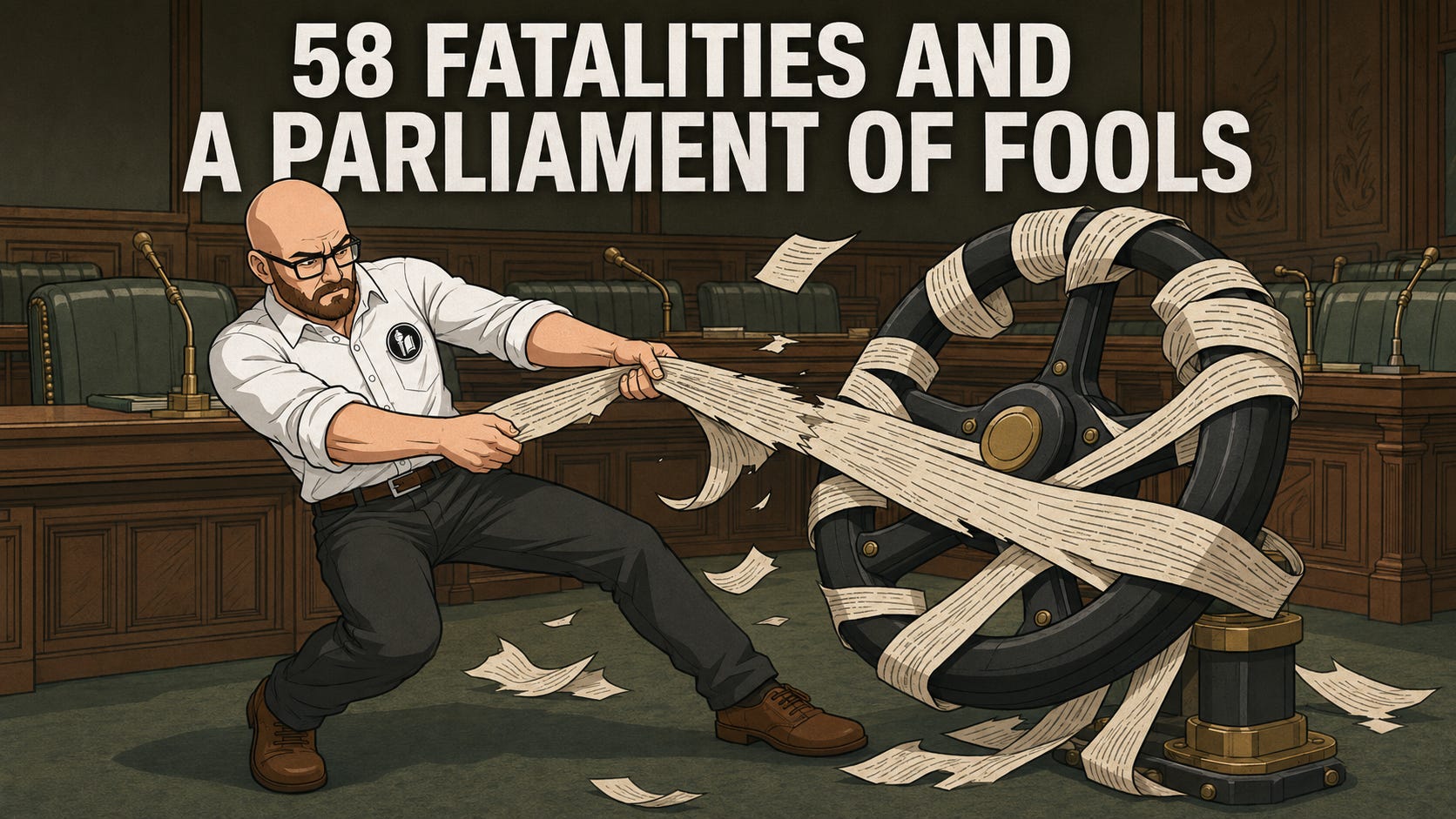
The death toll on Canada’s highways is rising, but in Committee Room 016, the only casualty was decorum. On a gray Tuesday in November 2025, the Standing Committee on Transport, Infrastructure and Communities did not discuss the Driver Inc. scheme that is flooding Canadian roads with unsafe, ghost-operated heavy trucks. They did not pass legislation to stop the tax evasion model that incentivizes dangerous driving. Instead, they spent two hours arguing over who raised their hand first.
The proceedings of November 25, 2025, offer a rare, unvarnished glimpse into the paralysis of modern governance. As the death toll from heavy truck collisions hit a post-pandemic high of 399 fatalities in 2023, the elected officials tasked with oversight dissolved into a spectacle of procedural warfare, “bush league” insults, and a filibuster that ran out the clock while families waited for answers.
The Theatre of the Absurd
The meeting began not with a gavel, but with a mutiny. At 3:35 p.m., Committee Chair Peter Schiefke attempted to manage the speaking list for a debate on the Driver Inc. crisis. Conservative MP Philip Lawrence immediately challenged the Chair, claiming he had raised his hand before Liberal MP Mike Kelloway.
In a functioning parliament, this would be a triviality. In this committee, it was a declaration of war. Lawrence challenged the Chair’s ruling, forcing a recorded vote. In a stunning breach of protocol, the committee voted 5–4 to overturn the Chair’s decision on whose hand was raised first. The ruling party had lost control of the room over a gesture as simple as a wave.
“That’s incredible, guys,” Kelloway sputtered, watching the vote tally. “The hand was up before yours. That’s incredible.”
The tone was set. For the next several hours, the urgent business of road safety was hijacked by accusations of “childish behaviour,” “silliness,” and “greasy” political games. The Conservatives accused the Liberals of silencing victims. The Liberals accused the Conservatives of being “cynical and conspiratorial.” Meanwhile, the substantive motion—to force the government to release documents exposing the extent of the Driver Inc. tax scheme—sat gathering dust on the table.
The Ghost Fleet
While the MPs bickered, the reality of Driver Inc. continued to operate unchecked outside the frantic bubble of Parliament Hill. This tax avoidance scheme allows trucking companies to misclassify drivers as “independent contractors” (incorporated entities) rather than employees. By doing so, companies bypass labour standards, workers’ compensation premiums, and payroll taxes. Drivers, often coerced into the scheme, lose their safety net and are incentivized to drive longer, faster, and more recklessly to make ends meet.
The human cost is not theoretical. The committee’s own evidence highlighted a grim trajectory: heavy truck fatalities have climbed steadily since the pandemic, from 336 in 2020 to 399 in 2023. In that same year, 58 heavy truck drivers or passengers themselves were killed in collisions.
Witnesses from the industry describe a sector under siege. Legitimate companies are being undercut by “ghost fleets” that slash costs by evading the law. Driver training schools are deteriorating, with reports of corruption and falsified documents. The Driver Inc. model creates a race to the bottom where safety is the first expense to be cut. As Liberal MP Stéphane Lauzon noted—in a moment of clarity amidst his marathon speech—”The model is broken, and this practice must be stopped as soon as possible.”
Yet, stopping it requires political will, and on this Tuesday, will was in short supply.
The Weaponization of Grief
The ugliest skirmish of the afternoon was not over tax code, but over the victims of these crashes. The opposition Bloc Québécois and Conservatives had pushed for a motion to invite accident survivors and bereaved families to testify. The Liberals resisted, arguing that such testimony should be heard in camera (privately) to protect the dignity of the families, rather than parading their trauma in a public, televised hearing.
Stéphane Lauzon, the Liberal member for Argenteuil—La Petite-Nation, launched a blistering counter-attack. He accused Bloc MP Xavier Barsalou-Duval of exploiting the victims for fundraising. Lauzon pointed to the Bloc’s website, where an article criticizing the Liberals for “silencing victims” was allegedly placed directly above a “Donate” button.
“Why use people’s grief, suffering and trauma for political gain?” Lauzon demanded, his voice rising. “It is so shameful... If this is not an attempt to score political points, I don’t know what is.”
The moral high ground, however, was slippery. While Lauzon championed the “dignity” of the victims, his tactic to protect them involved a relentless filibuster that ensured no business could be conducted at all. By speaking for hours—looping through arguments about administrative burdens, the definition of emails, and the logistics of document retrieval—he effectively prevented the committee from voting on the very motion that would have invited the survivors to speak.
The Billion-Dollar Oversight
The core of the dispute was a motion demanding the production of “all correspondence, reports, emails, and documents” related to Driver Inc. from the Departments of Transport, Revenue, and Employment.
Lauzon framed this request as a logistical nightmare that would paralyze the government. “We are talking about tens of thousands of communications items,” he warned. He described a scenario where public servants, instead of inspecting trucks or auditing tax returns, would be drowning in a sea of Zoom chats, ephemeral text messages, and draft emails.
“It becomes very cumbersome for the apparatus,” Lauzon argued. “The administrative costs would mainly be related to sorting... We rely on a number of communication tools today.”
To the opposition, this defense was a smokescreen. They saw a government desperate to hide the scale of its negligence. The Driver Inc. scheme is not a new phenomenon; it has been festering for years, draining an estimated billion dollars annually from the economy and degrading road safety. The opposition’s demand for documents was an attempt to find out who knew what, and when.
But Lauzon held the floor. He spoke of the T4A slip. He spoke of the need for “tax fairness.” He spoke of the “structural solution.” He spoke until the clock ticked past the allocated resource time.
The Clock Runs Out
As the meeting neared its mandatory end time of 5:30 p.m., the absurdity peaked. Conservative MP Dan Albas, realizing the filibuster would succeed, sarcastically asked if the resources could be extended “until midnight.”
The Chair confirmed that the interpreters and technical staff were only booked until 5:30. The “resources” were exhausted.
“Excellent,” Albas quipped.
Lauzon, undeterred by the sarcasm or the collapsing patience of the room, continued his monologue. He praised the interpreters. He reiterated his respect for the trucking industry. He circled back to the dangers of the “Driver Inc.” model, describing it as a “cycle of misconduct.”
It was a perfect irony: a passionate, word-perfect condemnation of a safety crisis, delivered solely to prevent any action from being taken to solve it.
At 5:30 p.m., the feed cut. The motion to produce documents was not voted on. The survivors were not invited. The “Driver Inc.” loophole remained open. Outside on Highway 417, the heavy trucks rolled on, some legitimate, some ghosts, all sharing the road with an unsuspecting public.
The Hansard Files are more than just transcripts; they are the black box recordings of a system in freefall. We dig through thousands of pages of committee evidence to bring you the stories that politicians hope you’ll never read. Subscribe today to support independent investigative journalism that refuses to let the dust settle.
Source Documents
Standing Committee on Transport, Infrastructure and Communities. (2025, November 25). Evidence (No. 016). House of Commons of Canada.
Standing Committee on Human Resources, Skills and Social Development and the Status of Persons with Disabilities. (2026, January 26). Evidence (No. 021). House of Commons of Canada.
"The proceedings of November 25, 2025, offer a rare, unvarnished glimpse into the paralysis of modern governance."
I don’t believe Canada's current Democratic Institutions, with its warring factions of corporate fan club controlled political parties, qualifies as "modern governance".
While the Westminster system and its “opposition” concept made for a good debating club to advise the Crown, it is a poor way to try to govern.
https://r.flora.ca/p/lets-work-to-fix-parliamentary-flaws
Anyone taking bets on whether the Liberals want "Driver Inc" to bring in a flood of migrant drivers (legal or otherwise) to ensure there is never another Freedom Convoy?
Driver certification is provincial jurisdiction. If memory serves, commercial licenses require recertification if the driver moves but not if they're hauling through another province. That being said, it's become a running joke that whenever there's a heavy truck collision, tell the driver to tighten his turban and put his sandals before the police arrive.