


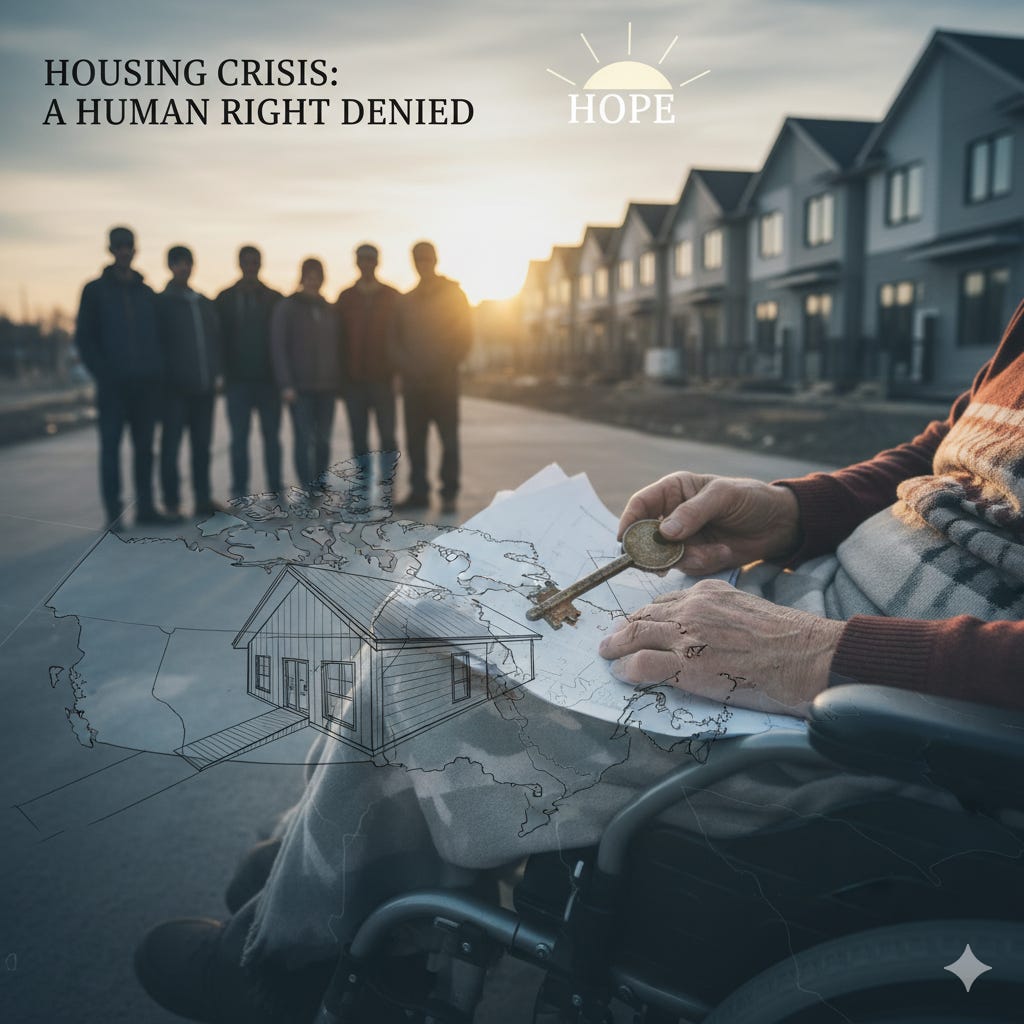
A stark new report released in October 2025 by the Canadian Human Rights Commission and the Office of the Federal Housing Advocate lays bare a crisis that has long been understood by those living it, but is only now being quantified with such clarity. The document, titled Monitoring the right to adequate housing for people with disabilities, confirms that for the 8 million Canadians with disabilities, the promise of a safe and affordable home is increasingly out of reach. The findings suggest this is not simply a market issue, but a systemic failure to uphold a fundamental human right, with devastating consequences for individual dignity, safety, and independence.
The Unspoken Crisis: Homelessness and Insecurity
For many, the fear of losing their home is a constant source of anxiety. For Canadians with disabilities, that fear is a statistical reality. The federal report reveals that people with disabilities are nearly four times more likely to experience homelessness than those without disabilities. The problem extends to what is called “hidden homelessness”—temporarily staying with family or friends because you have nowhere else to go. Here, people with disabilities are more than twice as likely to find themselves in this precarious situation.
This instability is amplified by the fact that people with disabilities are more likely to be renters. In 2022, about a third of people with disabilities were renters, compared to just over a quarter of people without disabilities. Renting inherently offers less stability than ownership, and the data shows this vulnerability is being exploited. In a shocking finding, two in five people with disabilities who were evicted did not receive a formal notice, stripping them of the legal protections and time needed to find a new home.
A System Failing at the Seams
Even for those who have a home, the conditions are often inadequate, inaccessible, and unsupportive. The report paints a grim picture of a system failing to provide the basic necessities for a life of dignity.
Accessibility and Support
You might assume that finding an accessible home in Canada is a manageable task. The data tells a different story. Less than 10% of publicly owned social and affordable housing units are accessible, and that number is actually decreasing. This shortage has a direct impact. Between 2017 and 2022, the number of people with physical disabilities who needed but did not have a physical aid at home—like a walk-in shower—jumped from about 251,000 to over 310,000.
The crisis extends beyond physical modifications. The ability to live independently often depends on supports for daily tasks. The report shows a dramatic increase in unmet needs. In 2017, about 835,000 people with disabilities needed help at home but didn’t get it. By 2022, that number had surged to nearly 1.3 million people. The most common unmet needs were for heavy household chores, everyday housework, and getting to appointments.
Habitability
Beyond accessibility, the very quality of the housing is a major issue. People with disabilities are significantly more likely to live in homes needing major repairs and to have issues with pests like cockroaches or bedbugs. They are also more likely to live with mould or mildew, a serious health hazard. For Indigenous women with disabilities, the problem is particularly acute; 17% reported dissatisfaction with their housing due to mould, compared to 11% of Indigenous men with disabilities.
The Affordability Trap
The core of the housing crisis is, for many, its crushing cost. People with disabilities are almost twice as likely to live in what is called “core housing need,” a situation where their housing is inadequate, unsuitable, or unaffordable.
Renters with disabilities are hit especially hard. In 2022, over a third of them spent more than the 30% affordability benchmark on housing. One person quoted in the report stated, “I make less than $15,000 a year, and $12,000 of it goes to my shelter. I live in constant fear of becoming homeless.” This financial precarity means people with disabilities are more likely to have to skip or delay a rent or mortgage payment.
The result is a desperate search for affordable options that don’t exist. People with disabilities are more than twice as likely to have a household member on a waitlist for social and affordable housing, with some waitlists stretching seven years or longer.
The Human Cost: Safety, Location, and Isolation
The impacts of this crisis go far beyond finances. They erode a person’s sense of safety, community, and autonomy.
People with disabilities are less likely to feel safe in their homes and are more likely to be housebound because they feel unsafe leaving. This is especially true for women. The data on hidden homelessness is particularly alarming: more than half of women with disabilities who were in a temporary living situation said it was because they were fleeing violence or abuse. This is a massive disparity compared to the 30.9% of men with disabilities who said the same.
The location of available housing often creates further barriers, isolating people from their communities and essential services. People with disabilities report higher dissatisfaction with their neighbourhoods and are less likely to feel like a part of their communities. Many cannot access government services simply because of where they live and a lack of accessible transportation.
When community-based housing with proper supports is unavailable, the alternative is often institutionalization. The report notes that tens of thousands of people with disabilities live in group homes, and in 2021, over 7,500 people under the age of 55 were living in nursing and seniors’ homes—an environment primarily designed for older people and an inappropriate housing option for younger adults.
We Can’t Fix What We Don’t Measure
Underpinning all these issues is a profound lack of data. The report identifies significant gaps in how Canada collects information on housing. Many national surveys simply exclude the most vulnerable people, including those living in institutions, people experiencing homelessness, children with disabilities, those in Northern and rural areas, and Indigenous people living on reserves.
This exclusion means that the true scale of the crisis is likely even worse than reported. Without comprehensive data, it’s impossible for governments to design effective policies. The report makes it clear that we cannot fix a problem that we refuse to fully see.
The Data Brief
Canadians with disabilities are nearly 4 times more likely to experience homelessness than people without disabilities.
In 2022, nearly 1.3 million people with disabilities needed help at home but did not receive it, up from 835,000 in 2017.
Less than 9% of publicly owned social and affordable housing units in Canada are accessible.
People with disabilities are almost twice as likely to live in “core housing need,” a measure of housing that is inadequate, unsuitable, or unaffordable.
Over half (54.5%) of women with disabilities experiencing hidden homelessness reported it was due to fleeing violence or abuse.
Major national surveys often exclude people in institutions, people experiencing homelessness, and children with disabilities, creating significant data gaps.
Beyond the Numbers
The data presented by the federal government is not just a collection of statistics; it is evidence of a profound, systemic breach of a fundamental human right. The report methodically documents how the systems meant to support Canadians are failing those with disabilities at every turn—from building codes that ignore accessibility to social benefits that don’t cover the cost of rent. This isn’t a problem that can be solved with piecemeal funding or minor policy tweaks. It demands a foundational shift in how we approach housing—not as a commodity, but as a pillar of equality and human dignity. A home is more than shelter; it is the foundation of dignity, and for millions of Canadians, that foundation is cracking under the weight of systemic neglect.
Source Documents
Canadian Human Rights Commission & Office of the Federal Housing Advocate. (2025, October). Monitoring the right to adequate housing for people with disabilities: Summary of outcome indicator results.