


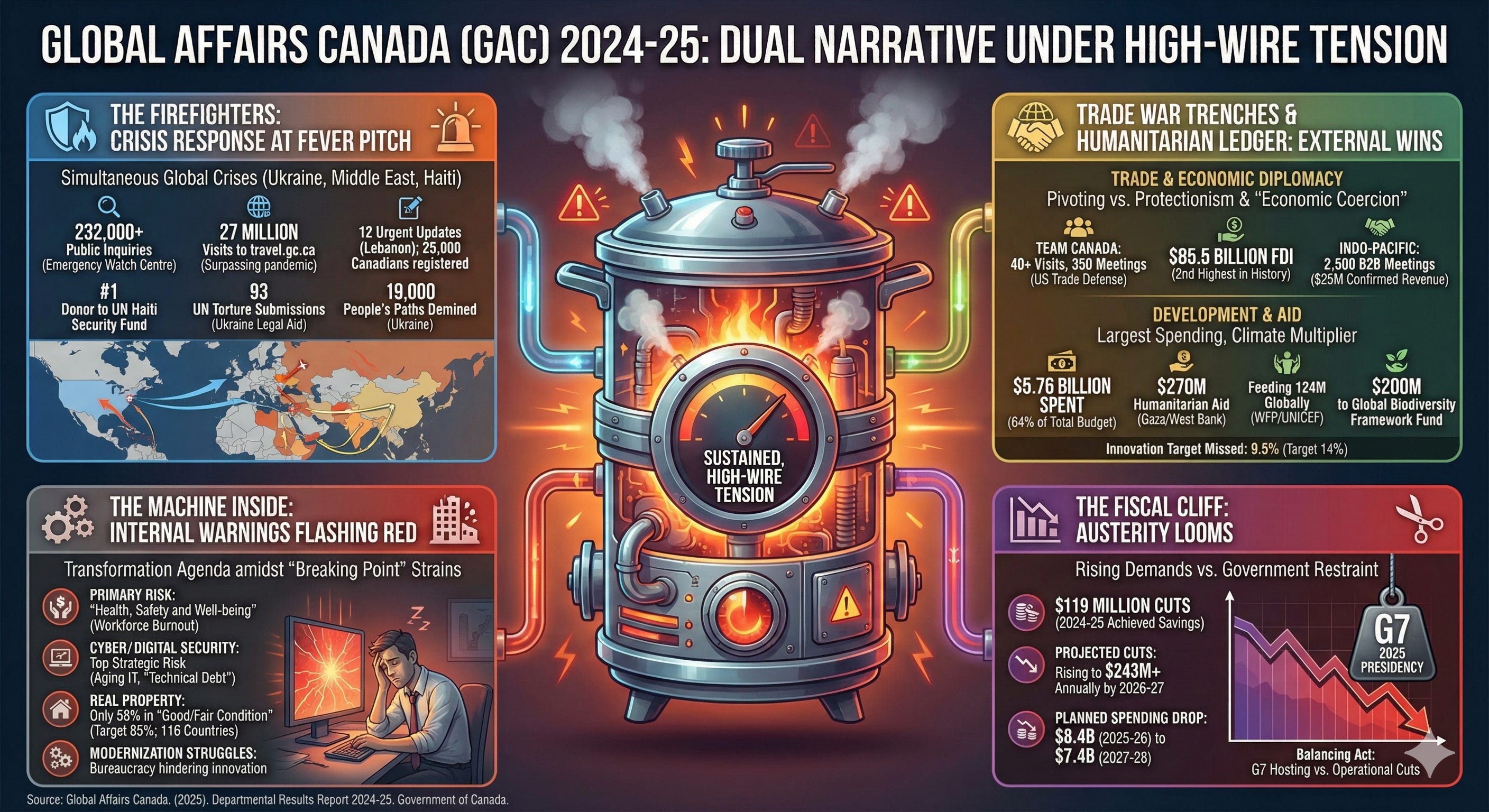
The fiscal year began not with a handshake, but with a warning siren. Inside the concrete fortification of 125 Sussex Drive in Ottawa, the mood was one of sustained, high-wire tension. The world had become, in the sterile language of government reports, a place of “increased global instability.” But behind that phrase lay a chaotic reality: armed conflicts in Ukraine and the Middle East, a deepening crisis in Haiti, and the tectonic grinding of trade wars.
For Global Affairs Canada (GAC), the 2024-25 period was not merely a fiscal cycle. It was a stress test of the nation’s diplomatic machinery. With a budget of over $9 billion and a workforce of more than 13,000, the department was tasked with projecting Canadian influence outward while simultaneously conducting urgent repairs on its own internal infrastructure. The objective was clear: maintain a “deliberate and principled approach” in a world that seemed to be losing its principles entirely.
As the department pivoted to handle everything from emergency evacuations in Lebanon to the looming spectre of the 2025 G7 presidency, the data revealed a dual narrative. On the surface, Canada achieved significant tactical victories in trade and aid. Yet beneath the hood, the engine of Canadian diplomacy was flashing red, warning of workforce burnout, aging technology, and the looming austerity of budget cuts.
The Firefighters
The most visceral measure of the department’s year was found in its response to crises. The Emergency Watch and Response Centre, the nerve centre for consular disasters, operated at a fever pitch. In previous eras, a crisis might be a singular event—a hurricane or a localized coup. In 2024-25, the crises were simultaneous and unrelenting.
The conflict between Israel and Hamas, coupled with the instability in Lebanon, forced the department into a rapid mobilization footing. The numbers tell a story of frantic logistics: over 232,000 public inquiries flooded the response centre. The website travel.gc.ca received 27 million visits, surpassing even the panic-induced traffic of the pandemic years. In Lebanon alone, the department issued twelve urgent updates and coordinated with other ministries to reach 25,000 registered Canadians, preparing the ground for potential mass evacuations.
This was not limited to the Middle East. In Haiti, where gang violence had effectively collapsed the state, Canada became the largest donor to the UN Trust Fund for the Multinational Security Support Mission. The department did not just send checks; it deployed experts. Canadian support established compliance mechanisms to prevent sexual exploitation within the mission and funded the Haitian National Police.
Further east, the war in Ukraine demanded a different kind of firefighting. It was legal and forensic. GAC deployed experts to document human rights violations and support the creation of a special tribunal for the crime of aggression. This was diplomacy as crime scene investigation, with Canadian legal advisors helping to draft submissions to the UN Committee Against Torture on behalf of ninety-three victims. The department was operating on the ground in conflict zones, clearing mines in Kyiv and Kharkiv to allow 19,000 people to move safely through their own country.
The Trade War Trenches
While the consular teams managed physical safety, the trade commissioners were entrenched in economic warfare. The global trading system, once defined by opening borders, was rapidly shifting toward protectionism and “economic coercion.” The United States, Canada’s most vital partner, presented a complex challenge. Following the U.S. elections, the threat of unjustified tariffs loomed large.
GAC’s response was the deployment of “Team Canada.” This was a full-court press involving over forty visits to the U.S. by the Prime Minister, ministers, and provincial leaders. The strategy was to flood the zone, conducting over 350 meetings to remind American decision-makers that their economy was inextricably linked to the north. They fought battles over steel, aluminum, and softwood lumber in the courts and the boardrooms, challenging the U.S. under CUSMA and at the World Trade Organization.
Simultaneously, the department accelerated its pivot away from reliance on North America. The Indo-Pacific Strategy moved from theory to practice. Trade missions to Indonesia, the Philippines, and South Korea generated 2,500 business-to-business meetings. The result was $25 million in confirmed revenue, but more importantly, it established a foothold in the fastest-growing economic region on earth. Negotiations on the Canada-Indonesia Comprehensive Economic Partnership Agreement concluded, promising market access to a nation of nearly 280 million people.
Investment flowed the other way as well. Despite the geopolitical headwinds, Canada attracted $85.5 billion in foreign direct investment. It was the second-highest level in the country’s history, a statistic the department wielded as a shield against critics who claimed Canada was losing its competitive edge.
The Humanitarian Ledger
The expenditure on “Development, Peace and Security Programming” dwarfed all other categories, consuming nearly 64 percent of the department’s spending. At $5.76 billion, this was the heavy artillery of Canadian soft power. The spending was driven by the sheer scale of human suffering.
In Gaza and the West Bank, Canada poured in $270 million in humanitarian assistance. This funding went to the World Food Programme and UNICEF, attempting to feed 124 million people globally and treat over 100 million children for malnutrition. The logistical challenges were immense. In Gaza, Canadian funding supported mine action activities, deploying explosives experts to protect humanitarian convoys trying to deliver aid through active war zones.
Climate change acted as a force multiplier for these crises. The department found itself responding to natural disasters that were magnified by environmental degradation. When Cyclone Remal hit Bangladesh and Hurricane Beryl swept through the Caribbean, GAC’s response had to be immediate. But beyond reaction, there was an attempt at future-proofing. Canada became the largest donor to the Global Biodiversity Framework Fund, putting $200 million toward halting biodiversity loss.
This massive outlay of funds was not without friction. The department struggled to innovate in how it delivered this aid. A target to have nearly 14 percent of initiatives implementing “innovative solutions” fell short, hitting only 9.5 percent. The bureaucracy of benevolence proved difficult to modernize.
The Machine Inside
Perhaps the most critical story of the 2024-25 report is the one taking place inside the hallways of the Pearson Building. The department is in the midst of a painful “transformation agenda.” The internal risk assessment painted a picture of an organization stretched to its breaking point.
The primary risk identified was “Health, safety and well-being.” The report explicitly stated that the cumulative effect of continuous crises and increased workloads was threatening employee retention. The department was running hot. To mitigate this, GAC updated its Foreign Service Directives, aiming to make life abroad more sustainable for staff and their families. They modernized medical plans in twenty-four countries and introduced new leave policies for those serving in high-risk zones.
Technologically, the department was fighting a defensive war. Aging IT systems and a reliance on legacy technology left the department vulnerable. Cyber and digital security were listed as top strategic risks. In a world of state-sponsored cyber espionage, GAC’s digital infrastructure—the nervous system of Canadian diplomacy—required urgent hardening. The department pushed to migrate systems to the cloud and enhance secret-level networks, but the “technical debt” remained a heavy burden.
There was also the physical reality of Canada’s presence abroad. The department manages real property in 116 countries. Many of these embassies and consulates are aging. The target to have 85 percent of properties in “good and fair condition” was missed by a staggering margin, with only 58 percent meeting the standard. Budget constraints and a growing portfolio meant that Canada’s diplomatic footprint was literally deteriorating.
The Fiscal Cliff
The final tension in the 2024-25 report is financial. While the demands on Global Affairs Canada have never been higher, the government’s fiscal policy has shifted toward restraint. Budget 2023 mandated spending reductions. In 2024-25, the department identified nearly $119 million in cuts. This number is projected to rise to over $243 million annually by 2026-27.
The department achieved these initial savings by slashing travel budgets and professional services, and by scaling back the International Assistance Innovation Program. It is a precarious balancing act. The department is preparing to host the G7 Leaders’ Summit in Kananaskis in 2025—a massive, expensive logistical undertaking—while simultaneously cutting operational costs.
The financial outlook shows a sharp decline in planned spending, dropping from $8.4 billion in 2025-26 to $7.4 billion in 2027-28. This accounts for the sun-setting of various climate and biodiversity initiatives, as well as the end of G7 funding. However, for a department citing “workforce burnout” and “IT vulnerability” as primary risks, the trajectory suggests that the pressure inside the pressure cooker is unlikely to abate.
As the fiscal year closed, Global Affairs Canada stood as a vital but strained institution. It had successfully navigated a year of fires, evacuations, and trade skirmishes. It had secured investment and delivered aid. But the internal fissures—the crumbling buildings, the tired staff, the aging servers—remain the silent crisis that no amount of diplomacy can talk away.
Source Documents
Global Affairs Canada. (2025). Departmental Results Report 2024-25. Government of Canada.