


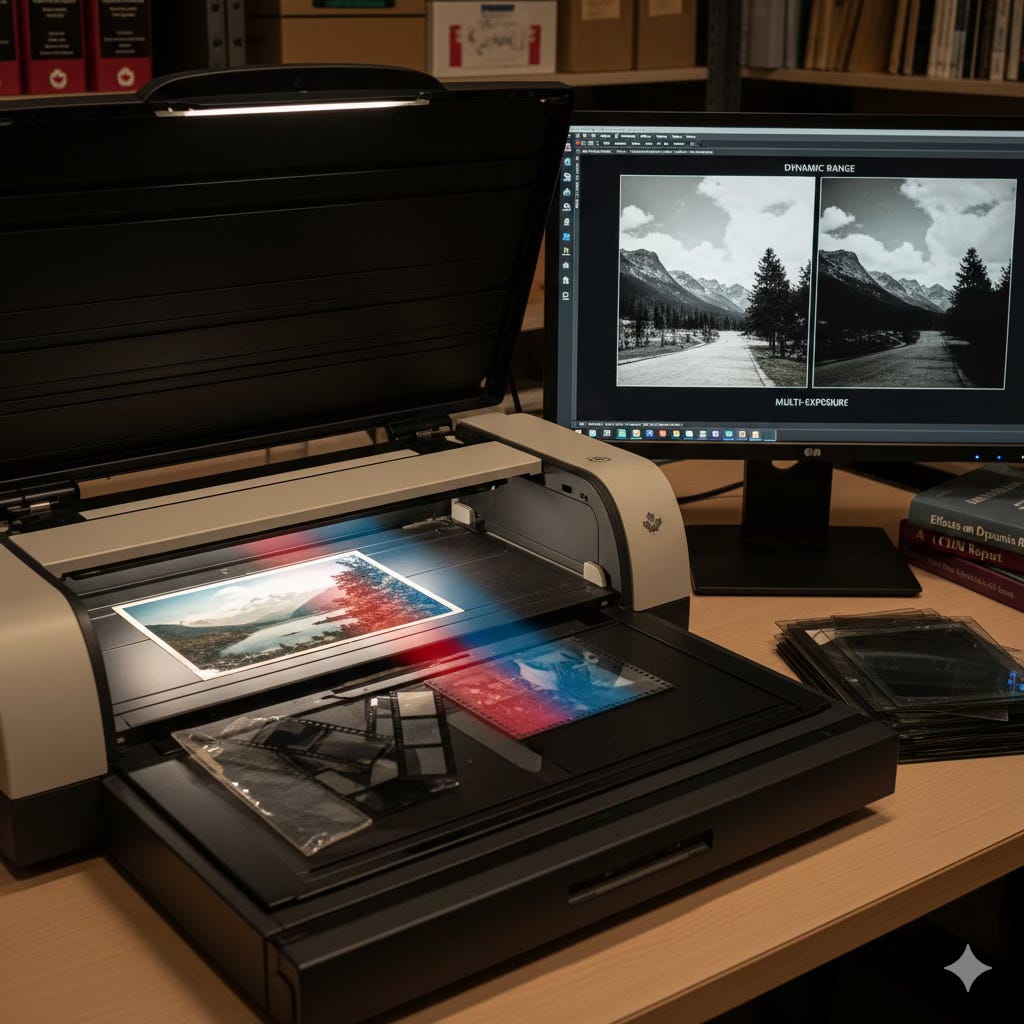
A new technical report from the Canadian Heritage Information Network (CHIN) provides a deep dive into a problem that rarely makes headlines but is crucial for preserving our collective memory: how to best digitize our cultural heritage.
As archives and museums work to save fragile transparencies, film, and negatives, they face a significant technical challenge. How do you capture the full detail in both the brightest and darkest parts of an image at the same time? This ability is called “dynamic range,” and achieving the high standards set by digitization guidelines is difficult. The CHIN report, authored by Ern Bieman, set out to test which scanning techniques actually improve this metric.
The central question is simple. Are special, time-consuming scanner features worth the effort? The findings offer clear guidance for any institution tasked with creating a faithful digital record of our history.
The Challenge: Capturing Light and Shadow
When you scan a transparency, the scanner needs to “see” nuances in both the very dark, opaque sections and the very light, near-transparent sections. The term for this is dynamic range.
The Federal Agencies Digital Guidelines Initiative (FADGI), a key benchmark, sets high standards for this. The report notes that many scanners struggle to achieve the highest quality levels. If a scanner can’t capture that full range, details are lost, and the digital copy is an incomplete representation of the original.
To solve this, many professional scanners and software offer a “multi-exposure” feature. This functions much like the High Dynamic Range (HDR) feature on your smartphone. The scanner makes multiple passes: some at lower exposures to capture details in the bright areas, and some at higher exposures to capture details in the dark areas. It then combines these into a single, detail-rich image.
This process, however, takes extra time, which can significantly slow down digitization workflows. The CHIN study aimed to quantify the benefit. Was the extra time worth the result?
The Findings: What Works and What’s Risky
The research provides a clear, data-driven answer. The report’s findings show that using the multi-exposure feature provides a significant, consistent benefit.
Multi-Exposure Scanning
On average, enabling multi-exposure increased dynamic range by 0.27. The report highlights that this improvement was observed “regardless of the hardware, software or infrared settings used.”
What does this mean in practice? This jump in quality is not just a minor technical tweak. The report states this improvement can often bump a scan up a full level of quality as defined by the FADGI guidelines. This is the difference between a “basic” scan and a high-quality archival master.
The Infrared Surprise
The study also tested the infrared dust and scratch removal feature, which is common on film scanners. Its purpose is to detect and remove artifacts like dust.
Surprisingly, this feature also increased dynamic range, by an average of 0.18. The report explains this is because the feature reduces image “noise,” which helps the scanner distinguish the true image signal in the darkest patches. When combined, multi-exposure and infrared scanning together achieved an average dynamic range of 3.71, a major improvement over the 3.26 average when using neither.
However, this finding comes with a major caveat. The researchers note it is unclear how infrared scanning affects other metrics, such as spatial resolution. There is a risk that in “flattening” noise, the software might also be flattening real, fine-grain detail.
Until this is better understood, the report offers a practical recommendation: for any image scanned using infrared, a second version should be scanned without the feature to ensure no detail is permanently lost.
Is the Extra Time Justified?
This brings us back to the workflow cost. Using both multi-exposure and infrared scanning added between 30 seconds and one minute per trial scan in the experiment.
For an archive with tens of thousands of images, this is a significant time investment.
The report’s conclusion, however, is decisive. Given the measurable and substantial improvement in dynamic range, the authors state that using both features is “likely to be justified in most workflows.”
The Data Brief
Multi-exposure scanning is the most effective tool, significantly boosting dynamic range and improving scans by as much as a full FADGI quality level.
Infrared scanning also improves dynamic range, not by capturing more detail, but by reducing image noise.
The report issued a key warning that infrared scanning might adversely affect spatial resolution, or the fine detail, of an image.
The recommended practice is to use multi-exposure, and if using infrared for dust removal, to also save a copy of the scan without the infrared feature applied.
The added workflow time (30-60 seconds per scan) is considered a worthwhile trade-off for the major gain in archival quality.
The Bottom Line
This technical report from CHIN provides a clear, evidence-based roadmap for Canadian heritage institutions. While it may seem like a minor technical issue, the choice of scanning settings has permanent consequences. The methods used today will determine the quality of the digital legacy we leave for future generations. This report argues that a small investment in time is a critical step in ensuring the digital copies of our history are as rich and detailed as the originals.
Source Documents
Bieman, E. (2025). Effects on Dynamic Range: An Evaluation of Multi-Exposure Features and Related Variables in Two-Dimensional Image Scanning. Canadian Heritage Information Network.