


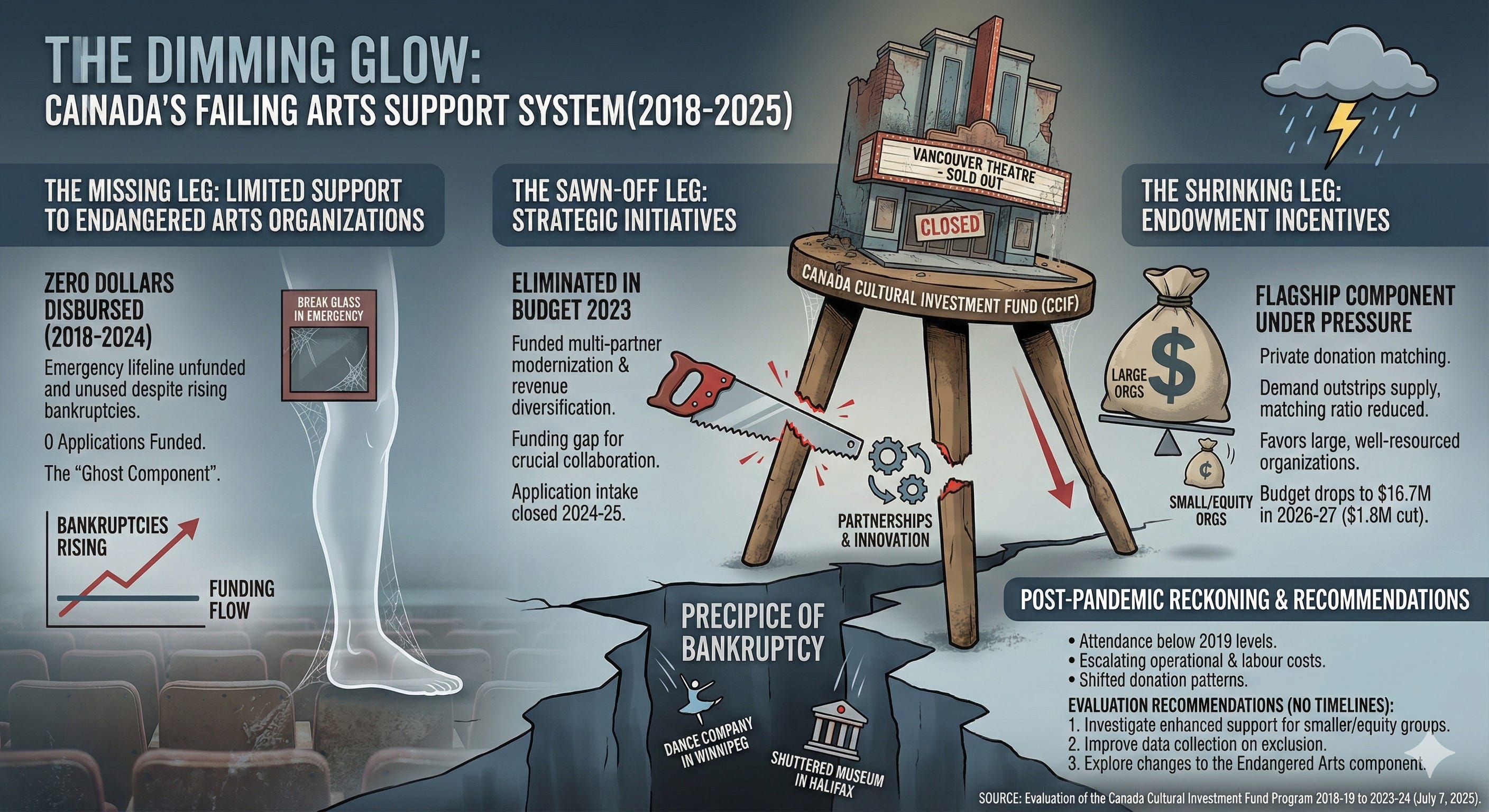
In the dimming glow of a Vancouver theatre that once hosted sold-out runs of Canadian plays, the stage manager counts the house: half-empty seats, rising hydro bills, and a payroll that can no longer be met.
Across the country in Winnipeg, a contemporary dance company cancels its season. In Halifax, a rural heritage museum locks its doors for good.
Inflation, labour shortages, shrinking attendance, changing donation patterns, and the lingering shock of the pandemic are pushing professional arts organizations toward the precipice.
Yet for six straight years — 2018-19 through 2023-24 — the one federal tool explicitly created to catch organizations facing imminent closure disbursed exactly zero dollars.
The Limited Support to Endangered Arts Organizations component of the Canada Cultural Investment Fund remained unfunded and unused, even as the sector’s bankruptcies rose.
That single fact, buried in a 50-page evaluation released quietly on July 7, 2025, is the sharpest indictment of a program meant to ensure the long-term financial health of Canadian culture.
The Three-Legged Stool with One Leg Missing
The Canada Cultural Investment Fund (CCIF) was born in 2001 with a simple, almost elegant promise: get private donors to give, and Ottawa will match, dollar for dollar, to build permanent endowment funds.
Over two decades it has grown from $3.1 million to roughly $20 million annually, becoming the federal government’s primary mechanism to leverage private money into perpetual income for professional arts organizations.
Two other components completed the design:
Strategic Initiatives ($3–4 million a year) funded multi-partner projects to modernize business practices and diversify revenue.
Limited Support to Endangered Arts Organizations — the emergency component — was intended to provide bridge financing to organizations that had community support and viable restructuring plans but faced immediate closure.
In practice, one leg was sawn off before the crisis even hit.
Between 2018-19 and 2023-24, Limited Support received no budget allocation at all.
Not a single application was funded.
Not one organization on the brink received the lifeline it was created to provide.
Meanwhile, the evaluation notes “rising bankruptcies in the sector.”
The Matching Game Becomes a Lottery
Endowment Incentives, the program’s flagship component, remains the strongest pillar.
It successfully leveraged private donations, created new endowment funds, and promoted long-term financial health.
But demand has far outstripped supply.
Applications soared, forcing the program to reduce the matching ratio and the average grant per organization.
What was once a reliable 1:1 match became a partial match, then a fraction.
Large, well-resourced organizations — symphonies, major theatres, major museums — continued to raise millions from private donors and received the lion’s share of federal dollars.
Smaller organizations, Indigenous-led groups, and equity-seeking organizations faced significant barriers and received disproportionately less.
The evaluation is blunt: larger organizations disproportionately receive a greater share of available resources.
The lever works — but mostly for those who already have leverage.
Partnerships Severed Overnight
The Strategic Initiatives component performed exactly as intended.
Multi-organization projects improved ticketing systems, audience development, revenue diversification, and digital transformation.
Arts organizations formed consortia, shared expertise, and built resilience.
Then, in Budget 2023’s “refocusing” exercise, the component was eliminated.
Application intake closed in 2024-25.
All approved projects were allowed to finish, but no new partnerships will be funded.
The evaluation records the sector’s immediate concern: a funding gap now exists for collaborative business-improvement projects, just as inflation and labour costs make collaboration more urgent than ever.
The Ghost Component Nobody Talks About
Limited Support to Endangered Arts Organizations has not been used since 2008.
It sits in the program guidelines like a fire extinguisher behind glass that no one is allowed to break.
The evaluation dryly states the component “did not have specific budget allocations and went unused during the 6-year evaluation period, despite rising bankruptcies in the sector.”
No further explanation is offered in the public document.
No data on how many organizations quietly folded rather than apply, or were told not to apply, or were simply unaware the tool existed.
Only the fact: the tool existed, the need existed, the money did not flow.
Post-Pandemic Reckoning
The evaluation confirms what every arts board already knew: the sector is still bleeding from COVID.
Attendance remains below 2019 levels in most disciplines.
Operational costs have escalated dramatically.
Donation patterns have shifted toward emergency campaigns and away from endowment gifts.
Labour issues — including union contracts signed in better times — now strain budgets written on hope.
The program that was “crucial” during the pandemic (by leveraging emergency private donations into permanent capital) is now facing the same headwinds without the same tools.
In 2026-27 the Endowment Incentives budget itself drops to $16.7 million — a $1.8 million cut announced in Budget 2023.
The stool now has two legs, one of them shortened, and the third leg was never there.
Who Gets Saved, Who Gets Left
The evaluation’s data on equity is sparse but damning in its sparsity.
Access for Indigenous communities and equity groups “is limited.”
Data collection is insufficient to even measure the full extent of the exclusion.
Smaller organizations repeatedly told evaluators they lack the staff, expertise, or donor base to compete in a high-volume endowment campaign against national flagship institutions.
The program that is supposed to foster financial autonomy currently rewards those who already possess it.
The Recommendations Ottawa Cannot Ignore
The evaluators offered three recommendations to the Senior Assistant Deputy Minister, Cultural Affairs:
Investigate further options to enhance supports for the arts sector, particularly for smaller arts organizations including those representing Indigenous peoples and equity groups.
Improve data collection tools and methods to strengthen performance measurement, particularly for equity groups and Indigenous communities.
Explore options and possible changes to the Limited Support for Endangered Arts Organizations component to better address the needs and gaps in the arts sector.
No timelines are attached.
No commitment to reverse the Strategic Initiatives cut is mentioned.
Only the quiet acknowledgment that the emergency component, as currently designed, does not work.
Epilogue in a Minor Key
Canada’s cultural sector is not asking for charity.
It is asking for the tools it was promised: a functioning emergency component, partnership funding that still exists, and an endowment program that does not systematically favour the large over the small, the downtown over the regional, the settler over the Indigenous.
The evaluation has laid the evidence on the table.
The question is whether anyone in Ottawa is willing to pick it up before the lights go out for good.
Source Documents
Evaluation Services Directorate. (2025, July 7). Evaluation of the Canada Cultural Investment Fund Program 2018-19 to 2023-24.