


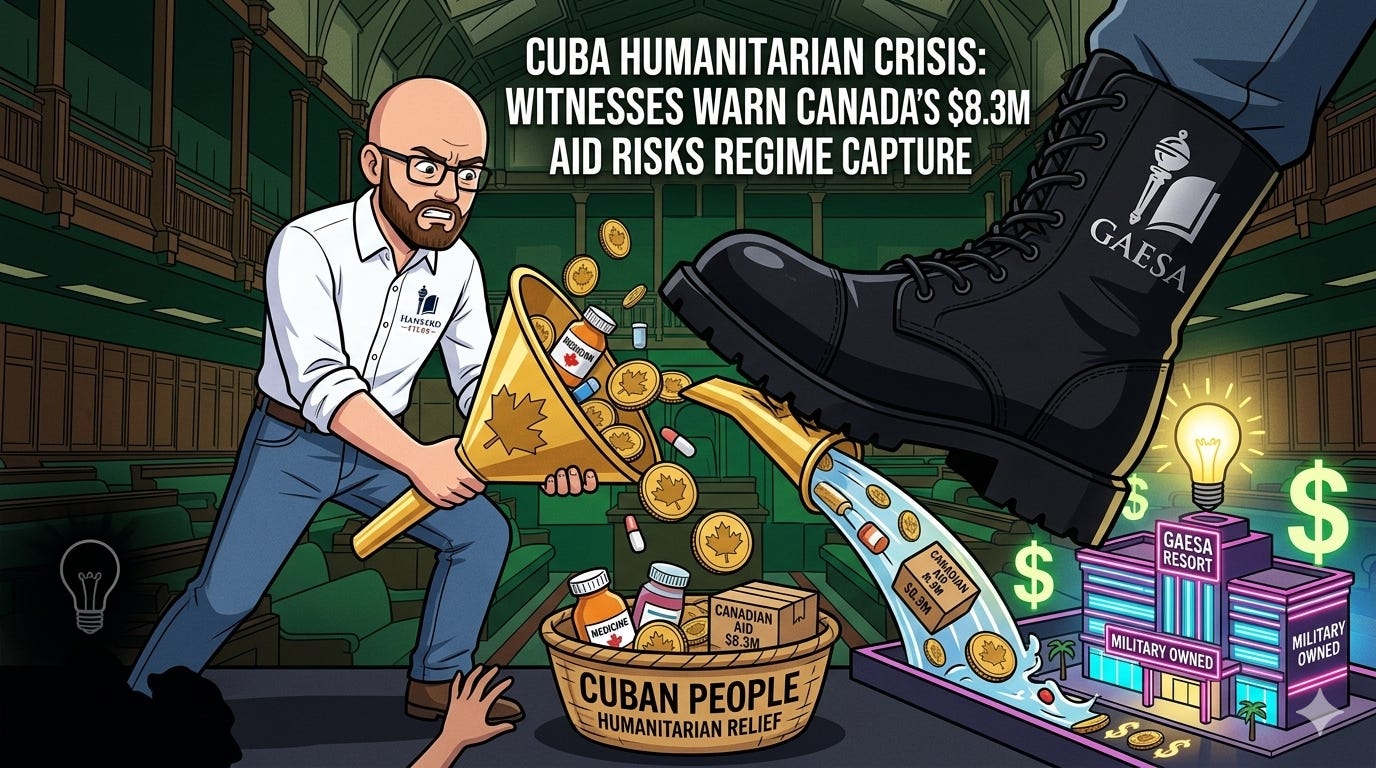
In a committee room on Parliament Hill on February 26, 2026, Cuban exiles delivered raw testimony about the Cuba humanitarian crisis consuming their homeland. Blackouts lasted up to 22 hours a day. Pharmacies stood empty of basic medicine. Families skipped meals as inflation made salaries meaningless. Hospitals operated without supplies. Over 1,200 political prisoners remained behind bars, many held under a 2022 penal code described by international observers as draconian. The International Committee of the Red Cross had not visited Cuban prisons since 1989. This was not a temporary breakdown. Witnesses insisted it was the predictable result of 67 years of centralized control that prioritized elite power and military tourism over the needs of 11 million people.
The Standing Committee on Foreign Affairs and International Development had convened specifically to examine the humanitarian situation in Cuba. Chair Ahmed Hussen opened the hybrid meeting. Interpretation was provided in Spanish where needed. Witnesses from the Cuban Canadians Coalition, Ciudadanía y Libertad, the Center for a Free Cuba, and the Cuban Observatory of Human Rights spoke in turn, their accounts painting a picture of systemic collapse.
Witnesses Expose Root Causes of Cuba Humanitarian Crisis
Kirenia Carbonell, public relations director of the Cuban Canadians Coalition, described a multi-dimensional structural collapse. GDP had contracted more than 15 percent between 2020 and 2024. Agricultural production had plummeted on an island historically capable of feeding itself. Electricity infrastructure, long neglected, failed repeatedly. More than half a million Cubans had fled to the United States alone since 2022. Carbonell rejected any narrative that pinned the disaster solely on external sanctions. The crisis, she said, stemmed from deliberate domestic policy choices. Resources were systematically diverted to maintain control rather than serve citizens. Hunger itself had become a tool of governance.
Carolina Barrero Ferrer of Ciudadanía y Libertad reinforced the point. The regime used repression efficiently while basic services collapsed. Seven out of ten Cubans skipped at least one meal daily. Only three percent could obtain medicine through the public system. Older adults and families of political prisoners suffered most acutely. The situation now rivalled or exceeded conditions in Haiti. Oppression functioned. Services did not.
John Suarez of the Center for a Free Cuba and Yaxys Cires of the Cuban Observatory of Human Rights added grim statistics on repression. Protests in July 2021 had triggered mass arrests. Families still searched for loved ones. Minors, artists, journalists and academics remained imprisoned. The 2022 penal code criminalized dissent. Cires noted that repression machinery responded quickly to any sign of unrest.
Luxury Hotels versus Blackouts: The GAESA Empire
Witnesses repeatedly returned to the role of GAESA, the military-run conglomerate that controls roughly 60 percent of the Cuban economy and holds $18.5 billion in cash reserves. While ordinary Cubans suffered chronic blackouts and shortages, the regime had constructed around 400 luxury hotels. Oil shipments from allies such as Venezuela, Mexico and Russia were often resold on international markets instead of powering homes and hospitals. Billions had flowed into dollar-only retail chains and five-star resorts. Regions near those hotels still endured power outages. A toxic garbage crisis in Havana burned for more than a week without proper intervention. Carbonell noted that elite properties and military hospitals received priority while citizens faced empty shelves.
Barrero Ferrer described a toxic cycle. Propaganda channels abroad masked the reality. Even during periods of normalized relations with the United States, the same mismanagement persisted. The regime doubled down on luxury tourism and elite privilege while the electrical grid crumbled and transportation systems failed.
The $8.3 Million Test for Canadian Aid
The hearing occurred at a pointed moment. The previous day, Foreign Affairs Minister Anita Anand had announced $8.3 million in new humanitarian assistance to Cuba, roughly doubling previous annual levels. MPs pressed witnesses on how that money could reach ordinary citizens.
Carbonell was blunt. Aid routed through government channels or regime-partnered organizations had ended up in military hospitals, elite mansions and regime-controlled enterprises. Federaciones presented as independent NGOs were in fact regime organs. She urged Canada to partner instead with verified faith-based groups such as Caritas and independent civil society organizations on the ground. Direct delivery offered the only reliable guarantee.
Barrero Ferrer echoed the warning. International bodies like UNICEF and the Red Cross often lacked capacity inside Cuba to bypass regime gatekeepers. When aid had reached eastern provinces devastated by storms, it had come from private Cuban-Canadian efforts or U.S. channels, not official pipelines. One successful small-scale model involved Ciudadanía y Libertad shipping one tonne of medicine and supplies directly.
Suarez added historical context. Even the United States had managed limited humanitarian deliveries through trusted networks such as the Catholic Church. Canada, with its long diplomatic ties to Havana, possessed both leverage and responsibility. He called for explicit conditions ensuring funds never touched GAESA accounts and for the creation of humanitarian corridors with verification mechanisms.
Calls for Prison Access, Sanctions and Accountability
Witnesses offered concrete recommendations. Route all assistance through independent channels. Apply Magnitsky-style targeted sanctions on officials responsible for repression and corruption. Insist on unconditional access for neutral observers to prisons. Support independent journalists and human rights defenders. Carbonell stressed that Cubans were not asking Ottawa to engineer regime change. Three million people in exile alongside those on the island would drive any democratic transition. What they sought was an end to policies that legitimized the structures causing the suffering.
Parliament’s Intense Week
This detailed examination of the Cuba humanitarian crisis took place during one of the busiest periods on Parliament Hill. Between late February and mid-March 2026, 11 standing committees held evidence sessions across a wide range of national issues. The Foreign Affairs committee’s focus on Cuba stood out as MPs confronted how best to respond to one of the Western Hemisphere’s most pressing humanitarian emergencies.
The testimonies left a clear challenge. Canada’s historical engagement with Cuba now faces a test. The $8.3 million commitment and future policy decisions will determine whether Canadian assistance reaches suffering citizens or inadvertently sustains the system that created the crisis.
The Cuba humanitarian crisis shows no signs of easing. Parliament has received detailed evidence from those closest to the reality on the ground. How Ottawa chooses to act on that evidence will shape not only outcomes for ordinary Cubans but Canada’s credibility on human rights and effective aid delivery.
Hansard Files digs through dense parliamentary transcripts so you don’t have to. Subscribe to support independent reporting that uncovers what really happens on the Hill.
Source Documents
Standing Committee on Foreign Affairs and International Development. (2026, February 26). Evidence, NUMBER 024.
Standing Committee on Public Accounts. (2026, March 9). Evidence, NUMBER 026.
Standing Committee on Justice and Human Rights. (2026, March 11). Evidence, NUMBER 020.
Standing Committee on Fisheries and Oceans. (2026, March 9). Evidence, NUMBER 026.
Subcommittee on International Human Rights of the Standing Committee on Foreign Affairs and International Development. (2026, March 9). Evidence, NUMBER 013.
Standing Committee on the Status of Women. (2026, March 10). Evidence, NUMBER 028.
Standing Committee on Procedure and House Affairs. (2026, March 10). Evidence, NUMBER 024.
Standing Committee on Indigenous and Northern Affairs. (2026, March 12). Evidence, NUMBER 025.
Standing Committee on Access to Information, Privacy and Ethics. (2026, March 9). Evidence, NUMBER 031.
Standing Committee on Citizenship and Immigration. (2026, March 9). Evidence, NUMBER 023.
Standing Committee on Industry and Technology. (2026, March 9). Evidence, NUMBER 027.
Very good article and the constant dilemmas of international aid. Funds intended for some modicum improvement for the average Cuban or benefit to the governing regime. I am also impressed that the hearing facilitated both English and Spanish languages.
" ... GAESA, the military-run conglomerate that controls roughly 60 percent of the Cuban economy and holds $18.5 billion in cash reserves. While ordinary Cubans suffered chronic blackouts and shortages, the regime had constructed around 400 luxury hotels. Oil shipments from allies such as Venezuela, Mexico and Russia were often resold on international markets instead of powering homes and hospitals."
Time's up? Or will GAESA simply run Cuba for the US and themselves.