


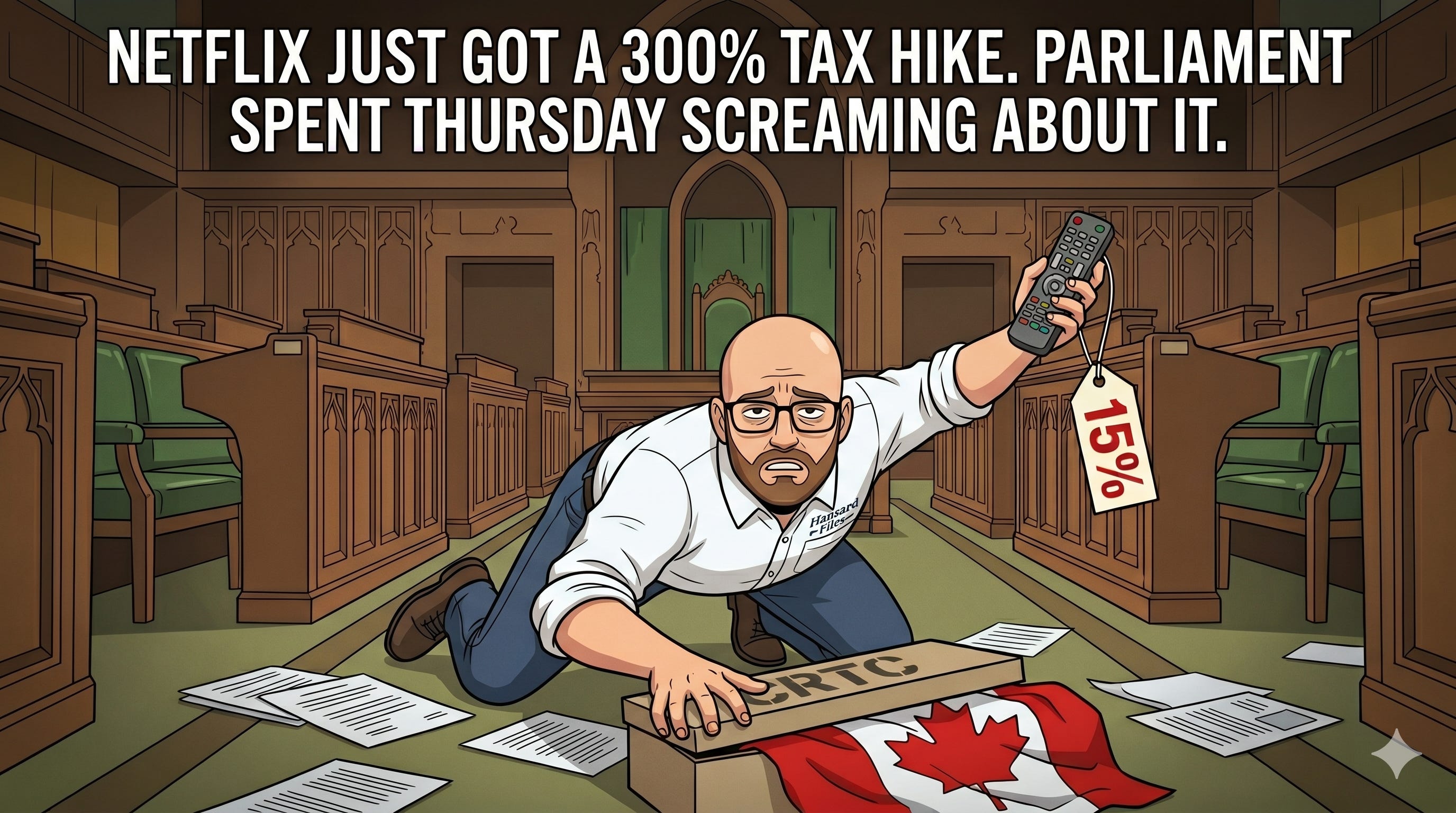
The argument started, as many do in the House of Commons, with a number.
Fifteen per cent. That’s what Canada’s broadcast regulator, the CRTC, ruled streaming giants like Netflix, Disney+, and Amazon Prime must now hand over from their annual Canadian revenues toward homegrown content. It was a steep climb from the 5% floor the regulator had set just two years earlier. Three times higher. Done, as the CRTC put it, to stabilize funding at more than $2 billion in support of Canadian and Indigenous content, including French-language programming and local news.
The Online Streaming Act had handed the CRTC the legal authority to do this back in 2023. Now, on May 28, 2026, Parliament was grappling with what that authority had produced, and the chamber did not sound like a body in agreement.
The fee that broke the room
The CRTC’s announcement landed on May 21. By the time members took their seats a week later, two distinct versions of the same policy had taken shape on opposite sides of the aisle.
On the government side: a sovereign nation protecting its culture from American digital monopolies. On the opposition side: a punishing tax hike, dressed up in patriotism, arriving at exactly the worst moment imaginable.
The timing argument was hard to dismiss. CUSMA renegotiations are on the horizon. The United States had already flagged the Online Streaming Act itself as a trade irritant. And here was Ottawa, not softening the regulation in anticipation of the talks, but tripling it. Conservative members pressed the point repeatedly: what signal does a 300% fee increase send to Washington when Canada is trying to negotiate from a position of partnership?
The government’s response leaned on a separation of powers. The CRTC is an arm’s-length quasi-judicial tribunal. Ministers don’t direct it. The streaming fee is a domestic regulatory matter, not a trade concession. The line was technically accurate. It did not seem to satisfy anyone who had to make the argument with conviction.
Guilbeault’s ghost in the room
There was something almost symmetrical about the timing. The day before the streaming debate, on May 27, Steven Guilbeault stood in the House of Commons and resigned from the Liberal caucus. His reason was the inverse of what his former colleagues were arguing across the aisle: not that the government had done too much to reshape Canada’s economic relationship with powerful industries, but that it had done too little.
“If I told him then that one day he would serve as a member of Parliament, that he would even be the minister of environment and climate change, I am not sure that 25-year-old would have believed that,” Guilbeault told the chamber, speaking of his younger self. “We should believe in our dreams. Sometimes they come true.”
His farewell address was personal, measured, and quietly devastating. He had spent years inside the tent. He was choosing, now, to leave it.
The irony was not lost in the chamber. A former minister who’d built his reputation on forcing industries to internalize costs they’d rather pass along was walking out the door, in part because he believed the government had made its peace with exactly those industries. The Bloc Québécois were quick to name it. MP Gabriel Ste-Marie invoked former federal environment minister Catherine McKenna’s description of Canada’s oil industry leaders as fat cats making huge profits from war while demanding subsidies, language that landed harder given the Guilbeault news that afternoon.
The government’s $25-billion Canada Strong Fund, designed to direct public money into oil and gas projects, was the specific target. With fossil fuel companies in Canada projected to post $90 billion in profits this year, critics argued the math didn’t square.
The gas tax motion that wasn’t going anywhere
A day earlier, Wednesday afternoon brought its own spectacle. The Conservatives introduced an opposition motion demanding the cancellation of all federal taxes on gas and diesel for the remainder of the year, along with the permanent elimination of the Clean Fuel Standard. The debate was spirited. It was also, given parliamentary arithmetic, mostly performative.
The numbers the Conservatives brought to the floor were real enough. Canadian gas prices run 13% higher than American prices, or about 22 cents more per litre. Gas costs 50 cents more per litre today than it did when global oil prices sat at comparable levels in 2014. Equifax had just reported insolvency volumes up 19% year-over-year, at levels not seen since 2009. Mortgage delinquencies climbed 52% in Ontario and 36% in British Columbia. Canadian households now carry $1.77 of debt for every dollar of income.
Conservative MP Mike Lake quoted C.S. Lewis: “If you have taken a wrong turning, then to go forward does not get you any nearer.” MP Eric Lefebvre reached for Milton Friedman: “If government were put in charge of the Sahara Desert, there would be a shortage of sand within five years.”
The government countered with its own list: the Canada child benefit, the national school food program, a 10-cent excise tax reduction on gas.
Liberal MP Kevin Lamoureux quoted the Leader of the Opposition back at him, specifically a line about how a tax “this high” would cause “mass hunger and malnutrition,” framing it as the kind of extreme rhetoric that undermines serious debate.
Neither side moved an inch.
What the streaming fight is actually about
Back to Thursday. Back to 15%.
The Bloc Québécois stood firmly with the government on the streaming levy, and their reasoning was different from the Liberals’, sharper in some ways. This wasn’t abstract policy for Quebec members. French-language content has always operated on thinner margins, in a smaller market, competing for attention against English-language and American cultural product. Without mandatory contribution requirements, platforms built to maximize global engagement have little structural incentive to invest in Québécois storytelling. The CRTC rule, for them, was not an irritant. It was air.
The Conservatives saw it differently. Not because they oppose Canadian culture, their members were careful to say so, but because a 300% increase in a single regulatory cycle, timed to arrive just as Canada needs American goodwill, looks less like cultural policy and more like a provocation. They pointed to the fact that traditional broadcasters, who currently pay between 30% and 45% of revenues, would actually see their rate lowered to 25% under the new framework. The rates are moving in opposite directions depending on who you are, which suggests the regulation is doing more complex work than simple cultural protection.
The CRTC’s vice-president of broadcasting told reporters after the announcement that the commission is “not in touch with the government about the status of trade negotiations.” That may be true. It doesn’t mean the government can avoid the political consequences of what its arm’s-length regulator does in its name.
A week that keeps asking the same question
Take the full week together and a pattern emerges. The gas tax debate, the Guilbeault resignation, the streaming levy fight, the ongoing arguments over the Clean Fuel Standard and the Canada Strong Fund: each one is, at its core, an argument about cost. Who pays it. Who gets to pass it on. Who absorbs it when there’s nowhere left to shift it.
Canadian households hold $1.77 of debt for every dollar of income. The projected federal deficit has grown to $68 billion, roughly double what was projected. Insolvency is rising. Property values in parts of British Columbia face legal uncertainty. And Parliament spent this particular week doing what Parliament does: fighting over the terms of the next adjustment rather than the direction of the whole.
In the House of Commons, Guilbeault’s empty seat is already the most interesting thing in the room.
Hansard Files spends weeks in the archives so you don’t have to. If stories like this matter to you, subscribe to keep this work independent.
Source Documents
House of Commons. (2026, May 25). House of Commons Debates, 45th Parliament, 1st Session, No. 121. (X3-451-121-eng.pdf)
House of Commons. (2026, May 26). House of Commons Debates, 45th Parliament, 1st Session, No. 122. (X3-451-122-eng.pdf)
House of Commons. (2026, May 27). House of Commons Debates, 45th Parliament, 1st Session, No. 123. (X3-451-123-eng.pdf)
House of Commons. (2026, May 28). House of Commons Debates, 45th Parliament, 1st Session, No. 124. (X3-451-124-eng.pdf)
House of Commons. (2026, May 26–28). House of Commons Journals, Nos. 121–124. (X2-451-121 through X2-451-124.pdf)
House of Commons. (2026, May 26–29). Order Paper and Notice Paper, Nos. 122–125. (X4-451-122 through X4-451-125.pdf)
CRTC. (2026, May 21). Broadcasting Regulatory Policy CRTC 2026-95 and 2026-96. Government of Canada.
"You either pay now or pay later" - a persistent refrain.
There is a feeling that Canada sold-out it's sovereignty long ago. It's population waits anxiously...
Canada opened it's doors to US "entertainment" decades ago. For those who could afford it, this dates back to the 1950s. Over these decades, the US Entertainment Machine has "lulled" Canada's population into a deep sleep walk.
Thoughts of Mr. Guilbeault as I read an article linked in a recent article:
https://bam.brookfield.com/press-releases/brookfield-raises-20-billion-record-transition-fund
Another busy day at the office, Mike. I didn’t realize the Canada Strong Fund focused on O&G investments. It is regrettable that we must de-focus on conservation efforts and I sympathize with. Mr. Guilbeault. However, there isn’t tons of manoeuvring space around unjustified tariffs and the US/Israeli incursions in the Middle East.
One day, Canada will have to get back on track.