


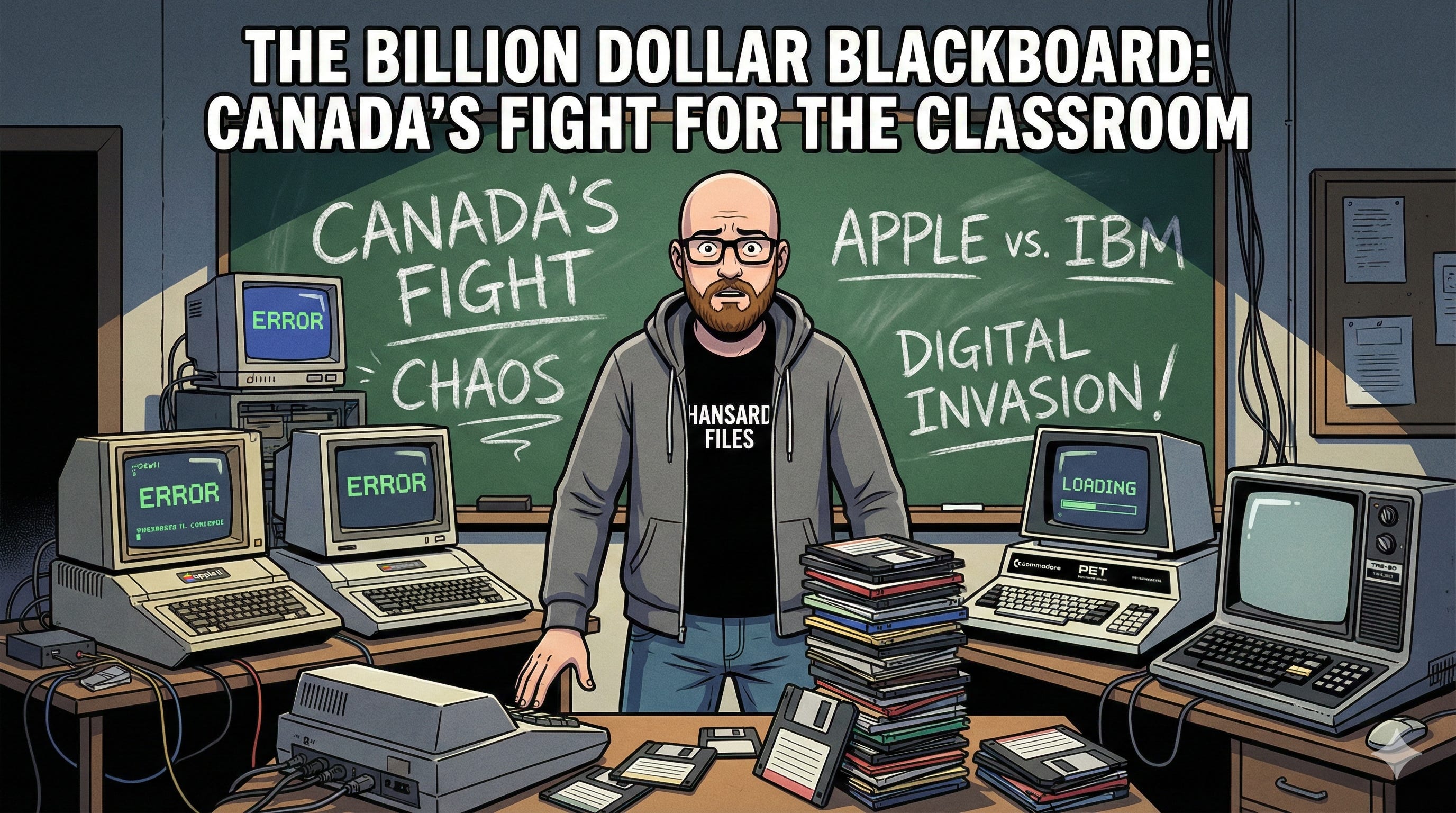
By 1985 the Canadian classroom was no longer a sanctuary of chalk dust and predictable curriculum. It had become the frontline of a quiet and chaotic war where the combatants were school boards, provincial ministries, and multinational technology giants. Computers were arriving in schools not by strategic design but through what desperate administrators termed a revolution by infiltration. They entered through back doors and bake sales, bought by parents and teachers who sensed a seismic shift in the world order and refused to wait for permission to join it. At the center of this turbulence was the concept of computer learning, a burgeoning field that promised to revolutionize the human mind but threatened to turn the nation into a passive colony of American industry.
The stakes were immediate and terrifyingly high. A national task force warned that without a coherent strategy Canada risked producing a generation that was non-competitive and non-literate in the evolving information society. While parents clamored for access to the future, policymakers watched with growing alarm as the educational landscape fractured. Wealthier districts bought expensive hardware while poorer ones went without, creating a schism of “computer rich” and “computer poor” students that threatened the country’s democratic promise. The computer had ceased to be a mere calculator or a novelty; it was now a cultural fixture, and the battle to control it would determine whether Canadian students would learn from Canadian innovations or merely consume American products.
The Revolution by Infiltration
The arrival of the microcomputer in the early 1980s caught the educational establishment off guard. Unlike the centralized mainframes of the past that required climate-controlled rooms and massive budgets, these small and relatively affordable machines bypassed official procurement channels entirely. The result was anarchy. By 1983 over 33,000 microcomputers sat in Canadian schools, a number expected to double within a year. Yet there was zero coordination. A school in British Columbia might buy an Apple II while a district in Manitoba committed to the Radio Shack TRS-80 and a board in Ontario experimented with the Commodore PET.
Teachers faced a chaotic supply scene that bordered on the absurd. They would purchase a machine only to find that the software they needed ran exclusively on a competitor’s hardware. This incompatibility fragmented the marketplace and locked schools into specific hardware ecosystems. If a district tried to switch vendors, they rendered their entire library of software useless overnight. The hardware manufacturers understood this trap perfectly. They knew that if a school bought an Apple, they would buy Apple content, and eventually they would be forced to buy more Apples to run that content. It was a cycle of dependency that American firms were eager to exploit.
Apple Computer Inc. aggressively pursued this strategy of market hegemony through what amounted to a hearts-and-minds campaign. They lobbied for tax credits to donate thousands of computers to schools in California, calculating that a “giveaway” today would secure a loyal customer base for decades. Canadian officials watched these maneuvers with trepidation, realizing that every donated Apple II was another brick in a wall that shut out domestic innovation. The classroom was being colonized, and the teachers—often acting as hobbyists and pioneers—were unwittingly digging the trenches for foreign monopolies.
The Pedagogy of Drill and Practice
Beneath the hardware chaos lay a deeper struggle to define the very nature of learning. The content available for these new machines was often abysmal. Because the adoption of technology had been so helter-skelter, the industry was flooded with amateur software created by teachers in a labor of love rather than by professional teams. The result was a proliferation of “drill and practice” routines—electronic flashcards that did little more than automate the boredom of rote memorization.
Critics argued that this approach betrayed the true potential of computer learning. It used the machine to “program the child” rather than allowing the child to program the machine. Visionaries like Seymour Papert championed a radically different philosophy known as unstructured learning. Papert argued against the didactic model where the computer simply administered tests and graded answers. He proposed “microworlds” where children could master geometry by directing a digital turtle in the LOGO programming language. In Papert’s vision, a child could learn mathematics as naturally as learning French in a French-speaking country, acquiring “powerful ideas” without the artificial constraints of a curriculum or grades.
However, the reality of 1985 lagged painfully behind this utopian ideal. Constructing a single hour of high-quality intelligent content required up to 300 hours of development time. The sheer cost of creating these smart systems threatened to strangle the industry before it could walk. Schools were left dependent on cheap mass-produced software from the United States that emphasized repetitive tasks over creative inquiry. The educational system found itself caught between the promise of artificial intelligence—where computers could act as Socratic tutors—and the reality of crude, pixelated drills that did little to expand the mind.
The Billion Dollar Vulnerability
The economic implications of this technological shift were staggering. By the early 1980s, the trade deficit in computer and office equipment had already surged past $2 billion. The warning signs were flashing red: if Canada remained a passive consumer, it would simply export its wealth to American hardware giants like Apple and IBM. These corporations were aggressively donating equipment to schools not out of charity, but to lock in future market dominance.
The federal government found itself paralyzed by a jurisdictional standoff. While it poured nearly $1 billion annually into manpower training, it was constitutionally barred from direct involvement in education, which remained a provincial fiefdom. This left the nation with ten different strategies for computer learning, creating a disjointed market where a student in Quebec faced an entirely different digital reality than one in Manitoba.
In the absence of federal leadership, Ontario attempted a forceful counter-strike. The province launched a bold industrial policy to subsidize the development of a “Canadian Educational Microcomputer” known as the Icon. Designed specifically for the classroom with networking capabilities, superior graphics, and the ability to handle the Telidon videotex standard, the Icon represented a desperate attempt to marry educational needs with industrial survival. The Ontario Ministry of Education offered schools a massive subsidy, covering 75 percent of the cost to ensure that the Icon could compete against the cheaper, mass-market American machines.
Yet this strategy carried immense risks. By betting on a unique Canadian machine, Ontario risked isolating its students on an island of incompatibility. Software developed for the Icon would not run on the thousands of Apples already sitting on desks in other provinces. While Quebec launched its own initiative to build a local machine called the MAX-20, other provinces watched from the sidelines, wary of the costs and the fragmentation. The result was a balkanized map of Canadian education, where the tools of learning were determined by local industrial policy rather than pedagogical best practices.
The Search for Intelligent Tutors
While bureaucrats fought over hardware contracts, researchers were racing to unlock the next generation of computer learning: Artificial Intelligence. The limitations of 1985 technology were severe, but the prototypes for “intelligent tutors” offered a glimpse of a radically different future. Systems like SOPHIE, an expert in electronic troubleshooting, could engage students in a natural language dialogue, analyzing their troubleshooting strategies and critiquing their logic rather than just marking their answers right or wrong.
Another system, BUGGY, was designed to diagnose the specific “bugs” in a student’s mental arithmetic. It didn’t just flag an error; it built a “student model” to understand why the student was making the mistake. This moved computer learning away from the frame-oriented approach—where a student simply moved from one screen of text to another—toward a knowledge-based interaction that mimicked a one-on-one session with a human expert.
The barrier was accessibility. These intelligent systems required computing power that was vastly beyond the capabilities of the Apple IIs and Commodores sitting in the average classroom. They ran on expensive mainframes or LISP machines, accessible only to a rarified group of researchers in universities and military labs. The challenge was to shrink this intelligence down to the microchip, a feat that seemed agonizingly close yet financially prohibitive. Until that breakthrough occurred, Canadian students were stuck with “page-turning” software that treated the computer as little more than an expensive textbook.
A Nation at the Crossroads
As the decade hit its midway point, the disconnect between the potential of computer learning and the reality on the ground was stark. The military and federal government had failed to act as “catalyst users,” awarding major training contracts to U.S. firms instead of nurturing domestic expertise. When the Canadian military needed a training system for its new CF-18 fighter jets, the contract went to McDonnell Douglas, bypassing Canadian firms and deepening the reliance on foreign technology.
The educational system was buckling under the strain of copyright piracy. Teachers, frustrated by limited budgets and disorganized supply channels, were widely copying diskettes, creating a “black market” of learning materials that further discouraged professional software development. The legal system had no answer for this. The copyright laws of the industrial age were toothless against the magnetic ease of the floppy disk.
Canada stood at a precipice. The choice was clear: coordinate a national strategy to build a viable software industry and export “intelligence” to the world, or watch as the educational system was colonized by foreign interests. The revolution by infiltration had succeeded in bringing the machine into the classroom, but it had failed to bring order or sovereignty. Without immediate and coordinated intervention, the technology that promised to liberate the mind would instead bind the nation to the economic imperatives of Silicon Valley.
Source Documents
Plowright, T., & Wills, R. M. (1985). Computer Learning in Canada: The Policy Environment. The Institute for Research on Public Policy.
I was a fan of the ICON computers as a high school student in that era, and feel what happened with that initiative was unfortunate. Later I was the Authorized Commodore Repair person for Eastern Ontario. While I was a fan of the technology, and the more open availability of documentation compared to Apple or Atari, I wasn't a fan of the fact that all of these were distant foreign corporations that weren't all that concerned with what was happening around where I lived.
In the early 2000's I tried to alert the federal government to the problem of allowing non-owners locks on computer (so-called technological protection measures) and the centralizing impact that would have on Media, and now we have the same antique political thinking confused about "big tech" and the tech oligarchies they helped create.
Note: My first introduction to microcomputers was a "computer mobile" (like a bookmobile), which was a single classroom set of PET computers that was shared with the schools in Sudbury that visited my school when I was in Grade 8. Changed my life entirely.
I was raised on PEI and my running joke is "Welcome to PEI... set your watch back 50 years."
My first two years of public education were in a one-room school house heated by a wood stove in the middle of the room... and no plumbing... One teacher; students from grades 1 thru 6. No telephone mainly because telephone service hadn't yet been installed in the area.
When I tell people this, it really seems unreal yet it's true!!
Computers? The consolidated high school didn't have a computer lab. I wonder if they do now?