


In the archives of the National Research Council of Canada sits a report from June 1958, a document designated ME-210. It details the development of a curious craft called the “Comox Torpedo.” On its surface, the report is a straightforward technical summary of a long-decommissioned piece of military hardware. It is filled with details on hull construction, propeller drag, and engine modifications. Yet, reading it today feels like unearthing a map to a lost world.
The report documents a kind of public sector innovation that feels alien to our modern experience. We have grown accustomed to government projects defined by decade-long timelines, billion-dollar budgets, and mountains of consulting reports. The story of the Comox Torpedo is the opposite. It is a story of extreme urgency, intense focus, and a bias for rapid, physical action. It presents a proven, historical alternative to our current state of innovative inertia, and it poses a critical question: what did they know in 1943 about getting things done that we have since forgotten?
A Mission of Urgent Clarity
The Comox Torpedo project began in the summer of 1943. The problem it was meant to solve was severe. During troop landings, smoke screens were essential for protection, but the aircraft laying them were suffering heavy losses. The Army Technical Development Board, in collaboration with the National Research Council (NRC), needed a replacement. They needed it fast.
The general specification for the craft was brutally clear and demanding. According to the report, it had to:
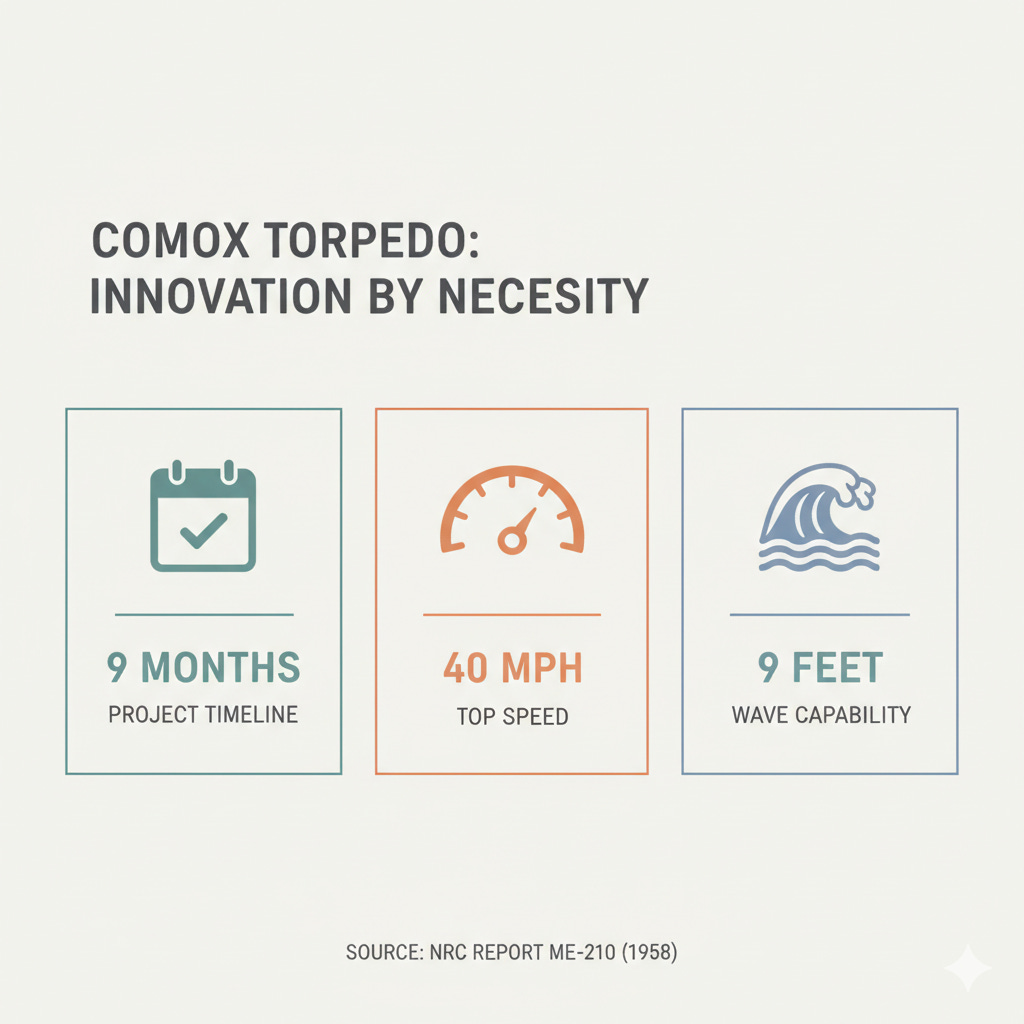
Carry a 248-pound smoke generator at a speed of 35 to 40 m.p.h.
Be able to operate in a force 3 to 4 sea, meaning waves of 6 to 9 feet in height.
Run unmanned for two nautical miles on a preset course, make a turn, and resume its course to lay smoke.
The timeline was not years, but months. The entire development period, from concept to successful demonstration, ran from July 1943 to March 1944. This was not a research project intended to produce a paper. It was a development project intended to produce a working machine under extreme conditions. The mission’s clarity and urgency created the necessary conditions for a different mode of work to emerge.
Innovation as High-Speed Tinkering
The core of the Comox Torpedo story is not one of immaculate, pre-planned design. It is a story of what you might call high-speed tinkering. The team, a collaboration between the NRC, the military, and hydrofoil pioneer F. W. Baldwin, built things, tested them in the real world, watched them fail, and immediately rebuilt them to be better. The report is a chronicle of pragmatic, hands-on problem solving.
Consider the hull. The original plywood bottom had a “most disconcerting tendency to crush...inward” when hitting rough seas. Worse, a vacuum effect would then suck the plywood away from its screws on the next wave. The team considered making the hydrofoil struts longer to lift the hull higher but rejected it due to an “unacceptable” weight penalty. Instead, they chose a more direct solution. They fastened wooden strips to the original bottom, added another sheet of plywood, added another set of strips running the other way, and put a final sheet of plywood on top. Then, the report notes, the entire assembly was “sewn” together with bolts. They solved the problem by building a stronger bottom, right there, right then.
This pattern repeats throughout the project:
The Engine: A standard 4-cylinder Jeep engine was not powerful enough. So, the NRC made a special manifold to add a second carburettor, boosting the horsepower from 59 to 68.
The Propeller: The best available propeller was not a perfect match, causing the engine to overspeed to 6400 r.p.m. The report dryly notes, “no case of engine failure was reported” despite running the engines far beyond their intended limits for up to 20 hours per craft.
The Foil Finish: To see if manufacturing time could be reduced, the team built two sets of hydrofoils. One was carefully finished with sharp edges and smooth welds. The other was left rough, with thick edges and unfinished welds. The speed difference was a mere 1.6 m.p.h. The conclusion was pragmatic: for production, the rough foils were “quite acceptable.”
Launching: How do you launch a hydrofoil from a larger ship in a heavy sea? The team built a davit system and simply dropped the craft, with a pilot and a full-throttle engine, 5 feet into the water from the side of a moving Landing Craft Infantry.
This is the essence of high-speed tinkering. It is a process of relentless, iterative engagement with the physical world. The goal is not to produce the perfect plan, but to produce a working artifact. The report is filled with evidence of a team that was building, not just studying.
Failure as a Feature, Not a Bug
Here is the detail I find most revealing. The project had its share of failures. When the time came for a formal demonstration before representatives of the General Staff, the report states it was “outstanding in that everything possible went wrong and the demonstration could be considered as a most complete failure.” Fuses for the automated systems got damp and failed. Rudder control cords changed tension with moisture, sending the craft off course.
In a modern context, a failure of this magnitude would trigger inquiries, reports, and likely the project’s cancellation. In November 1944, the response was different. The team was “given a period of 4 days grace.” They fixed the fusing, revised the rudder settings, and ran the demonstration again. This time, the craft “successfully demonstrated” and “met fully the General Staff specification requirements.”
This episode reveals a fundamentally different relationship with failure. Failure was not an indictment of the project’s viability. It was simply a source of data about what needed to be fixed next. Ultimately, the project was abandoned not because the Comox Torpedo failed, but because an even better technology, smoke rockets, had been developed to solve the same problem. This is the sign of a healthy innovation ecosystem, one where the goal is to solve the mission, not to protect the project.
The Blueprint in the Archives
The Comox Torpedo is more than a historical curiosity. It is a detailed blueprint of a different model of public innovation. One driven by a clear and urgent mission. One that prioritizes hands-on tinkering over theoretical planning. And one that treats failure as an inevitable and useful part of the process. The contrast with today’s risk-averse, process-heavy approach is impossible to ignore. The team in 1943 did not have better technology or smarter people. They had a better system, one forced upon them by necessity. We don’t need to invent a new way to innovate, we just need to remember our own.
In Other News...
Beyond this deep dive, you can find more analysis and commentary on the On Hansard site.


Sources:
Kuhring, M. S. (1958). The Comox Torpedo - A Canadian Contribution Towards Hydrofoil Development (Report No. ME-210). National Research Council of Canada, Division of Mechanical Engineering.