


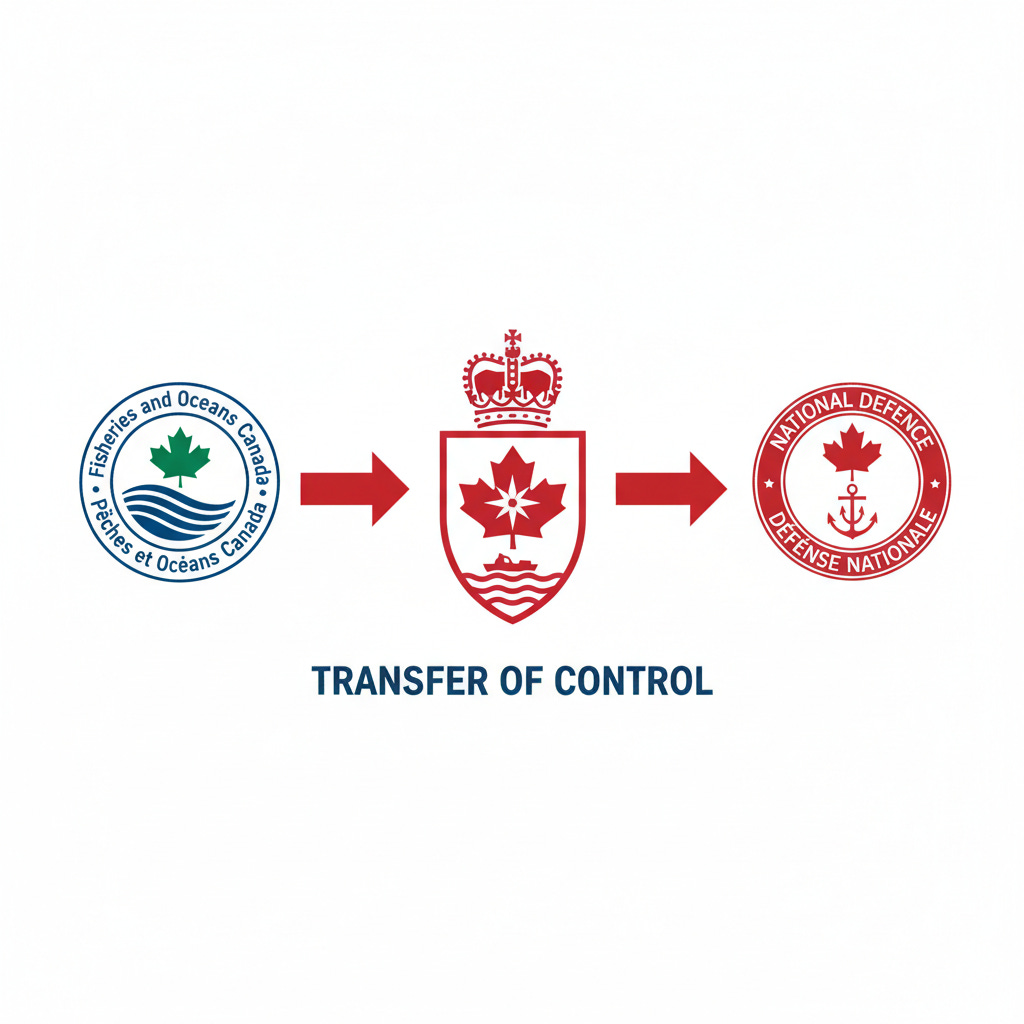
If you are an engaged observer of Canadian governance, you learn to look for important signals in unusual places. You do not always find them in the theatre of Question Period or in bold headlines. Sometimes, the most consequential changes appear without fanfare, buried deep within the routine administrative publications of the state. The September 24, 2025, issue of the Canada Gazette, Part II, is a perfect example. To a casual observer, it is 35 pages of dry regulatory updates. But on page 3997, a short, 11-line document titled SI/2025-96 quietly executes one of the most significant restructurings of Canada’s maritime responsibilities in a generation.
This order, issued on the recommendation of the Prime Minister, transfers the entire Canadian Coast Guard from the Department of Fisheries and Oceans to the Department of National Defence. It was not the subject of a bill debated in the House of Commons. It was not reviewed in detail by a parliamentary committee. It was enacted through a powerful and often misunderstood executive tool. The feeling of civic frustration that arises from such a discovery is understandable. It feels opaque, a decision of immense public importance made behind closed doors. This feeling is not a misunderstanding of the process. It is a direct perception of a fundamental tension in our system of government between executive authority and parliamentary oversight.
The Instrument of Change
The problem for anyone trying to follow this issue is that the change was both sudden and silent. The mechanism used was an Order in Council, a formal decision made by the Governor General on the advice of the Prime Minister and Cabinet. Here’s the detail I find most revealing. The legal authority for this move comes not from new legislation, but from a pre-existing statute: the Public Service Rearrangement and Transfer of Duties Act. This Act gives the executive branch broad power to reorganize departments. The order itself is brutally efficient in its language.
...transfers from the Department of Fisheries and Oceans to the Department of National Defence the control and supervision of those portions of the federal public administration in the Department of Fisheries and Oceans known as the Canadian Coast Guard and the Canadian Coast Guard Support Services Group.
This single sentence accomplishes a monumental task. It reassigns a civilian agency with a vast portfolio, including search and rescue, environmental response, icebreaking, and marine navigation services, placing it under the command structure of Canada’s military. The action is perfectly legal. The Act grants the executive the discretion to make such changes. But the process itself ensures that the rationale, the debate, and the consideration of alternatives happen outside of the public’s view. We are presented with a finished decision, published in the official record, leaving us to ask why this was done and what it means for the future.
Governance by Decree
This points to a critical question about how our government operates. How can such a fundamental shift in policy occur without public debate? The answer lies in what we can call Governance by Decree. This is not to suggest an authoritarian action, but to provide a memorable label for a legitimate process where the executive uses authorities previously granted by Parliament to make significant changes without returning to Parliament for a specific mandate. Parliament creates the vessel, the Public Service Rearrangement and Transfer of Duties Act, and the government then uses that vessel to steer the ship of state as it sees fit.
The core of the issue is the profound cultural and operational realignment this transfer implies. The Coast Guard has always maintained a distinct civilian and service-oriented identity. Its red and white vessels are symbols of safety and aid. The Department of National Defence, rightly, has a different mandate centered on national security and armed defence. Placing a civilian service under a military department raises unavoidable questions. Will the Coast Guard’s mission change? Will its priorities shift from environmental response and scientific support to sovereignty patrols and security operations? Will its personnel be militarized? The Order in Council, by its nature, provides no answers. It is a declaration, not an argument. This lack of a public rationale is the source of the injustice pipeline. It denies citizens the opportunity to hear, debate, and challenge the reasoning behind a major policy shift affecting the country’s maritime identity.
More Than a Transfer, A Shift in Principle
The transfer of the Canadian Coast Guard is far more than an administrative shuffle documented in an obscure government publication. It is a powerful case study in the use of executive authority in the Canadian system of governance. The legality of the move is not in doubt, but the method bypasses the public discourse that a change of this magnitude ought to receive. The frustration you may feel is not a sign that the system is broken, but a sign that it is working as designed, with a significant amount of power concentrated in the executive. The agency you gain from this analysis is the ability to recognize the mechanism at play. You can now see an Order in Council not as a piece of administrative trivia, but as the final step in a process of decision-making that happens largely out of sight.
A government’s structure is a statement of its priorities, and some statements are made without ever being spoken aloud in the House of Commons.
In Other News…


Source:
Her Majesty the Queen in Right of Canada. (2025, September 24). Order Transferring from the Department of Fisheries and Oceans to the Department of National Defence the Control and Supervision of the Canadian Coast Guard and the Canadian Coast Guard Support Services Group. Canada Gazette, Part II, 159(20), 3997.