


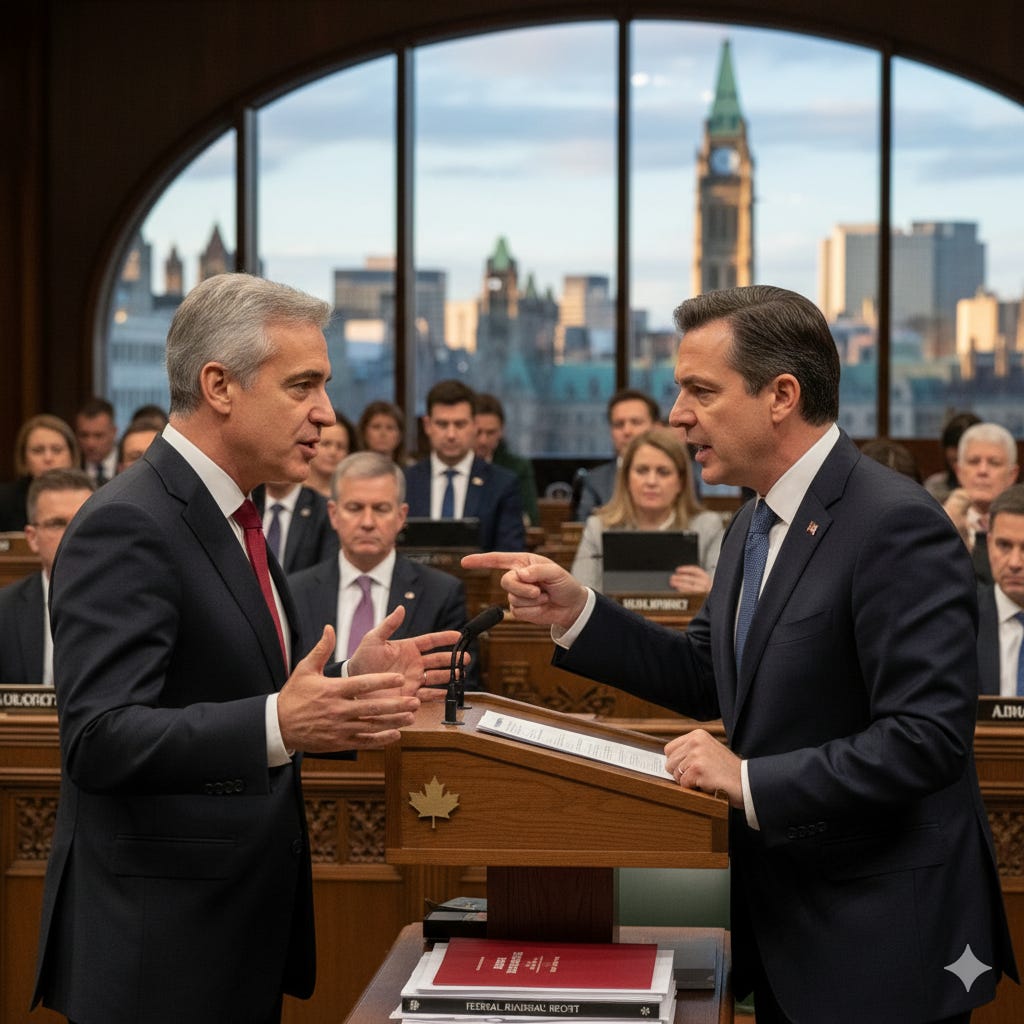
A charged session in the House of Commons on Wednesday saw the upcoming federal budget become the central battleground for Canada’s political leaders. The debate, framed by Conservative accusations of fiscal mismanagement and Liberal promises of historic investment, exposed the deep divides over how to address national affordability and economic security. While the economy took centre stage, critical failures in government services and ongoing trade disputes causing layoffs in the auto and forestry sectors added significant weight to the Opposition’s attacks, painting a picture of a government under pressure on multiple fronts.
The Budget Battleground
The primary conflict of the day was the direct exchange between Prime Minister Mark Carney and Opposition Leader Pierre Poilievre over the government’s tenth budget. The debate crystallized two opposing economic narratives.
Mr. Poilievre, speaking for the Conservatives, argued that a decade of Liberal policy has created a “haunted house of debt and a nightmare on main street.” He pointed to “monster deficits,” rising prices, and “vampire taxes draining paycheques.” The core of his argument is that government spending is the direct cause of the affordability crisis. He cited that food price inflation is now double the Bank of Canada’s target and that two million Canadians use food banks monthly. The Conservative demand is simple: an “affordable budget” that cuts wasteful spending and ends “hidden taxes” to make life affordable.
In response, Prime Minister Carney defended his government’s record and outlined a forward-looking vision. He promised the November 4 budget would be both “affordable and bold.” What does this mean in practice? He committed to getting operational spending under control and balancing spending over the next three years. Simultaneously, he promised “the biggest investment in this country in generations,” including the largest capital spend and most ambitious trade diversification in Canada’s history. When challenged on inflation, the Prime Minister stated that for the 21st consecutive month, Canada’s inflation rate remains within the Bank of Canada’s target range.
This exchange reveals the fundamental tension shaping federal politics: the Opposition’s call for immediate fiscal restraint versus the government’s strategy of using targeted investment to drive long-term growth.
Trade Disputes and Job Losses
The abstract debate over fiscal policy was grounded by concrete examples of economic pain felt by Canadian workers. Members from the Bloc Québécois and the NDP highlighted the real-world consequences of unresolved trade disputes with the United States, placing direct pressure on the Prime Minister.
The most immediate crisis discussed was in the automotive sector. Yves-François Blanchet of the BQ raised the recent layoff of 300 workers at the Paccar truck manufacturing plant in Sainte-Thérèse-De Blainville, which he directly linked to a 25% tariff imposed by the White House. This came, he noted, six months after the Prime Minister promised to settle trade negotiations “with a snap of his fingers.”
Similarly, Gord Johns of the NDP pointed to the forestry sector, where the “government’s failure to secure a fair softwood lumber agreement” has left workers behind. He stated that 50,000 jobs in British Columbia alone are at risk, and a promised $1.2 billion in support to counter U.S. tariffs has not yet materialized for the sector.
The Prime Minister acknowledged the “disappointing” situation at Paccar and other auto plants but maintained that Canada already has “the best agreement with the United States” and continues to negotiate. These events, however, provide potent ammunition for the opposition, allowing them to connect the government’s international policy directly to job losses at home.
Scathing Reports on Government Services
Adding to the government’s challenges were revelations from two separate Auditor General reports that provided the Opposition with clear evidence of administrative failure.
The first, and most damaging, was a report on the Canada Revenue Agency (CRA). Conservative MP Kelly Block described it as “scathing,” noting that complaints against the CRA’s contact centres have risen 145% in three years. More alarmingly, the report found that callers who do get through receive incorrect information 83% of the time, and the phone system is nearly four times over-budget, costing taxpayers over $190 million.
The second report focused on the national child care program. Conservative MP Laila Goodridge stated that despite billions in spending, the shortage of available child care has actually worsened over the last five years. The report found the government is behind on its promise to create 250,000 new spaces and lacks key data on how many spaces are unused. While the government defended the program by highlighting that the average cost for families is down to about $16 a day, the Auditor General’s findings fuel a narrative of costly, ineffective program delivery.
The Data Brief
Economic Showdown: The upcoming November 4 budget is the key political focus. The Conservatives are demanding spending cuts and tax reductions to address affordability, while the Liberals promise controlled operational spending alongside historic capital investments.
Trade Woes: Unresolved trade disputes with the U.S. are resulting in real job losses, with 300 auto workers laid off at a Quebec plant and 50,000 B.C. forestry jobs at risk due to tariffs.
Service Failures: An Auditor General’s report revealed major issues at the Canada Revenue Agency, including a 145% increase in complaints and a call system that provides incorrect information 83% of the time.
Child Care Scrutiny: Another Auditor General report found the government is falling behind on its child care space creation targets despite billions in spending, though the government maintains it has successfully lowered costs for families.
Source Documents
House of Commons. (2025, October 22). House of Commons Debates (Hansard), 45th Parliament, 1st Session, Vol. 152, No. 041.