


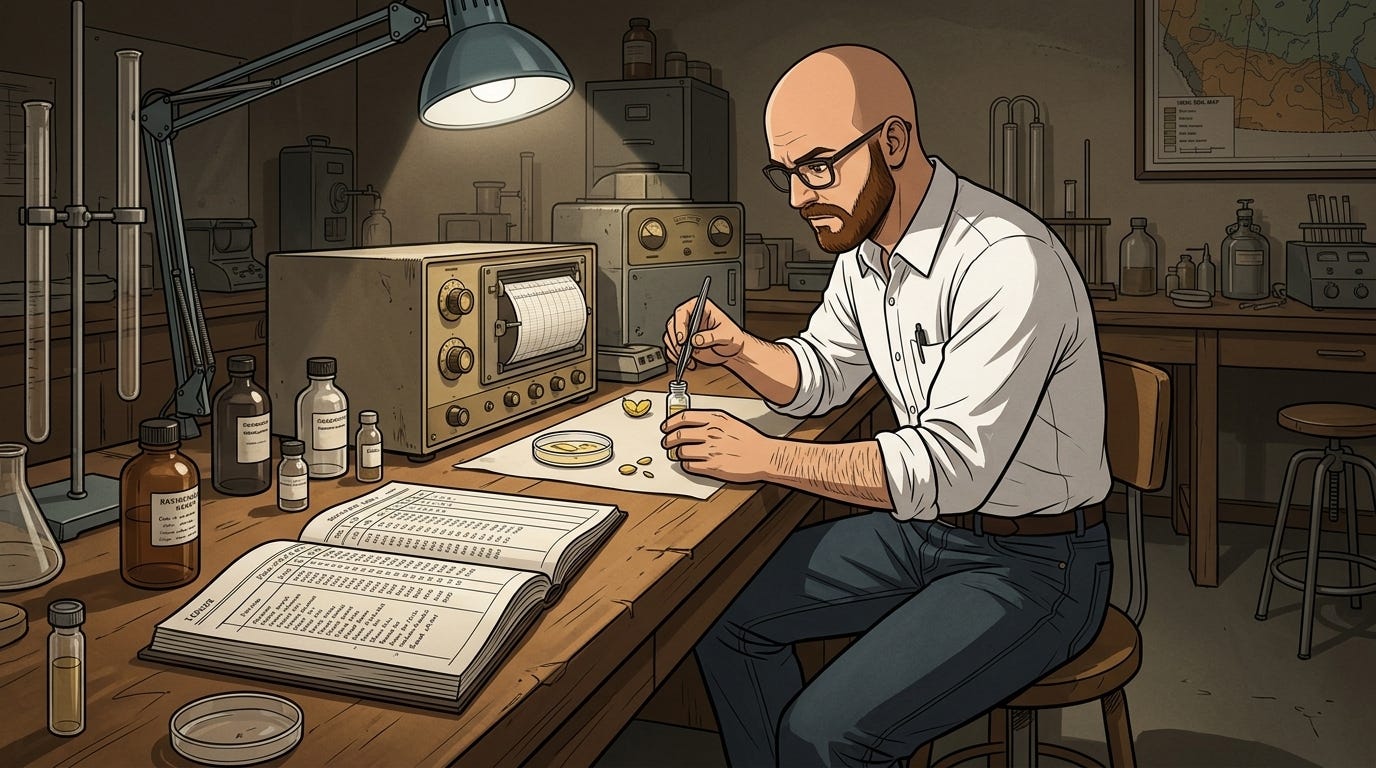
In 1963, Keith Downey’s team found a rapeseed plant of Polish origin with something nobody else had located. One seed contained no erucic acid.
They could not simply grind it up to confirm the result. That would destroy the seed. So a researcher cut it with an eye surgeon’s scalpel, removed enough material for analysis and kept the embryo intact. The remaining half went into carefully controlled greenhouse conditions.
It germinated.
The plant was frail. Some doubted it would live. A normal plant might have produced 2,000 seeds. This one produced five.
Five were enough.
Those seeds became the basis of a breeding program that produced Span, registered in 1971 as the first low-erucic variety of Brassica campestris. According to a 1992 history published by the National Research Council’s Plant Biotechnology Institute, Downey knew of no other source with the same low-erucic trait. The world’s stock descended from that half-seed, found, tested and grown in Saskatoon.
It was one breakthrough in a longer public research effort. Canola did not begin with a new name or a marketing campaign. It began with scientists learning how to read the chemistry of a seed without killing the plant inside it.
Before Canola, Both Products Had a Problem
The rapeseed available to Canadian farmers in the early years produced oil with high levels of erucic acid. Its leftover meal contained glucosinolates that limited its value in animal feed.
Burton Craig, one of the chemists at the National Research Council’s Prairie Regional Laboratory in Saskatoon, later reduced the problem to a blunt line: “The only trouble with the crop was that the oil was no good, and the meal was no good.”
The crop still had practical appeal. It grew on the Prairies and offered farmers an alternative to wheat. During the Second World War, its oil had been used as an industrial lubricant. Turning it into an accepted food crop required a different kind of work.
At first, analyzing rapeseed oil was slow and hungry for material. Scientists needed large quantities of oil and several days to separate and measure its fatty acids. Plant breeders could not screen thousands of seeds that way. They needed a fast method that used very little material.
In 1957, the Prairie Regional Laboratory bought its first gas-liquid chromatograph. The machine promised speed, but its standard materials could not provide the separation Craig needed. The laboratory ordered a polyester from the manufacturer. Delivery could take weeks or months, so Craig went to the library, found a small book of commercial recipes and began making his own.
He synthesized about 50 polyesters in one week. One worked. The manufacturer later adopted it and sold it as “Craig’s Polyester.”
The instrument changed the scale of the work. Fifty analyses could be completed in the time formerly needed for one. Within a few years, Craig’s group had reduced the required sample from pounds of oil to the oil inside one seed.
That made plant breeding measurable.
The Scalpel Changed Canola Breeding
The next step depended on a discovery by Downey and graduate student Bryan Harvey. They found that a seed’s erucic acid content was governed largely by the genetic constitution of the developing embryo, not the maternal plant.
That distinction mattered. Under the old process, a breeder who identified a promising seed had to plant related seeds saved from the same parent and hope they shared the trait. Testing half a seed and growing the other half would remove a generation of uncertainty.
There was an anatomical problem. Inside the seed coat sat a miniature plant, with a root, a growing tip and two folded seed leaves. Harvey had to cut away enough tissue for the chemical analysis without damaging the parts required for growth.
He used an eye surgeon’s scalpel. The half-seeds produced odd seedlings, sometimes with only one initial leaf or pieces of both, but they survived and grew into productive plants.
Downey then used the method to search several thousand B. campestris seeds collected from around the world. Most offered little. The species generally had less erucic acid than B. napus, but the samples did not show the variation needed for selection.
Then came the Polish seed, the weak greenhouse plant and its five descendants.
The discovery solved only the oil side of the problem. Low erucic acid did not remove the glucosinolates from the meal. The crop that would eventually be called canola still needed a second research stream.
A Polish Variety Supplied the Other Half
By the mid-1950s, researchers had connected glucosinolate concentrations in rapeseed meal with thyroid disorders in test animals. Processing experiments showed that heat, moisture and the enzyme myrosinase could change how those compounds behaved, but feed manufacturers could not know whether every batch had been processed correctly. Glucosinolates could also be broken down by myrosinase from other material mixed into feed.
The researchers concluded that processing alone would not settle the issue. Plant breeders would have to remove the glucosinolates.
That meant another search.
Clare Youngs, Les Wetter and a technician spent two years developing a rapid method that could measure glucosinolates in small samples. In 1967, they handed it to the breeders. Downey began testing every sample available to him, including material from Poland.
Among those samples was Bronowski. It produced such a low reading that the researchers first suspected their analytical method had failed. They ran longer, more laborious tests. The result held.
Bronowski was otherwise an unimpressive variety. The NRC history says it was virtually unknown in Poland and that records of its development had been destroyed during the Second World War. Its useful trait survived in a batch of seed.
The Saskatoon group sent some to Baldur Stefansson at the University of Manitoba. Stefansson and Downey ran separate but cooperative breeding programs, combining Bronowski’s low-glucosinolate trait with the zero-erucic characteristics already developed. In field trials beginning in 1972, Stefansson’s line yielded slightly better.
In 1974, Agriculture Canada registered his variety, Tower, as the world’s first zero-erucic, low-glucosinolate B. napus rapeseed. The Co-operative Vegetable Oil plant in Altona, Manitoba, specialized in Tower and sold its meal at a premium for animal feed.
The other major Prairie species took longer. Plant breeder Sid Pawlowski crossed B. napus, B. campestris and B. juncea to move the low-glucosinolate characteristic into a plant suited to a wider portion of the Prairies. Downey later made the final selections. The resulting variety, Candle, was licensed in 1977 as the first low-glucosinolate, zero-erucic B. campestris.
Both Tower and Candle carried Bronowski in their ancestry. The low-erucic trait in Candle led back to the plant that had produced five seeds.
Rapeseed Received a New Name
By the late 1970s, Canadian farmers were growing a product materially different from the rapeseed still common elsewhere. Its oil was low in erucic acid. Its meal was low in glucosinolates. The industry called it “double-low” rapeseed, but the old name still carried the crop’s history and did nothing to distinguish the new varieties in the market.
The Rapeseed Council formed a committee to find another name. Its preferred choice was “canola.” The word had no prior meaning, although it sounded like an abbreviation for Canadian oil. The Western Canadian Oilseed Crushers Association trademarked it in 1978. The Rapeseed Council became the Canola Council of Canada two years later.
The new name arrived after the hard part.
Craig’s homemade polyester made the chemistry visible. Harvey’s scalpel kept the selected embryo alive. Downey’s team coaxed five seeds from a failing plant. Bronowski supplied a second rare trait after its own history had largely disappeared. Stefansson, Pawlowski and other public researchers carried those traits into varieties farmers could grow and processors could sell.
The NRC history called canola a billion-dollar success story. Its most consequential moment fit inside a seed coat.
Hansard Files spends weeks in the archives so you don’t have to. If stories like this matter to you, The archive stays free. A paid membership funds the hours to work the next file.
Source Documents
National Research Council Canada, Plant Biotechnology Institute. (1992). From rapeseed to canola: The billion dollar success story. https://doi.org/10.4224/40004068
One helluva story Mike, I knew Canola had been created here in Canada, but I had not heard the complete story. It makes me sad that one of of PMMCs budget cuts was in the agricultural research area. Agriculture is too important an area to Canada to cut back on.
OMG! What a thoroughly magical story.