


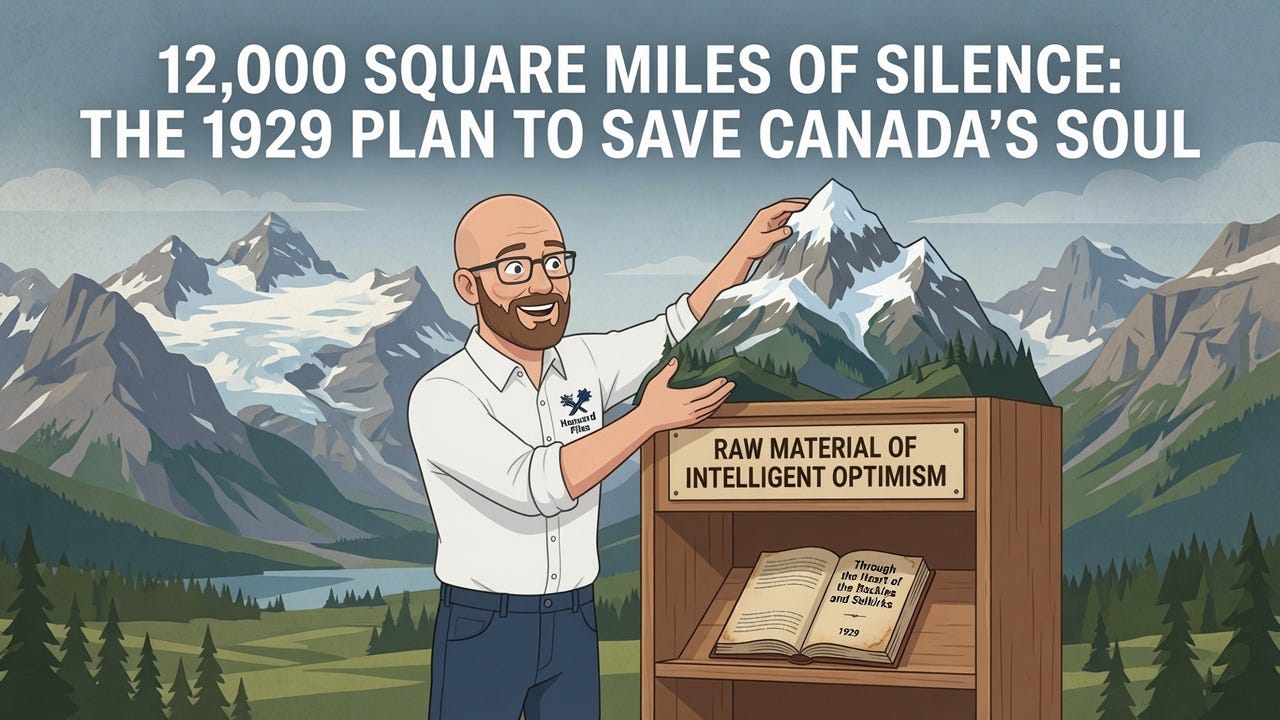
The legend began with a hunter named Ah-ka-noosta. According to the stories told by the western tribes, he was a man who refused to age. Every spring, he would vanish into the high peaks, leaving his people behind in the valleys. Every autumn, he would return, his vigor restored and his youth renewed, as if he had drunk from a secret fountain. His brothers, skeptical and jealous, whispered that he had found a magic lake—an Elixir of Life hidden in the clouds. But Ah-ka-noosta insisted there was no magic. He had simply slept in the “tepee of the pine forest” and lived like the eagle.
In 1929, the Canadian government took this legend and turned it into federal policy.
At the height of the Roaring Twenties, just months before the stock market would crash and shatter the world’s optimism, Canada’s Department of the Interior released a remarkable document titled Through the Heart of the Rockies and Selkirks. It was technically a guidebook, a bureaucratic inventory of the Canadian Rockies National Parks. But in reality, it was a manifesto for a new kind of national identity—one rooted not in industry or conquest, but in the “healing, ennobling and inspiring agencies of Nature”.
This was the blueprint for the “Playground of the World,” a designated sanctuary of 12,000 square miles where the modern citizen could wash away the grime of the city and, like Ah-ka-noosta, steal a little more time from death.
The Great Landscape Architect
To understand the stakes of this 1929 vision, one must understand how the government viewed the land itself. The guide does not describe the mountains merely as geology; it describes them as a deliberate construction by the “Great Landscape Architect of the Universe,” designed specifically for the “perpetual pleasure and refreshment of man”.
The writer, M.B. Williams, portrays the Rockies as a violently birthed masterpiece. He invites the reader to imagine a time “ages before the mollusc, the jellyfish and the crustacean were squirming in the Cambrian slime,” when the entire region was the floor of a prehistoric sea. The narrative paints a picture of “Titanic forces” buckling the earth’s crust, lifting millions of years of sedimentary rock miles into the air.
But the guide draws a sharp, poetic distinction between the two great ranges that dominate the park system: the Rockies and the Selkirks.
The Rockies are the youthful upstarts—”gaunt, grey peaks” that rise sharp and bare, their limestone spires carved by “frost-tooth” and “ice-claw”. They are the dramatic, castellated fortresses that stunned the early explorers.
The Selkirks, located within the “moat” of the Columbia River’s great bend, are the ancient elders. Ages older than the Rockies, their sharp edges have been rubbed smooth by the “thumb of Time”. Because they catch the heavy Pacific moisture, they are not grey and barren but wrapped in “darkly beautifully green” forests and capped with massive icefields. In the Selkirks, the government noted, one could count over a hundred glaciers from a single peak, a “frozen desolation” that fed the lush valleys below.
The Iron Horse and the Motor Age
By 1929, the “closed door” to these mountains had been unlocked for forty years, pried open by the steel rails of the Canadian Pacific Railway. The guide speaks of this era with a sense of conquered luxury. The wealthy tourist could now travel through the “heart of the wilderness in luxurious Pullmans,” finding accommodation “comparable to the best on the continent”.
The railway had civilized the wild. In Banff, visitors could swim in the sulphur springs where the water ran at a steaming 94 degrees—the very spot that had birthed the national park system. They could gaze at the “Pearl of the Canadian Rockies,” Lake Louise, or marvel at the engineering miracle of the Connaught Tunnel.
But the 1929 text reveals a pivotal shift in how humans interacted with this landscape: the arrival of the automobile.
The “Transmontane motor road” and the Banff-Windermere highway were cutting new scars through the old forests. The guide celebrates this engineering as “one of the most successful pieces of engineering on the continent,” a road where “fear is practically eliminated”. For the first time, the autonomy of the driver was challenging the schedule of the train conductor. A motorist could leave the railway station at Lake Louise and drive nine miles into the “Valley of the Ten Peaks,” a place previously reserved for the hardy alpinist.
This accessibility created a new paradox. The parks were designed to be a “virgin land,” yet the government was aggressively paving the way for the masses. The justification was democratic: these mountains belonged to the people. There were to be “no monopolies and no concessions”. The land was not for sale; it was leased, controlled, and guarded by the “eternal vigilance” of the park administration against the twin threats of fire and commercial exploitation.
A Warehouse of Optimism
The true purpose of the park system, however, wasn’t tourism—it was psychological survival. J.B. Harkin, the Commissioner of National Parks, wrote a foreword to the guide that reads less like a bureaucratic memo and more like a prescription for a nervous breakdown.
Harkin argued that the parks existed so that the citizen could “stock his brain and his mind as he would a warehouse with the raw material of intelligent optimism”. In an era of industrial smoke and crowded tenements, the mountains offered “poise and restfulness.” They were a place to absorb the “buoyancy” of wild animals and the “sublimity” of the peaks.
This was the “Sanatorium of Nature”. The guide details the specific cures available in each district. In the Yoho Valley, one could witness the Takakkaw Falls, where water tangled “the rainbow in their folds”. In the Nakimu Caves of the Cougar Valley, visitors could descend into the “Witches’ Ballroom” or the “Judgment Hall,” where walls gleamed with “crystalline lime encrustations” resembling cauliflower.
For the weary, the government prescribed the “silence of the high places.” They promised that a few weeks in the saddle, traveling with a pack train of Mexican-bred ponies tied with the famous “diamond hitch,” would do more than any medicine. It was a call to return to the “Ancient Mother,” to strip away the anxieties of the city and rediscover the simple, brutal reality of survival.
The Democracy of the Wild
What stands out most in this 1929 document is the optimism of its scope. The government had set aside an area “two-thirds as great as Switzerland and almost as large as Belgium” not for resource extraction, but for “public use and enjoyment”.
They cataloged every inhabitant of this sanctuary. They described the Hoary Marmot, whose whistle pierced the mountain silence, earning him the name “Whistler”. They listed the Bighorn sheep, the “chamois of the American west,” so tame they would pose for photographs beside the new motor cars. They even noted the “Fool-hen,” a grouse so trusting it refused to fly from danger.
This was a curated Eden, protected by the Royal Canadian Mounted Police and a system of licenses. It was a vision of Canada that was wild yet orderly, dangerous yet accessible. It was a place where the “smoke of Indian campfires” had been replaced by the steam of the locomotive and the exhaust of the touring car, yet the spirit of Ah-ka-noosta remained.
“Babylon and Assyria, Greece and Rome have risen and passed,” the guide muses, “but they remain”. The mountains were the only permanent things in a world that was speeding up. And for the price of a train ticket or a tank of gas, the government offered its citizens a share in that immortality.
Our team digs through archives, government reports, and forgotten guidebooks to bring you the stories that shaped our world. If you believe in independent journalism that values depth over clicks, please subscribe to support our work.
Source Documents
Williams, M. B. (1929). Through the Heart of the Rockies and Selkirks. Department of the Interior, National Parks of Canada.
Canada outside of the cities remains a wonderful place. But oh, those cities... ugh!!
Thank you for an interesting read! As a youngster I accompanied my Ontario parents in taking the train to Lake Louise and staring with awe at the Valley of the Ten Peaks.
Thanks to J.B. Harkin!