


On September 17, 2025, a small group of academics and experts testified before the House of Commons Standing Committee on Science and Research. Their mandate was to discuss a seemingly straightforward topic: the impact of federal funding criteria on research excellence. What emerged was not a simple diagnosis, but a portrait of a system at war with itself. The testimony exposed a fundamental conflict over the very definition of “excellence,” revealing a system pulled in opposing directions by competing ideological, commercial, and political priorities.
For most Canadians, public funding for university research operates on a simple social contract. You, the taxpayer, provide billions of dollars, and in return, the nation’s sharpest minds produce two things of value: objective knowledge that benefits society and innovations that strengthen the economy. Yet, the evidence presented to Parliament suggests this contract is under strain. The system is struggling to define its own purpose, leading to frustration, inefficiency, and a growing disconnect between what the public expects and what the academic world delivers. This points to a critical question: what are we actually paying for?
The Ideological Cross-Currents
The most pronounced tension identified in the committee meeting revolves around the role of Equity, Diversity, and Inclusion (EDI) criteria in grant applications. Witnesses presented two irreconcilable views on its impact.
Dr. Yuan Yi Zhu, an assistant professor at Leiden University, argued that the current approach subordinates the pursuit of truth to ideological conformity. He described a system where funding is allocated based on criteria that have nothing to do with scientific merit. He offered a stark example from 2024, when the University of British Columbia advertised a Canada Research Chair on oral cancer with a significant restriction:
Candidates had to be people with disabilities, Indigenous people, racialized people, women or people from sexual minority identity groups. I find it frankly absurd to say that a white man can’t conduct research on oral cancer. It’s irrelevant.
Dr. Zhu contends this approach shrinks the talent pool and encourages a kind of intellectual dishonesty, where young scholars learn that success depends on “chasing grant money using buzzwords, regardless of what they actually believe is intellectually valuable and important.” Professor David Freeman of Simon Fraser University echoed this concern, highlighting a lack of political viewpoint diversity and the rise of what he termed “activist research,” where the goal shifts from truth-seeking to advocacy.
In direct opposition, Dr. Malinda Smith from the University of Calgary presented EDI not as a threat to excellence, but as a prerequisite for it. Citing a large body of empirical research, she argued that diverse teams consistently outperform homogeneous ones. She claims that traditional measures of merit, like publication counts, can be biased, favouring those with existing reputational advantages. Dr. Smith stated:
The evidence shows the opposite. EDI in research funding strengthen universities by expanding talent, mitigating biases, dismantling barriers and reducing systemic inequities. These conditions make academic freedom meaningful. Without EDIA, freedom and excellence remain privileges for a few.
Here we see the system’s first major contradiction. One set of experts views EDI as a distortion of merit, while another sees it as the only way to achieve true merit. Both cannot be right. This conflict is not a minor disagreement, it is a fundamental schism in how the purpose of research is understood.
The Excellence Assembly Line Paradox
The problem with Canada’s research funding apparatus can be understood through an analogy: The Excellence Assembly Line Paradox. Imagine a factory designed in the 1990s to produce a single, well-defined product: peer-reviewed basic research. Now, imagine that over the years, new managers have tried to retool that same assembly line to also produce commercial-ready products, advance specific social justice goals, and support a national linguistic agenda, all at the same time and using the same core machinery.
The result is a chaotic and inefficient process. The different goals require different tools, different evaluation metrics, and different timelines. Instead of a smooth operation, you get bottlenecks, waste, and a final product that often satisfies none of its intended purposes. The testimony before the committee reveals this paradox in action.
Ken Doyle, Executive Director of Tech-Access Canada, provided a clear illustration of the commercialization breakdown. He noted that Canada is world-class at turning money into research papers but struggles to turn that research into economic impact. He presented a damning statistic:
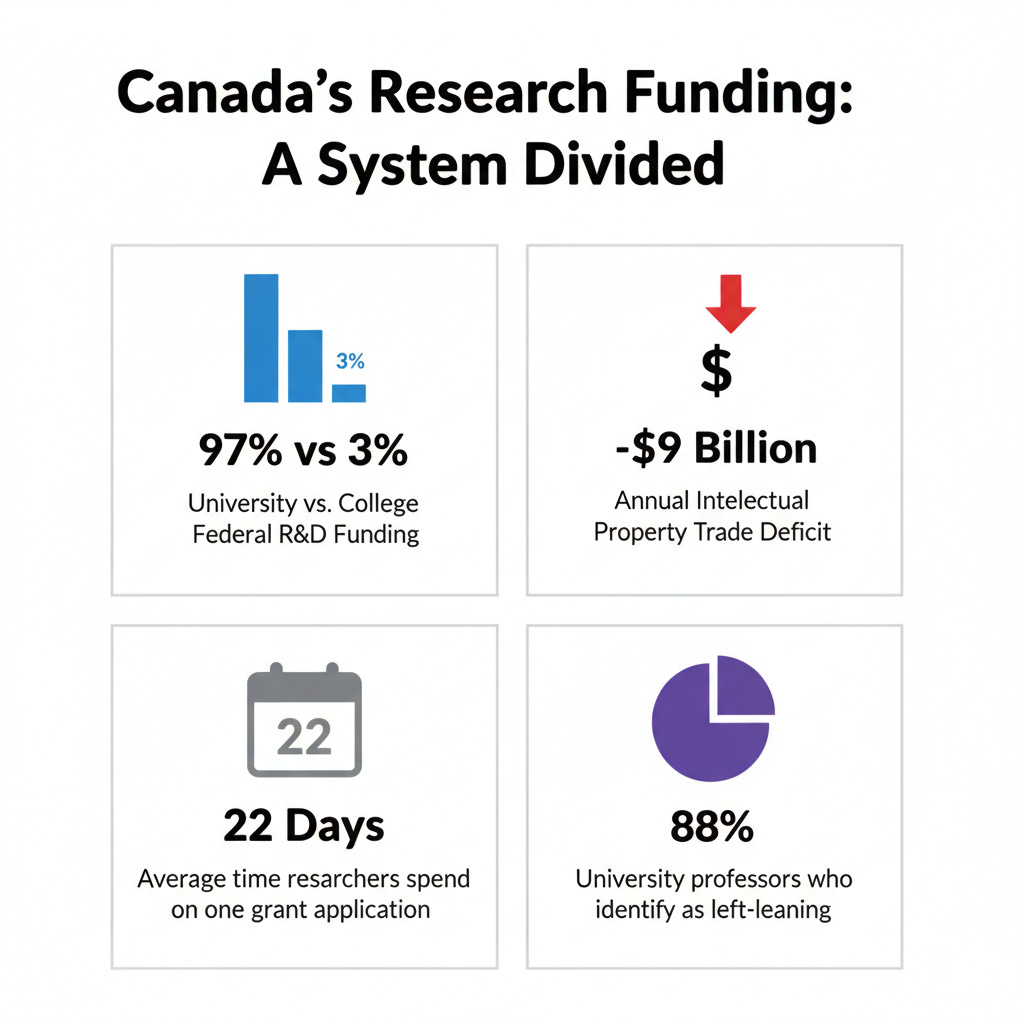
Last year, Canadians paid $17 billion to license foreign IP, yet we took in only $8 billion from licensing made-in-Canada IP outside our borders. That’s a nine-billion-dollar trade deficit.
Doyle argues that the system, which is overwhelmingly geared toward basic university research, is not built for applied R&D that moves at the “speed of business.” Colleges, which specialize in this area, receive only 3% of federal R&D funding compared to the 97% that goes to universities. The assembly line designed for academic papers is simply not equipped to produce commercial prototypes.
At the same time, Martin Normand of the ACUFC described how the system fails French-language researchers. He spoke of linguistic biases in evaluation committees and a systemic pressure that devalues research conducted in French or focused on Francophone communities. The assembly line, built predominantly for an Anglophone context, treats French-language inputs as an anomaly, hindering their progress and undermining the official policy of bilingualism.
The Loss of a Shared Goal
The core issue is not that one of these goals, be it social equity, commercialization, or basic research, is unworthy. The issue is that the federal funding system lacks a coherent strategy to pursue them. By layering competing and often contradictory objectives onto a single framework, it fails to do any of them particularly well. It creates a bureaucratic nightmare where, as one study found, researchers spend an average of 22 days writing a single grant application. It fosters deep cynicism among academics who feel forced to self-censor or adopt fashionable language to get funded. Most importantly, it breaks the social contract with the public by failing to deliver clear, consistent value in exchange for billions in public investment.
A System in Need of a Purpose
The testimony before Parliament was not just a debate about policy details. It was a plea to address a foundational crisis of purpose. The government, on behalf of Canadians, must decide what it wants from its multi-billion dollar investment in research. Pretending a single system can serve mutually exclusive definitions of excellence is a recipe for continued waste and disillusionment. A system that tries to be everything to everyone ultimately risks becoming nothing of value to anyone.
In Other News...
Beyond this deep dive, you can find more analysis and commentary on the On Hansard site.


Sources:
House of Commons. (2025, September 17). Standing Committee on Science and Research: Evidence (Meeting No. 3, 45th Parliament, 1st Session).