


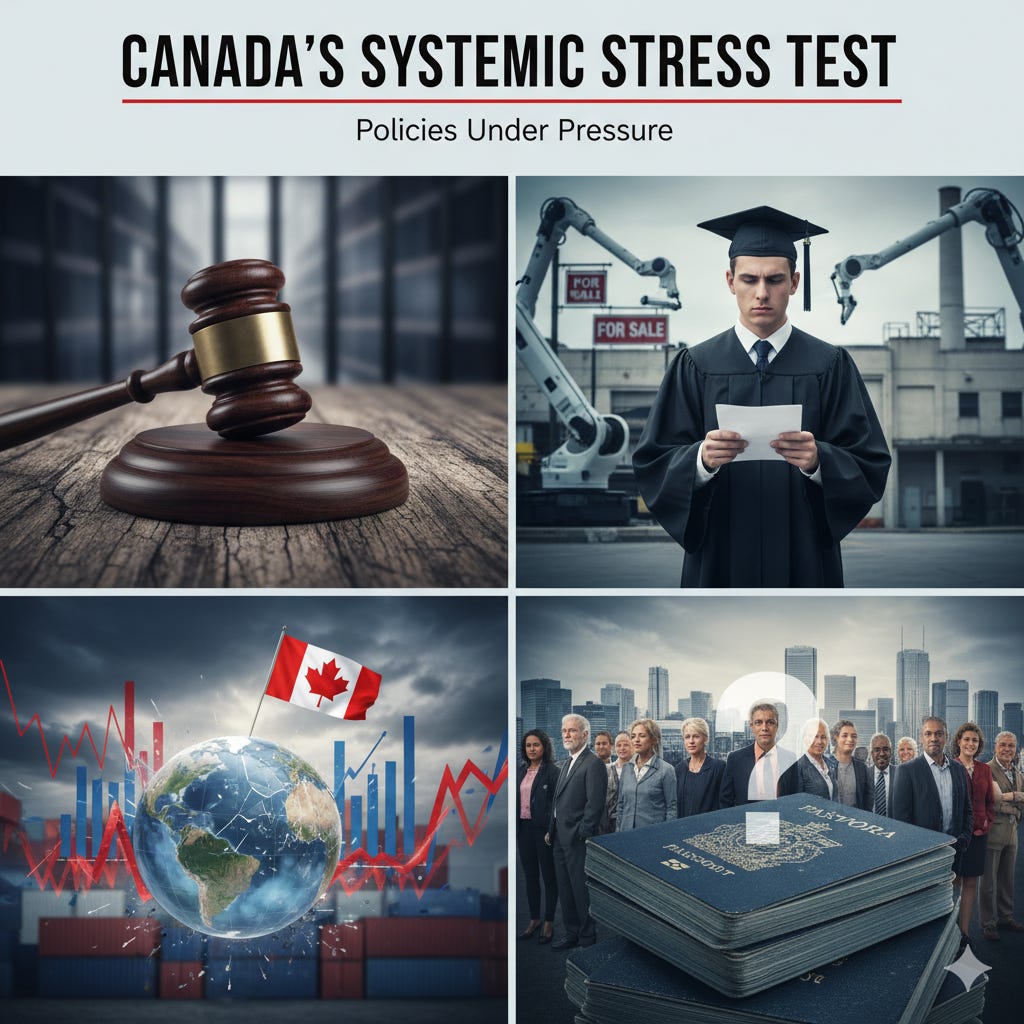
Across Parliament Hill, a series of critical conversations are unfolding in standing committees, and they paint a picture of a country at a crossroads. While the topics range from bail reform to youth employment and international trade, a single, powerful theme connects them all: Canada’s core policy pillars are under immense strain. Long-held assumptions about our justice system, economic competitiveness, and global standing are being tested, forcing a national reckoning. For educated Canadians trying to make sense of it all, these hearings offer a rare, unfiltered look at the systemic challenges shaping our future.
The Justice System’s Balancing Act
At the Standing Committee on Justice and Human Rights, you can see the fundamental tension in Canada’s approach to crime and punishment laid bare. The debate centers on bail reform and the handling of repeat violent offenders, pitting calls for public safety against the principles of rehabilitation and charter rights.
On one side, testimony from law enforcement described a system failing its communities. The argument was made that legislation like Bill C-75, which codified the “principle of restraint,” has gone too far, creating a “catch-and-release” reality where chronic offenders cycle through the system without meaningful intervention. From one perspective on the front lines, the problem isn’t an outlier; the “vast majority of individuals committing criminal offences today are doing so in a pretrial, recidivist way.”
On the other side, legal and civil liberties associations push back, arguing that this narrative isn’t supported by evidence. They point to Toronto police data showing significant drops in shootings, homicides, and other crimes, which is “incongruent with the rhetoric that our communities are becoming more violent and less safe.” They and others highlight that nearly 80% of people in provincial jails are legally innocent, awaiting bail or trial—a number that has more than doubled in 40 years. They contend that jails are “criminogenic,” meaning they actually increase the likelihood of reoffending, and that the real solutions lie in addressing the root causes of crime through social services, mental health programs, and rehabilitation. This places the committee at the heart of a difficult question: how do you balance the public’s right to safety with an accused person’s right to be presumed innocent?
An Economy of Diminishing Returns
Meanwhile, the Standing Committee on Human Resources is examining a youth unemployment crisis that feels like a symptom of a much deeper economic malaise. The testimony here reveals a troubling disconnect between Canada’s business environment and the prospects for its next generation.
Testimony from business owners delivered a stark diagnosis: Canada’s economy is structurally unwell. One witness stated that a “decade of declining productivity has left businesses less competitive, reducing our ability and willingness to create jobs.” They point to a cocktail of high taxation, excessive red tape, and risk-averse banks that punish entrepreneurship and discourage investment, especially when compared to the United States and Mexico. Another witness emphasized a critical “massive lack of tradespeople,” noting that while many youths go to university, they often emerge without the practical skills needed in sectors like manufacturing.
This skills mismatch is a major theme. An expert from a Quebec youth employment network warned of a “perfect storm of youth unemployment.” Young people, who make up 13% of Quebec’s workforce, represent 24% of workers vulnerable to automation from artificial intelligence. They are entering a job market where entry-level positions are disappearing, leaving them to wonder, “In a working world transformed by AI, where will I fit in?”. This economic pressure, combined with food insecurity and a general sense of disillusionment, creates a generation that feels left behind, questioning if they will do as well as their parents.
Navigating a Fractured World Order
The challenges aren’t just domestic. At the Standing Committee on International Trade, it’s clear that the global landscape Canada has relied on for decades is crumbling. The core message from officials and experts is that the rules-based international trading system, particularly with the United States, is broken.
A veteran trade counsel put it bluntly: “the WTO as an institution is dysfunctional, and the rules-based system that we used to know no longer exists.” This sentiment was echoed in ministerial testimony, which stated that the old model of “deepened integration grounded in assumed stability, can no longer be counted on.” The U.S. has shifted to a “more transactional and controlled approach,” using destabilizing tariffs of up to 50% on key Canadian sectors like steel, aluminum, and autos.
This new reality forces Canada into a difficult defensive posture ahead of the mandatory 2026 review of the Canada-United States-Mexico Agreement (CUSMA). The government is launching a new trade diversification strategy to find markets beyond the U.S., highlighting new agreements with Ecuador and Indonesia and renewed talks with Mercosur. However, some experts warn this is easier said than done. As Canada considers its own “Buy Canadian” policies to counter U.S. protectionism, it risks violating agreements with other allies and undermining its own diversification goals. For key sectors like agri-food, which exports over half its production, the rise of non-tariff barriers—regulatory hurdles that block market access—remains a persistent and costly challenge.
Redefining ‘Canadian’
Finally, the Standing Committee on Citizenship and Immigration is debating Bill C-3, a piece of legislation that gets to the very heart of what it means to be a Canadian citizen. The bill is a response to a 2023 court ruling that found the “first-generation limit”—a rule preventing Canadians born abroad from passing citizenship to their own children born abroad—to be unconstitutional.
The debate highlights a deep philosophical divide. On one side, advocates argue this is a fundamental issue of rights, not immigration. The argument is that the bill simply rights a historic wrong and makes the Citizenship Act compliant with the Charter, restoring citizenship to those who were unconstitutionally denied it.
On the other side, critics frame it as a “chain migration bill” that is being pushed through at a time when housing, health care, and job markets are already under severe pressure. They raise concerns about the bill’s core mechanism: the “substantial connection” test, which requires a parent to have spent a cumulative 1,095 days (three years) in Canada to pass on citizenship. Unlike the requirement for permanent residents, this period is not time-limited, and critics question how it can be verified, especially before 2019 when Canada did not reliably track exit data. They also point to the absence of language, citizenship test, or security screening requirements in the bill. With official estimates suggesting the bill will affect around 115,000 people, the debate forces a difficult conversation about the value of Canadian citizenship and the capacity of our systems to manage it.
The Data Brief
Justice in the Balance: The debate over bail reform highlights a deep societal conflict between ensuring public safety from repeat offenders and upholding Charter rights, with nearly 80% of provincial inmates legally innocent and awaiting trial.
Economic Stagnation: Business leaders warn that a decade of declining productivity, driven by high taxes and red tape, is stifling job creation, while youth face a “perfect storm” of skills mismatches and jobs lost to automation.
The End of Predictable Trade: The U.S. shift away from rules-based trade has destabilized key Canadian industries with heavy tariffs, forcing a difficult and risky pivot toward trade diversification ahead of the 2026 CUSMA review.
Citizenship Under Scrutiny: Bill C-3, designed to fix an unconstitutional law, has ignited a debate over the definition and value of Canadian citizenship, pitting the restoration of rights against concerns over systemic strain and the lack of traditional screening requirements.
Source Documents
Standing Committee on Citizenship and Immigration. (2025, October 2). Evidence (Meeting No. 5). House of Commons, Ottawa, Canada.
Standing Committee on Human Resources, Skills and Social Development and the Status of Persons with Disabilities. (2025, October 2). Evidence (Meeting No. 6). House of Commons, Ottawa, Canada.
Standing Committee on International Trade. (2025, September 22). Evidence (Meeting No. 3). House of Commons, Ottawa, Canada.
Standing Committee on International Trade. (2025, October 2). Evidence (Meeting No. 4). House of Commons, Ottawa, Canada.
Standing Committee on Justice and Human Rights. (2025, October 2). Evidence (Meeting No. 5). House of Commons, Ottawa, Canada.