


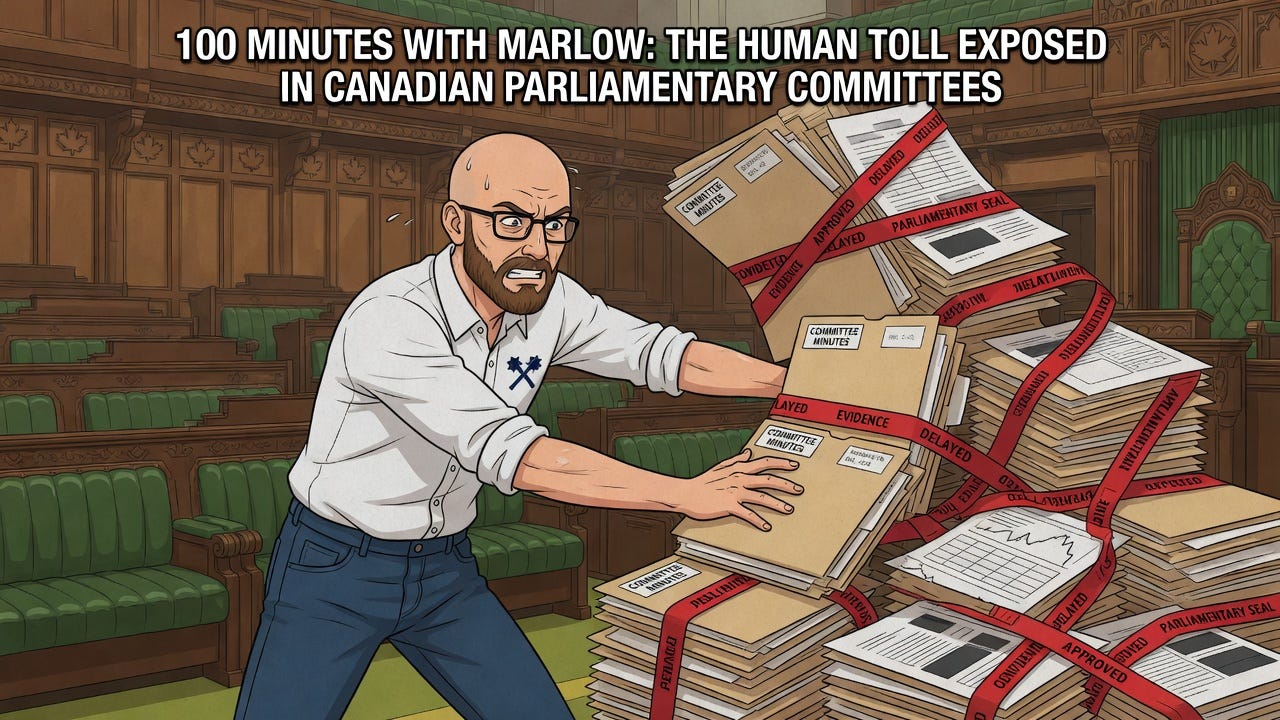
In August 2013, Briana Koop stood in front of a clearance rack flipping through summer clothing. Her toddler wanted to go to the park, but Koop had nothing to wear. She had given birth just days earlier, but the maternity clothes with their large elastic waistbands were a brutal reminder of a devastating truth. Her son, Marlow, had died of kidney failure within hours of his birth. Instead of being given the time to heal, grieving parents like Koop are routinely forced to navigate a maze of government paperwork, fighting to maintain their benefits while dealing with the impossible weight of their loss.
This was the stark reality presented during recent Canadian parliamentary committees. Across multiple rooms on Parliament Hill, the transcripts reveal a jarring disconnect between the machinery of government and the citizens it is meant to serve. From the Standing Committee on Human Resources, Skills and Social Development and the Status of Persons with Disabilities to Indigenous and Northern Affairs, the records expose systems that are failing the most vulnerable, leaving Canadians to fight for their dignity, their safety, and their very existence.
The Weaponization of Bureaucracy
At the Standing Committee on Justice and Human Rights, Kendra Cooke detailed a harrowing reality of coercive control. Three years post-separation, she continues to endure surveillance, financial abuse, and threats of violence. Yet, because there was no physical violence in the home, the child welfare and justice systems were woefully ill-equipped to respond. Cooke described a system designed to operate in silos, where her ex-partner was able to exploit loopholes, weaponizing the justice system against her. When she applied for a peace bond, she was told the current legislation did not support her request due to a lack of physical harm.
The theme of systemic betrayal echoed loudly in other chambers. Rachel Samulack, a public servant who lost her son Aaron 100 minutes after he was born, recounted her return to work. She was ineligible for parental leave because her baby had died. To make matters worse, an error at the hospital meant she automatically received the Canada Child Benefit, resulting in a sudden $14,000 debt to the government. Rectifying it required numerous calls to the Canada Revenue Agency, forcing her to repeatedly recount the trauma of losing her child to untrained service agents.
Existence or Extinction
The stakes were equally existential at the Standing Committee on Indigenous and Northern Affairs, where witnesses pleaded for the passage of Bill S-2. For Sharon McIvor, an activist who has been fighting for equality since 1968, the legislation represents a battle against erasure. She reminded the committee of the 1920 goal of the deputy superintendent of Indian Affairs to eliminate the “Indian problem” entirely. For her, the ongoing second-generation cut-off rule means that while her son eventually gained status after a 30-year legal battle, her great-grandchildren will not.
Zoë Craig-Sparrow, vice-president of Justice for Girls, put a human face to this bureaucratic extinction. She is the first in her family to graduate from university, breaking cycles of intergenerational trauma. But because her fiancé does not have status, their future children will be legally erased. They will not inherit her home on the reserve, nor will they possess the Aboriginal right to fish. “When we say this will lead to the legal extinction of first nations in three to four generations, we mean an extinction of entire nations and peoples,” Craig-Sparrow testified. She urged the committee to stop using the promise of future consultations as a weapon to delay equality.
The Front Lines Under Pressure
While families fight for basic recognition, the workers tasked with protecting the public are sounding the alarm over dangerous funding cuts. At the Standing Committee on Government Operations and Estimates, representatives for federal correctional officers detailed the terrifying reality inside Canada’s prisons
Frédérick Lebeau, a correctional officer, described environments where drones drop drugs and ceramic blades into prison yards on a daily basis. Instead of increasing support, the government is cutting millions from the Correctional Service of Canada budget, reducing mobile patrols and eliminating dedicated drug detector dog handlers. Officers are assaulted daily, and the technological fixes promised by management are quickly circumvented by organized crime. As Lebeau stated bluntly, nobody decides as a child to become a correctional officer because it is a tough job.
A similar sense of systemic collapse permeated the Standing Committee on Canadian Heritage, where independent journalists warned that the media landscape is actively being tilted against them. Sheila Gunn Reid of the Independent Press Gallery described a two-tiered system where independent reporters are routinely blocked from political events or treated as security threats, while legacy media outlets survive on government subsidies. The result is a broken information ecosystem where trust is eroding and local news deserts are expanding.
The True Cost of Delay
Whether it is a mother begging for the time to grieve her infant, a First Nations woman fighting for her future children’s legal existence, or a correctional officer bracing for the next drone drop, the transcripts tell a unified story. The policies debated in the abstract within Ottawa’s committee rooms have visceral, immediate impacts on the ground. When governments prioritize procedural compliance or budget reviews over the realities of human suffering, the resulting damage is profound. The records show that Canadians are not asking for miracles. They are simply asking for systems that recognize their humanity, protect their safety, and acknowledge their fundamental rights. The question that remains is whether the institutions tasked with serving them are finally ready to listen.
Hansard Files spends weeks in the archives so you don’t have to. If stories like this matter to you, subscribe to keep this work independent.
Source Documents
[House of Commons]. (2026, March 23). [Standing Committee on Human Resources, Skills and Social Development and the Status of Persons with Disabilities, Evidence No. 29]
[House of Commons]. (2026, April 15). [Standing Committee on Justice and Human Rights, Evidence No. 24]
[House of Commons]. (2026, April 16). [Standing Committee on Indigenous and Northern Affairs, Evidence No. 29]
[House of Commons]. (2026, April 14). [Standing Committee on Government Operations and Estimates, Evidence No. 34]
[House of Commons]. (2026, April 14). [Standing Committee on Canadian Heritage, Evidence No. 30]
Your notes about Briana Kopp brought to mind how upset my wife was when she was forced to take maternity leave while our son was HSC's neo-natal ICU for 10 weeks after his birth which meant that at the time, she only had 7(?) weeks with him when he came home. I cannot imagine having to go through what she and the others in today's had to go through.
This is a disturbing article Hansard where you provide real human personal stories of grief and bureaucratic frustration slamming into the seemingly impregnable and impersonal wall of government agencies.
Surely, somewhere else in the world, other governments have much better means of serving its citizens that Canada can explore and execute here and in timely fashion, not the Centre Block definition of “timeliness “.