


On a quiet Monday in June 2022, a worker at the Whiteshell Laboratories in Manitoba reached toward a pump to perform routine maintenance. They believed the equipment was safe. They were wrong. The resulting electrical shock to both hands did not kill the worker, but the jolt reverberated far beyond the immediate injury. It triggered a safety stand-down that peeled back the layers of operational complacency to reveal a disturbing truth about Canadian Nuclear Laboratories safety oversight.
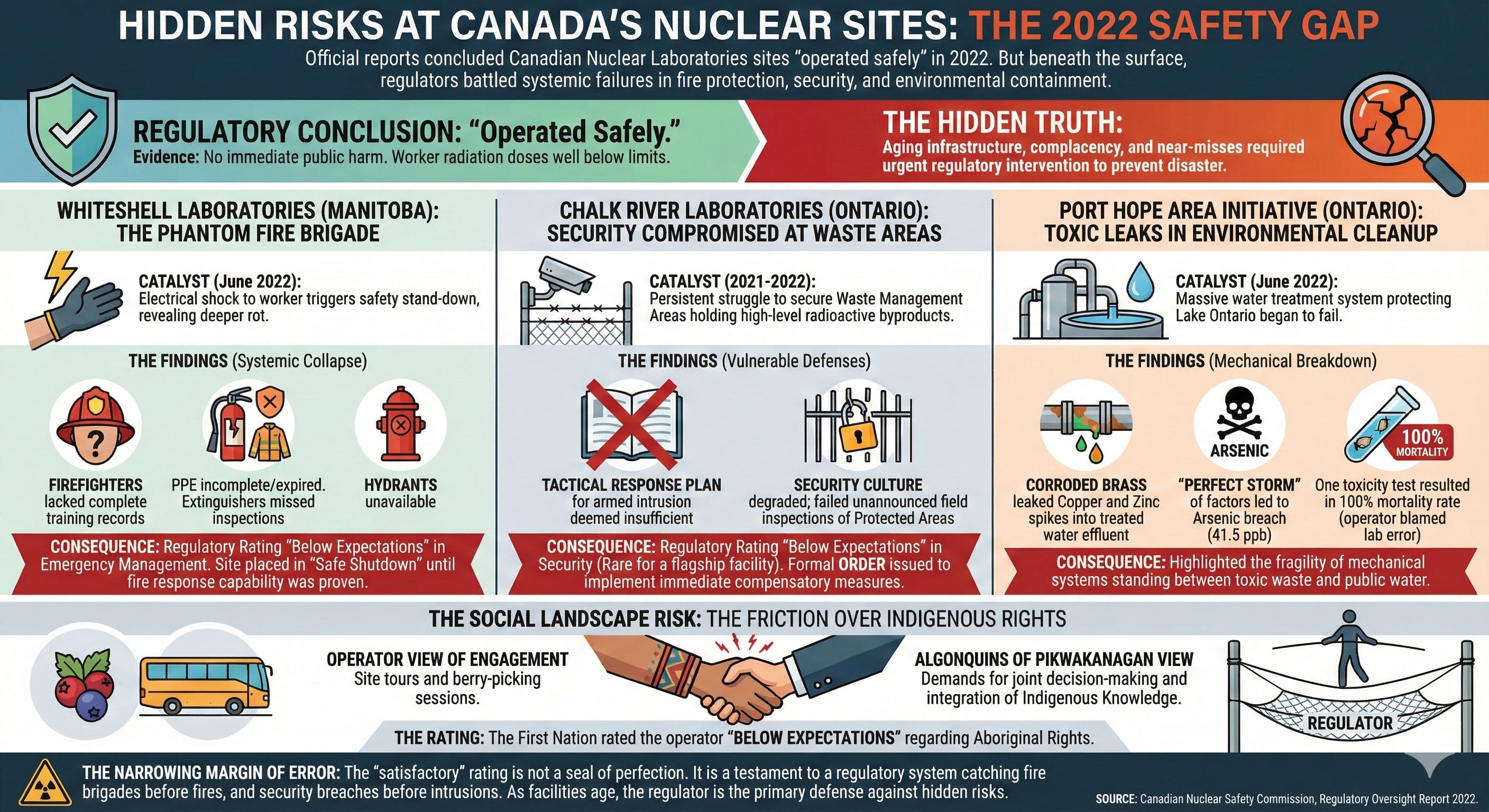
When the dust settled and the inspectors finished their work, they found that the facility—a decommissioning site holding radioactive waste—lacked a functioning fire protection program. Firefighters lacked complete training records. Equipment was expired. Hydrants were unavailable. If a blaze had ignited during that period, the ability of the site to respond was fundamentally compromised.
This incident serves as the centerpiece of a sprawling regulatory review that exposes the friction between Canada’s nuclear ambitions and the gritty reality of managing aging, hazardous infrastructure. While the overall verdict for 2022 suggests the industry is operating safely, the details hidden within the thousands of pages of compliance data tell a more complex story of near-misses, security gaps, and the constant battle to keep hazardous substances contained.
The Spark That Revealed a Void
Whiteshell Laboratories is a ghost of the nuclear age. Once a bustling research hub near Pinawa, Manitoba, it is now undergoing a long, slow death by decommissioning. The plan is to dismantle the site, but until that is finished, it remains a repository for low, intermediate, and high-level radioactive waste. Safety here is not theoretical. It is the only thing standing between stored radiation and the surrounding environment.
The electrical shock in June 2022 was the catalyst for a much deeper investigation. Following the near-miss, the operator voluntarily initiated a safety stand-down. Work stopped. During this pause, a self-assessment of the fire protection program uncovered a systemic collapse in readiness.
The findings were stark. The facility could not demonstrate that its fire response staff were adequately trained to fight a fire. Personal protective equipment for the firefighters was either incomplete or expired. When inspectors looked at the physical infrastructure, they found fire extinguishers that had missed their annual inspections and fire hydrants that were simply unavailable. Even the emergency lighting in the buildings had not been tested to standard.
For a nuclear site, fire is a catastrophic risk vector. It disperses radiation. It breaches containment. The realization that the site lacked a qualified minimum shift complement of firefighters forced the regulator to rate the facility as “below expectations” for emergency management. It was a failing grade on one of the most critical subjects.
Regulators from the Canadian Nuclear Safety Commission moved quickly. They issued a formal request for information and conducted a site visit in May 2023 to verify that the operator had placed fire hoses in areas where hydrants were dry and stocked the firehall with new gear. They found metal halide lighting that posed an ignition risk and ordered its removal. The site remained in a state of “safe shutdown” where only essential compliance and maintenance work could occur until the regulator was satisfied that a fire could actually be fought.
Guarding the Waste Management Areas
While Whiteshell struggled with fire protection, a different but equally concerning vulnerability emerged sixteen hundred kilometers to the east. Chalk River Laboratories in Ontario is the heart of Canada’s nuclear research. It is a massive complex operating under a single licence that covers reactors, radioisotope laboratories, and waste management areas.
Security at Chalk River is a matter of national importance. Yet throughout 2021 and bleeding into 2022, the site struggled to meet the bar. The regulator rated the security safety and control area as “below expectations,” a rare and serious designation for a flagship facility.
The trouble centered on the Waste Management Areas. These are the zones where the byproducts of decades of nuclear research are stored. The regulator found that the Tactical Response Plan—the playbook for how armed responders would neutralize an intrusion or attack—was insufficient. It did not meet regulatory requirements.
The regulator demanded a new plan. When the operator submitted one, it was rejected. The timelines were too loose, and the proposed measures were too weak. This stalemate resulted in a formal Order issued in October 2021, forcing the operator to implement immediate compensatory measures.
Throughout 2022, federal inspectors conducted unannounced field inspections to test these defenses. In September, they probed the Protected Areas at the waste sites and found further non-compliances. The specific details of these failures remain classified to prevent providing a roadmap to bad actors, but the regulatory reaction was public and severe. They demanded a programmatic review to understand why the security culture had degraded.
The operator was forced to create a Nuclear Performance Assurance Review Board and submit a detailed Security Program Oversight Plan. By the end of 2022, the site was still rated below expectations, trapped in a cycle of remediation and inspection as it tried to prove it could secure the nation’s nuclear legacy.
Toxic Waters and Corroded Brass
South of Chalk River, along the shores of Lake Ontario, the Port Hope Area Initiative represents a different kind of challenge. This is the largest environmental cleanup in Canadian history. The goal is to consolidate millions of cubic meters of historic low-level radioactive waste found in the soil of residential properties and the harbour.
The operation is industrial in scale, involving massive water treatment plants to ensure that the runoff from the cleanup does not poison the lake. But in June 2022, the systems designed to protect the environment began to fail.
Routine sampling at the Port Hope wastewater treatment plant revealed a spike in toxicity. The effluent—the treated water released back into nature—exceeded the weekly release limit for copper. It also breached the action levels for zinc.
The investigation traced the contamination not to the radioactive soil they were cleaning, but to the treatment plant itself. Brass components in the cooling loop of the evaporator were corroding, leaching heavy metals into the water they were supposed to be purifying. The operator had to scramble to reroute the cooling loops and isolate the corroded parts.
A week later, a second alarm sounded. This time, it was arsenic. The concentration in the effluent hit 41.5 parts per billion, breaching the action level. The cause was a “perfect storm” of mechanical and environmental factors: old reverse osmosis membrane filters, high water temperatures, low water levels, and a high concentration of arsenic in the primary collection ponds.
While these releases were diluted by the lake and deemed not to pose an immediate risk to human health, they highlighted the fragility of the mechanical systems standing between toxic waste and the public water supply. In another instance, a toxicity test on water fleas (Daphnia magna) resulted in a 100 percent mortality rate. The operator concluded this was a lab error, but for seven days, releases to the environment were halted until consecutive tests proved the water was safe.
Voices from the Unceded Territory
The technical data of radiation doses and copper concentrations often obscures the human landscape in which these facilities operate. All Canadian Nuclear Laboratories sites sit on the traditional or treaty territories of Indigenous peoples. The report reveals a growing tension between the corporate definition of “engagement” and the Indigenous definition of “rights.”
The Algonquins of Pikwakanagan First Nation provided a scathing assessment of the operations in their territory, which includes Chalk River. In a performance review submitted to the regulator, the First Nation stated that the operator was “operating below expectations” in most categories related to Aboriginal Rights.
Their critique was fundamental. They argued that they were not being treated as partners with a joint decision-making role. They pointed to a lack of meaningful integration of Indigenous Knowledge into site monitoring and management. They noted that despite the high-level talk of reconciliation, there were no concrete commitments to protect their rights at the Nuclear Power Demonstration Waste Facility.
The disconnect was palpable. The operator reported hosting site tours and berry-picking sessions, characterizing these as successful engagement. The Algonquins of Pikwakanagan described a need for “free, prior, and informed consent” and a rightful role as stewards of the environment that went beyond mere consultation. This friction underscores a significant risk for the industry: social licence is becoming as difficult to secure as a functioning fire protection system.
The Weight of the Report
Despite the untrained firefighters at Whiteshell, the security gaps at Chalk River, and the toxic leaks at Port Hope, the regulator’s final conclusion for 2022 was that these sites “operated safely.” This conclusion relies on a framework where safety is measured by the absence of catastrophe rather than the absence of risk.
The data supports this in the aggregate. The maximum radiation dose received by any worker was 5.48 millisieverts, well below the regulatory limit of 50. There were no releases that caused immediate harm to the public. The water, despite the arsenic and copper scares, remained safe to drink.
However, the narrative of 2022 is one of vigilance in the face of degradation. The systems designed to protect Canadians—fire suppression, security perimeters, water treatment—showed signs of strain. It was only through the intervention of inspectors and the issuance of orders that these gaps were identified and closed.
The “satisfactory” rating that concludes the report is not a seal of perfection. It is a testament to a regulatory system that managed to catch the fire brigade before the fire, and the security breach before the intrusion. As these facilities continue to age and decommission, the margin for error narrows, leaving the regulator as the only line of defense against the hidden risks inside Canada’s nuclear sites.
Source Documents
Canadian Nuclear Safety Commission. (2023, August 2). Regulatory Oversight Report for Canadian Nuclear Laboratories Sites: 2022 (CMD 23-M30).