


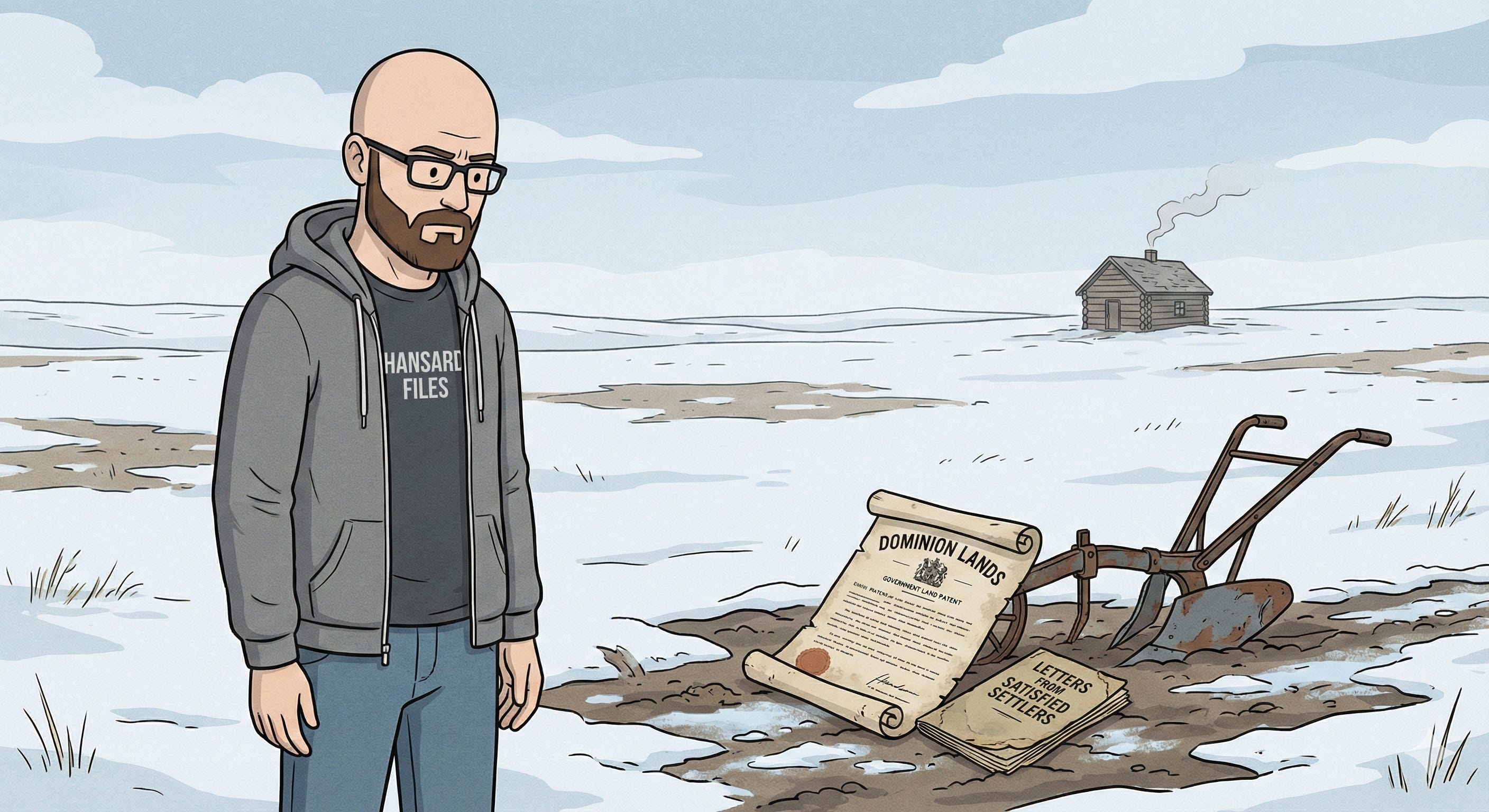
The paper trail of a nation often begins with a sales pitch, and few were as aggressive or as high-stakes as the campaign for Canadian homesteading in the early 20th century. In 1909, the Dominion of Canada was a vast, terrifyingly empty abstraction to the average British labourer—3.5 million square miles of silence, snow, and potential. To the government in Ottawa, however, this emptiness was a strategic liability. They needed bodies to hold the territory. They needed ploughmen to break the sod. And to get them, they printed pamphlets like Letters from Satisfied Settlers, a masterclass in bureaucratic seduction that promised the destitute of Edinburgh and Yorkshire a kingdom of their own, provided they could survive the winters and, perhaps more importantly, keep their mouths shut about how things were done “back home.”
This wasn’t just a brochure; it was a contract of expectations stamped with the authority of the Minister of the Interior. The document lays out a world where a man with twenty-five dollars in his pocket could become a landed aristocrat in six years. But reading through the testimonies of the men who took the bet reveals a grittier narrative—a saga of frozen wheat, sixty-mile treks for supplies, and the relentless, bone-crushing labor required to turn “Dominion Lands” into a home.
The Ministry of Great Expectations
The pamphlet opens with a mix of imperial pride and stern warnings. The Canadian Immigration Department in 1909 was not interested in tourists, dilettantes, or the urban poor looking for charity. The bold print on the second page makes the target brutally clear: “Farmers, Farm Labourers and Female Domestic Servants are the only people whom the Canadian Immigration Department advises to go to Canada”. Everyone else was told to stay away unless they had “money enough to support them for a time in case of disappointment”.
The government’s pitch was mathematically precise. Canada was not just a colony; it was a competitor to Europe itself, with an area “nearly equal to that of Europe” but a population a quarter less than Belgium. The emptiness was the asset. The Department of the Interior held the keys to millions of acres of agricultural land, “yet unoccupied and available for immediate settlement”. They offered it under a system of “responsible government” where life and property were as safe in the mining camps and forests as they were in the “best governed country of Continental Europe”.
But the real hook wasn’t the safety; it was the sovereignty. For a Scottish ploughman working a landlord’s field in Inverness, the concept of owning 160 acres was intoxicating. The pamphlet carefully curated “Answers from Satisfied Settlers” to prove it wasn’t a fantasy. These weren’t faceless statistics; they were men like Norman Morrison of Edinburgh, who arrived in December 1902. When Morrison stepped off the train at Shoal Lake, Manitoba, his total capital was $25.00. By 1909, he had fifty acres broken, ten head of cattle, five oxen, and a granary. He wasn’t rich, he admitted, but he was “comfortably off”. In the rigid class structure of Edwardian Britain, “comfortably off” with a deed in hand was a revolution.
The “Green” Britisher and the Culture of Silence
The transition from British subject to Canadian pioneer was violent, not just physically but culturally. The pamphlet is laced with a recurring, almost desperate piece of advice from the settlers to their countrymen: stop talking.
John R. Duncan, writing from New Westminster, British Columbia, warned new arrivals to “Be a Canadian from the very beginning”. His advice was blunt: “Don’t boast too much of ‘the Old Country,’ and be continually making comparisons”. The sentiment echoes through almost every letter. Joseph Bell, a settler in Bowden, Alberta, put it even more starkly: “A Britisher is green in Canada”.
The resentment towards the “arrogant Englishman” was evidently a tangible friction on the prairies. Seth Copeland of Innisfail, Alberta, advised newcomers “not to blow about the Old Country”. The message was clear: your experience in the manicured fields of Yorkshire or the rolling hills of the Lothians meant nothing against the brutal reality of breaking virgin prairie sod. The methods were different, the climate was lethal, and the social hierarchy was flattened. Eric Bird, writing from Gladstone, Manitoba, urged immigrants to “try and do as the Canadians do, and see things as they see them”.
Newcomers were urged to “hire out” to a successful farmer for at least a year before daring to take up their own land. This was the apprenticeship of the frontier. Robert Forrester, who settled in Hamar, Saskatchewan, arrived with no capital but the willingness to work. He and his brother spent two years working for others, absorbing the “ways of the country” before they bought their own team. By 1909, they owned 800 acres, eleven horses, and five cattle. The subtext of their success was patience. The graveyard of the west was filled with men who tried to impose British farming techniques on Saskatchewan soil.
The Economics of Survival
The financial data preserved in these letters offers a stark forensic accounting of the homesteading economy. The “free land” was only free if you could afford to survive on it. The initial 160 acres might have been a gift from the Crown, but the machinery required to work it was a heavy burden.
Take the case of Alex C. Thompson, who left Aberdeenshire in December 1901. His wage progression tells the story of a booming labor market. In 1902, he earned $200 with board. By 1904, it was $300. But Thompson didn’t just hoard cash; he leveraged it. He bought 160 acres in April 1905, paying $2,500. Three years later, that land was worth $3,500, and he had earned an additional $900 from his share of the crops. In six years, he had increased his net worth by $3,000—a fortune for a man who landed with $300.
But the margins were razor-thin, and the cost of entry for serious farming was high. Joseph Moore, from the Isle of Man, detailed the immense capital required to operate at scale. He paid $1,700 for nine horses—a staggering sum that suggests the high value placed on motive power in an era before tractors were common. His household effects, binders, wagons, and plows cost another $700. The “free” homestead was a capital-intensive industrial operation disguised as agrarian romance.
For those without thousands of dollars, the path was slower and harder. Henry William Sumpter of Ochre River, Manitoba, started by working in the city during the summer and on a farm for board during the winter. In 1907, he bought two oxen. By 1908, he homesteaded with three oxen, two cows, and a pig. His inventory for 1909 included “10 bags of flour,” a grim reminder that in the isolation of the bush, starvation was a logistical possibility, not just a financial one. Sumpter’s declaration that “100 golden sovereigns would not get me back to England” is a testament to the psychological value of independence, even when that independence consisted of a log cabin and ten bags of flour.
The Frost and the Isolation
The government pamphlet, for all its propaganda, could not entirely scrub the hardships from the record. The letters hint at the terrifying capriciousness of the Canadian climate. Leonard M. Hardy of Mannville, Alberta, admitted that his first crop in 1907 was “frozen”. His 770 bushels of wheat and 300 bushels of oats were “all more or less frozen,” forcing him to sell the wheat at a ruinous 50 cents per bushel. It was a disaster that could bankrupt a family in a single night. Yet, Hardy persisted. The next year, he harvested 1,200 bushels of wheat and sold them for 76 cents. The gamble had paid off, but the threat of the frost remained a constant, invisible gun to the head of every settler.
John G. Butterfield, settling in Tisdale, Saskatchewan, bragged about wintering his cattle outside with “no other feed than the straw stacks” and a wind shelter they “very seldom avail themselves of”. It was a boast of hardiness, but it revealed the brutal reality of livestock management on the frozen plains, where barns were a luxury and survival was a test of endurance.
Isolation was the other silent killer. John Shields, a settler in Nokomis, Saskatchewan, described his first year on a homestead “60 miles from a store”. For a year, he lived and worked in a void, three days’ travel from the nearest commercial outpost. By 1909, the railroad had arrived, bringing a town within three miles of his door, but those first twelve months represented a psychological ordeal that the pamphlet glosses over as “up-hill work”.
The distances involved were staggering. The pamphlet casually notes that Canada is 3,740 miles wide by rail. It describes a nation where the southern boundary is the latitude of Northern Spain and the northern boundary hits the latitude of Norway. For a British immigrant used to walking to the next village, the scale of Canada was an alien concept. John W. Waines advised young men to come in groups of two or three and take homesteads near one another, not just to share implements, but to share the burden of existence in a landscape that didn’t care if they lived or died.
The Empire’s Insurance Policy
What drove these men to endure the frost, the isolation, and the crushing labor? It wasn’t just money. It was the promise of a different kind of life. Henry Sumpter called his patent—the deed to his land—a “great insurance policy of at least $1,000” with no premiums attached. In England, the agricultural laborer was a cog in a machine owned by someone else, earning “2 1/2% per year”. In Canada, Sumpter wrote, “your farm is your stock... interest every week in milk, butter and eggs”.
This was the core of the 1909 sales pitch: the commodification of dignity. Donald McCoig, who had arrived in 1883 and spent twenty-five years on the land, wrote from Treherne, Manitoba, that he was now in a position to retire. “I could never have made the same success in Scotland,” he concluded. For the older men with families, the Canadian West was the only place on earth where one could “make an independence for himself”.
The document ends as a testament to a specific moment in imperial history, where the surplus population of the industrial center was siphoned off to secure the periphery. The “Satisfied Settlers” were the shock troops of this expansion, armed with ploughs and oxen, fighting a war against the climate and the wilderness. They were told to be quiet, to work hard, and to forget the Old Country. In exchange, they were given the one thing the Old Country could never offer them: a future that belonged to them alone.
As the pamphlet closes, the voices of the settlers fade, leaving only the statistical reality of a nation being built bushel by bushel. The “160-acre gamble” was the defining wager of a generation, and for men like Norman Morrison and Joseph Bell, the dice had landed on double sixes. They had traded the slums of Edinburgh and the tenant farms of Northumberland for the biting cold of the dominion, and in the process, they had ceased to be British subjects and become the first draft of a new nation.
Independent journalism relies on digging through the archives that others ignore. If you value deep-dive history that uncovers the forgotten blueprints of our world, please consider subscribing to support the Hansard Files.
Source Documents
Department of the Interior. (1909). Letters from Satisfied Settlers. Government of Canada.
The salt of the prairies
A very good article, Hansard! Your article is a testament to these western pioneers, the sacrifices turning eventually to rewards. And it is interesting that “Canadian-ness” was encouraged.