


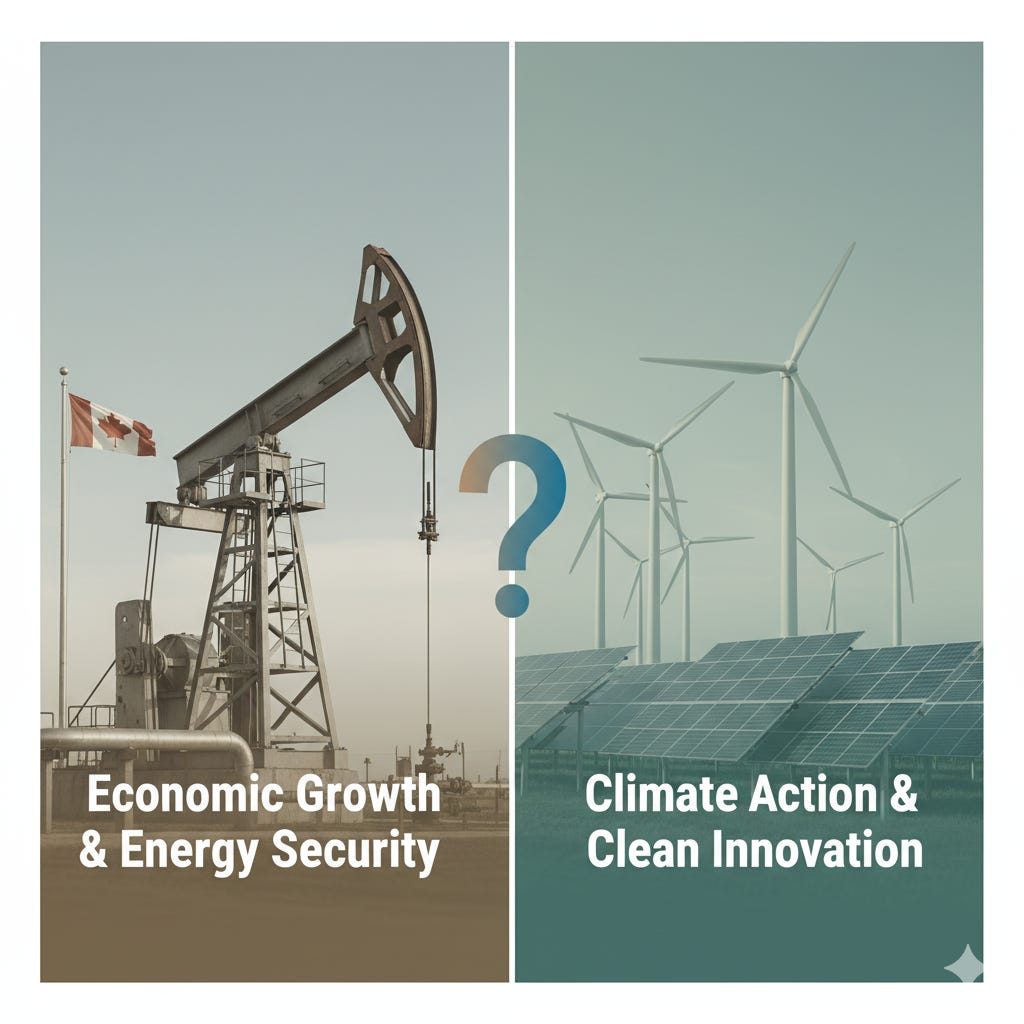
A major debate is unfolding about Canada's economic and environmental future. At the centre of the storm is a federal policy, the oil and gas emissions cap. The government frames it as a necessary step to fight climate change while modernizing the economy. Critics, however, call it a direct attack on the energy sector that will cost jobs and drive investment away.
Parliament is debating an opposition motion to repeal the policy, forcing a national conversation about two competing visions for the country. The discussion touches on everything from pipeline construction and international trade to job security and Canada's global climate commitments. Understanding this debate means understanding the fundamental questions about our national priorities.
This article breaks down the key arguments shaping this critical discussion, using the recent debate in the House of Commons as a guide.
Is It an Emissions Cap or a Production Cap?
The language used to describe the policy is at the heart of the conflict. The official opposition motion, introduced by Conservative MP Andrew Scheer, frames the issue unambiguously.
That the House call on the Prime Minister to immediately repeal the oil and gas emissions cap, which in effect is a production cap.
Opponents argue it is impossible to impose a hard limit on emissions from the oil and gas sector without forcing companies to produce less. For them, the policy is not about clean technology, but about intentionally shrinking a vital sector of the economy. They point out that no other major oil-producing nation has imposed a similar federal limit on its own industry.
The government, however, rejects this interpretation. Liberal MP Kody Blois stated the government’s position clearly.
When it comes to the emissions cap, the Liberals reject the premise that the cap is a production cap.
Supporters of the policy insist it is an emissions cap, a measure designed to lower the carbon intensity of each barrel of oil produced. The goal, from this perspective, is to spur innovation in areas like carbon capture, making Canadian energy cleaner and more competitive on a global stage where environmental standards matter.
The High-Stakes World of Investment and Jobs
The economic consequences of the cap are a primary focus of the debate. Critics of the policy warn of a severe economic fallout, claiming capital is already fleeing the country. Andrew Scheer highlighted a specific example of investment heading south.
TC Energy just announced that it is investing $8.5 billion in the energy sector. The bad news is that it will be in the United States. That will be $8.5 billion from a Canadian company investing in the United States instead of investing it here in Canada.
This argument is central to the opposition's case, they say the cap creates uncertainty that drives away investment and threatens thousands of jobs. They point to reports from the Parliamentary Budget Officer and the Conference Board of Canada, which project the cap could lead to tens of thousands of job losses and a significant reduction in Canada's gross domestic product.
The government offers a different economic vision. They argue that long-term prosperity depends on adapting to a changing world. Liberal MP Corey Hogan framed it as a matter of strategic positioning.
Building the strongest economy in the G7 means unlocking us as a conventional and renewable energy superpower with high environmental standards. Members opposite need to stop treating that as a conflict.
From this viewpoint, strong environmental standards are not a barrier but a requirement for attracting modern investment. They see the cap as a tool to accelerate the adoption of clean technologies, creating new jobs and ensuring Canadian energy products meet the rising environmental, social, and governance criteria of international partners.
Pipelines and Getting Canadian Energy to Market
The future of pipeline construction in Canada is inextricably linked to the emissions cap. Opponents of the cap are firm that no company will invest in building a new pipeline if the government simultaneously limits the amount of product that can flow through it. As
Andrew Scheer put it, “If members say yes to the cap, they are saying no to a new pipeline.”
This leads to another major point of contention, Canada's reliance on the United States as its primary customer. Critics frequently note that Canada sells its energy to the U.S. at a discount, which then re-exports it for a profit.
Conservative MP Gérard Deltell shared a commentator’s blunt assessment of this situation.
In a nutshell, the gas we refuse to sell to Europe ultimately ends up there anyway, minus a juicy profit margin swallowed up by an American company. The bottom line is this: there is no benefit to the environment, a major economic loss to Canada and a tidy sum being pocketed by the United States.
The government counters these arguments by questioning the previous Conservative administration's track record. Liberal MP Kevin Lamoureux challenged the opposition’s history on the file.
During that period under Stephen Harper and the Conservative government, it is important for Canadians to realize, not even one inch of pipeline was built that led to tidewaters.
They position their support for new liquefied natural gas projects and the completion of the Trans Mountain pipeline as evidence of their commitment to getting Canadian resources to global markets while meeting climate obligations.
The Global Climate Context
The debate also involves two different ideas of Canada's environmental responsibility on the world stage. Those who want to repeal the cap argue that producing more in Canada is better for the planet. Andrew Scheer explained this position.
If oil and gas production is going to increase, Conservatives believe that we should see it increase here at home, because we know that we can extract our natural resources with the highest environmental standards and the lowest emissions intensity and that Canadians will see the benefit of that.
This argument suggests that Canadian energy displaces production from authoritarian countries with lower environmental and human rights standards, leading to a net positive for the world.
On the other hand, parties like the Bloc Québécois argue that Canada's domestic emissions are the problem. They point to federal data showing a massive increase in pollution from the energy sector. BQ MP Patrick Bonin presented a stark statistic.
Between 1990 and 2022, greenhouse gas emissions from the oil and gas sector, the production of oil and gas, increased by 83%.
From this perspective, Canada is failing to meet its own climate targets precisely because of rising emissions from oil and gas. They contend that expanding production is incompatible with Canada’s legally binding commitments under the Paris Agreement and that the focus should be on accelerating a transition to renewable energy.
The debate over the oil and gas emissions cap represents a fundamental crossroads for Canada. It is a clash between two distinct visions for the nation's future. One vision prioritizes the immediate growth of the energy sector, arguing that removing regulatory barriers will unleash prosperity, create jobs, and enhance global energy security. The other vision argues that long-term economic survival depends on aligning with global climate goals, investing in clean technology, and transforming the very foundation of our energy systems.
As this debate continues, it forces all Canadians to consider what our national priorities should be in a world facing both economic uncertainty and an urgent climate crisis.
Source:
House of Commons. (2025, September 22). House of Commons debates (Vol. 152, No. 026). 45th Parliament, 1st Session.