


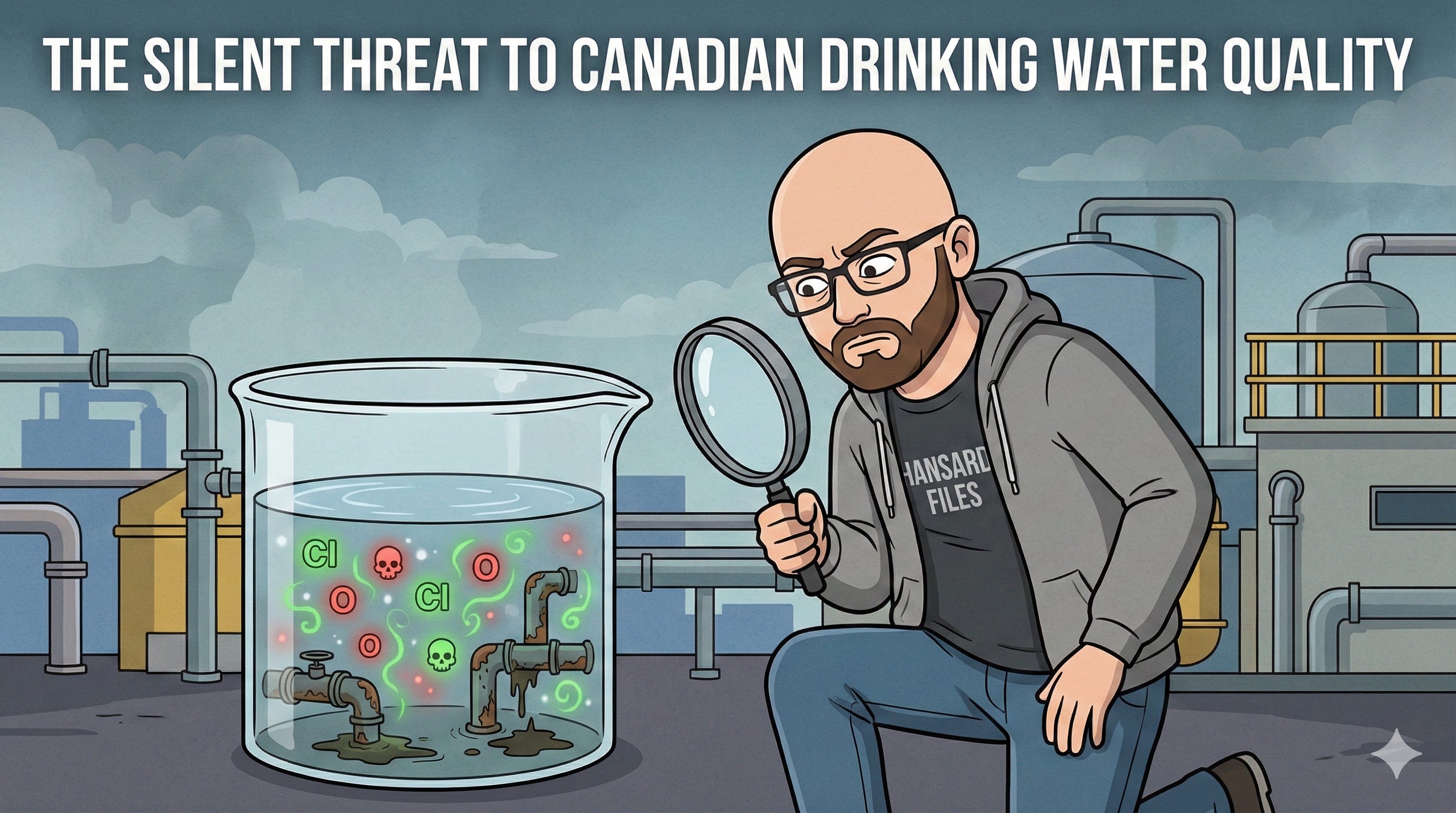
On a quiet Saturday morning in mid-February 2026, the federal government released a sprawling compendium of regulatory shifts, legal notices, and bureaucratic mandates. Hidden within the hundreds of pages of the Canada Gazette are decisions that will ripple through the daily lives of citizens, the balance sheets of massive industries, and the very chemistry of the environment. Among the most pressing of these quiet declarations is a critical update to Canadian drinking water quality.
The bureaucratic machinery never sleeps. It operates through technical standards, import tariffs, and complex chemical classifications. To the untrained eye, these documents are impenetrable walls of text. However, a closer reading reveals a high-stakes narrative of public health interventions, international trade battles over energy infrastructure, and the quiet policing of the domestic economy.
The Invisible Risks in Canadian Drinking Water Quality
Water is the lifeblood of the nation, yet the mechanisms used to keep it safe introduce their own complex vulnerabilities. The Minister of Health has initiated a profound review of the guidelines governing Canadian drinking water quality, specifically targeting the presence of chlorite and chlorate.
These chemicals are not naturally present in the environment. Instead, chlorite and chlorate are disinfection by-products of chlorine dioxide, an unstable gas utilized by municipal water treatment facilities as a primary disinfectant or biocide to control taste, odour, and colour. Furthermore, under certain specific conditions, hypochlorite solutions that are commonly used to treat drinking water can degrade and inadvertently form chlorate. The stakes for human health are significant. The draft guidelines outline troubling findings from animal testing.
Chlorite has been shown to adversely affect neurodevelopment and general development.
It also impacts brain and liver weights, and alters thyroid hormone levels in animals.
Chlorate exposure primarily causes thyroid and hematological effects, with the thyroid impacts being identified as the most sensitive endpoint.
To combat these invisible threats, Health Canada is proposing a maximum acceptable concentration (MAC) for chlorite in drinking water of 1 mg/L (1,000 µg/L). The proposed MAC for chlorate is identically set at 1 mg/L (1,000 µg/L). Interestingly, the government notes that a specific MAC for chlorine dioxide itself is not required, as it rapidly reduces to chlorite and, to a lesser extent, chlorate once in the drinking water supply.
While Canadian data suggests that current chlorite and chlorate levels in the drinking water are generally well below these proposed limits, the government explicitly warns that drinking water remains the main source of exposure for the general population. Treatment strategies must focus on prevention, as chlorate is notoriously difficult to effectively remove once it has formed.
The 220 Chemical Polymers Evading Deep Oversight
Beyond the water flowing from household taps, the chemical makeup of everyday commercial products is also undergoing a silent revision. The Minister of the Environment has issued a notice of intent under the Canadian Environmental Protection Act, 1999, to amend the Domestic Substances List (DSL).
The DSL acts as the official inventory of substances manufactured in or imported into Canada on a commercial scale. If a substance is not on this list, it is legally considered a new substance and requires a rigorous assessment of its potential impacts on human health and the environment before it can cross Canadian borders.
The new amendment specifically targets 220 polymers, aiming to add a regulatory flag in the form of the letter “P” to their official identifiers. This seemingly minor administrative keystroke carries massive industrial implications.
The letter “P” indicates that the specific form of the polymer originally assessed met the criteria for a “reduced regulatory requirement” (RRR).
Polymers that meet RRR criteria are considered to be of low concern, allowing manufacturers to bypass the heavy information requirements demanded for non-RRR polymers.
However, a substance synthesized in a low-concern RRR form can often be synthesized in a different form that does not meet these safety criteria.
By officially tagging these 220 polymers with the “P” designation, the government is closing a massive loophole. Moving forward, any person intending to manufacture or import these polymers in a form that falls outside the safe RRR parameters will be legally forced to submit detailed health and environmental risk data.
Austrian Steel and the Fight for Domestic Energy
While chemists analyze polymers, international trade lawyers are engaging in a fierce battle over the physical infrastructure of Canada’s energy sector. The Canada Border Services Agency (CBSA) has officially launched an investigation into the alleged dumping of oil and gas well casing originating in, or exported from, the Republic of Austria. Concurrently, the Canadian International Trade Tribunal (CITT) has initiated a preliminary injury inquiry to determine if this European steel is causing, or threatening to cause, material injury to domestic Canadian industries. The goods in question are highly specific. They include carbon or alloy steel casings, welded or seamless, with an outside diameter ranging from 4.5 inches to 9.625 inches (114.3 mm to 245.2 mm).
The complaint explicitly captures “green tubes”, which are intermediate or in-process pipes requiring further specialized processing, such as threading or heat treatment, before they can be deployed into active oil and gas wells. The outcome of this investigation could result in severe import tariffs, fundamentally altering the supply chain costs for energy producers operating in the Canadian West.
The Quiet Taxation of the Cannabis Industry
Far away from the heavy steel of the oil patch, the federal government is adjusting the financial realities of the legal cannabis sector. Through the Cannabis Fees Order, Health Canada is executing an automatic, inflation-adjusted price hike on the foundational licenses required to operate within the industry.
Effective April 1, 2026, the fees for screening various cannabis applications will be adjusted upward by the 2025 Consumer Price Index rate of 1.7%.
The screening fee for a standard cultivation license will increase from $4,040 to $4,109.
The screening fee for a micro-cultivation license will rise from $2,023 to $2,057.
The screening fee for a license focused on sale for medical purposes will also increase from $4,040 to $4,109.
While a 1.7% increase may appear modest in isolation, it represents the continuous, creeping cost of compliance in a highly regulated, hyper-competitive sector that frequently struggles with foundational profitability.
Revoked Charities and the Shadow of Enforcement
Finally, the Canada Revenue Agency (CRA) serves as the ultimate arbiter of corporate and philanthropic legitimacy. In this latest Gazette publication, the CRA’s Charities Directorate, under the authority of Director General Sharmila Khare, has moved to revoke the registration status of several high-profile charitable organizations for failing to meet the strict requirements of the Income Tax Act.
The organizations stripped of their charitable status, effective immediately upon publication, include:
The Play Better Foundation, based in Vancouver, British Columbia.
The Canadian Hockey League Scholarship Trust, based in Etobicoke, Ontario.
The International Humanitarian Society, based in Sherwood Park, Alberta.
The revocation of a charity’s registration is the financial equivalent of a death sentence. It strips the organization of its ability to issue tax receipts for donations, immediately cutting off the vital flow of philanthropic capital.
From the microscopic chemical composition of our drinking water to the global trade of heavy steel, the federal government’s regulatory apparatus touches every facet of modern life. The rules change quietly, published in dense columns of bilingual text, but the impacts are loud, profound, and inescapable.
Hansard Files exists to read the fine print so you don’t have to. We dig through thousands of pages of federal records to bring you the stories shaping your world. Subscribe today to support relentless, independent investigative journalism.
Source Documents
Government of Canada. (2026, February 14). Canada Gazette, Part I, Volume 160, Number 7.
"The rules change quietly, published in dense columns of bilingual text, but the impacts are loud, profound, and inescapable." Grateful, 'Hansard'.
As one who in the past has been responsible for the filing of papers for a charity , it is absolutely necessary to have your paperwork up to date. If you don’t , I question whether you are running your organization properly, and whether the funds are properly handled. The CRA are doing their job.