


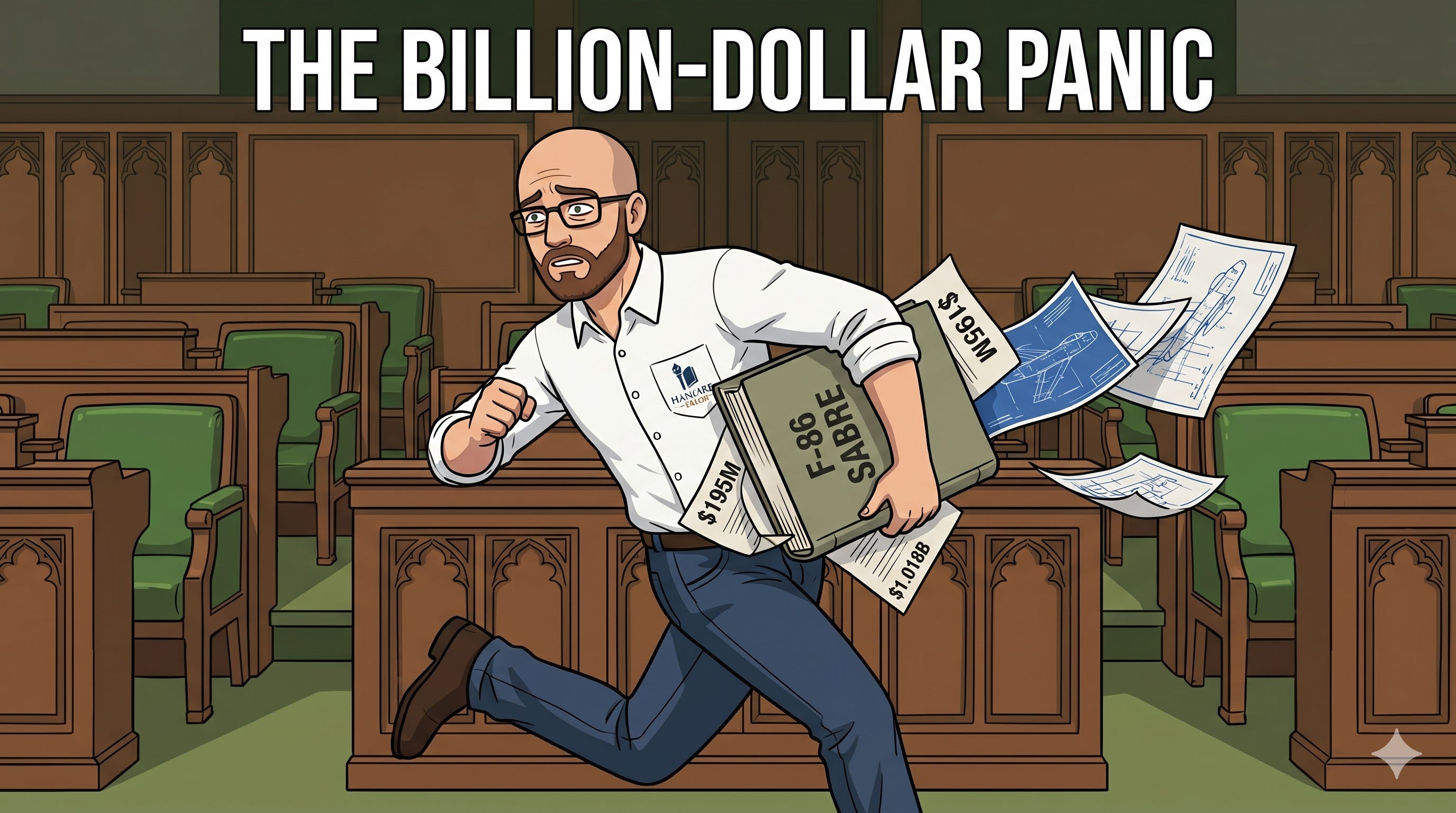
In the spring of 1950, Ottawa was a city asleep at the wheel of history.
Five years after the defeat of Germany, the urgency of global conflict had dissolved into the mundane bureaucracy of peace. The Department of National Defence (DND) was operating on a philosophy of “extreme economy.” The budget for the entire Canadian military in 1947–48 had been slashed to a skeletal $195 million. The army’s primary fighting unit, the “Mobile Striking Force,” was a modest airborne brigade designed solely for territorial defense—to clear enemy lodgements from the Canadian Arctic, not to fight a war in Europe.
According to a declassified Historical Section report from 1986—Report No. 93: The Canadian Army, 1950-55—the prevailing wisdom of the Canadian Chiefs of Staff was dangerously optimistic. They believed any future war would be “fought primarily in Europe,” and that Canada’s role would mirror World War II: a slow, methodical mobilization after hostilities began. They assumed they would have time.
On June 25, 1950, North Korean forces crossed the 38th Parallel, and time ran out.
The invasion did not just trigger a war; it shattered the psychological foundation of Canadian defence policy. As Report No. 93 documents, the government was forced to pivot overnight from a policy of “long-term planning” to one of immediate, desperate mobilization. The era of the shoestring army was over; the era of the billion-dollar garrison state had begun.
The Korean Catalyst
The shock of Korea was total. The report notes that while Canada had dabbled in collective security through the newly formed NATO, its military organization was still “in embryo form”. The government had no expeditionary force ready to deploy.
When the call came from the United Nations, Ottawa had to improvise. The “Special Force” raised for Korea was a scramble—a reaction to a crisis that military planners had considered probable but not imminent. But the real panic wasn’t about the Korean Peninsula; it was about what Korea signaled for Europe.
General Foulkes and the Chiefs of Staff realized the Soviet Union might use Korea as a distraction to launch a main assault in the West. Report No. 93 reveals a chilling shift in the strategic calculus: suddenly, the risk of “general war” was no longer a distant hypothesis. It was a day-to-day reality. The “Fire Brigade” mentality—small forces putting out small fires—was abandoned for a doctrine of “forces in being.”
The NATO Dilemma: Simonds vs. The Air Force
Perhaps the most fascinating revelation in the declassified files is the internal tug-of-war over where to place Canada’s new commitments. This was not just a matter of logistics; it was a battle for the soul of the Canadian military.
As Canada prepared to station troops permanently in Europe—a peacetime first—a sharp debate erupted over command. General Simonds, the Chief of the General Staff, argued fiercely that the Canadian Infantry Brigade Group should be placed under British command in the Northern Zone of Germany. His reasoning was geopolitical: he wanted to maintain a “balance of power” within NATO and prevent the Canadian Army from being totally subsumed by the American military machine.
The Royal Canadian Air Force (RCAF), however, had different ideas. They demanded integration with the United States Air Force (USAF), citing “strong logistical reasons” and the fact that they were already integrated with the Americans for North American air defense.
The result was a fractured compromise that defined Canada’s Cold War stance: the Army went to the British sector, driving British trucks and using British tactics, while the Air Force flew F-86 Sabres alongside the Americans, using American logistics. It was a schizophrenic deployment that underscored the country’s uncomfortable position sandwiched between two empires.
The Battle of the Married Quarters
The files also expose a bitter, almost petty, domestic dispute that carried massive morale implications. As Canadian troops settled into West Germany, the question arose: should their families go with them?
General Simonds said no. He argued that “the presence of servicemen’s families would interfere with the operation of the Canadian brigade” and would create a nightmare scenario if a sudden evacuation was needed. He wanted a hard, austere fighting force, unencumbered by dependents.
The Air Force, again, took the opposite view. The Chief of the Air Staff argued that separating families caused a “morale problem” that hurt recruiting. The press began to pick up the story, criticizing the lack of “Canadian communities” near the camps.
Simonds lost. By late 1953, the government capitulated. “Maple Leaf Services” was incorporated to build canteens, clubs, and theatres in Germany. Over 1,400 permanent married quarters were constructed. The Canadian military base in Europe was no longer a temporary bivouac; it had become “Little Canada,” complete with schools and shopping centers, cementing a permanent Canadian presence on the continent.
The Billion-Dollar Air Power Revolution
The most staggering statistic in the Report is not the number of troops, but the sheer explosion of cash—and where it went.
In 1949–50, the Air Force budget was $147 million. By 1953–54, it had skyrocketed to $1.018 billion.
This was a tectonic shift in Canadian defence policy. For the first time, the Air Force eclipsed the Army ($549 million) and Navy ($332 million) combined. The Cold War had turned the RCAF into the premier instrument of national power. The funding poured into the 1st Canadian Air Division in Europe and the Pinetree and Mid-Canada radar lines at home. The “shoestring” days were a distant memory; Canada was spending nearly half of its federal budget on defence, driven by the terror of Soviet bombers.
The Nuclear Shadow
By 1955, the frantic mobilization of 1950 had stabilized, but a darker shadow had lengthened over the planning tables. The report concludes with a somber assessment of “The Effects of Nuclear Development.”
In 1952, Canadian planners believed atomic weapons were “strategical” tools for the long term—weapons that wouldn’t affect the battlefield until “D plus 90” (90 days after the war started). They thought they could still fight a conventional war.
Three years later, that delusion was dead. The United States and the Soviet Union had both tested thermonuclear devices. The Chiefs of Staff were forced to admit that the “basic concepts of conventional strategy” were obsolete. The buffer time that Canada had always relied on—the months to mobilize, the weeks to cross the Atlantic—had evaporated. The next war would not last years. It might not even last weeks.
The “Preliminary Narrative” of Report No. 93 ends there, but the legacy of those five frantic years remains. Between 1950 and 1955, Canada dismantled its isolationist past and built the infrastructure of a modern military state. It was a transformation bought with panic, fueled by a billion dollars of taxpayer money, and forged in the sudden, terrifying realization that peace was no longer a guarantee, but a precarious standoff.
The Hansard Files digs through declassified military archives to find the pivot points that changed the nation. Subscribe to support independent investigative history.
Source Documents
Directorate of History. (1986, July). Report No. 93: The Canadian Army, 1950-55 Part I: Canadian Defence Policy (Declassified). National Defence Headquarters.
and so over the years, the DND became a place whose budget could be raided to supply 'savings' and industrial policy whenever the government of the time need to be 'austere'.
Those were the days, Mike. A dozen air defence squadrons in Canada, four fighter wings in Europe for NATO. And for a period of time No. 1 Wing was stationed in North Luffenham in Britain providing them with day fighter protection. This was due to delays in getting the Hawker Hunter into RAF service.