


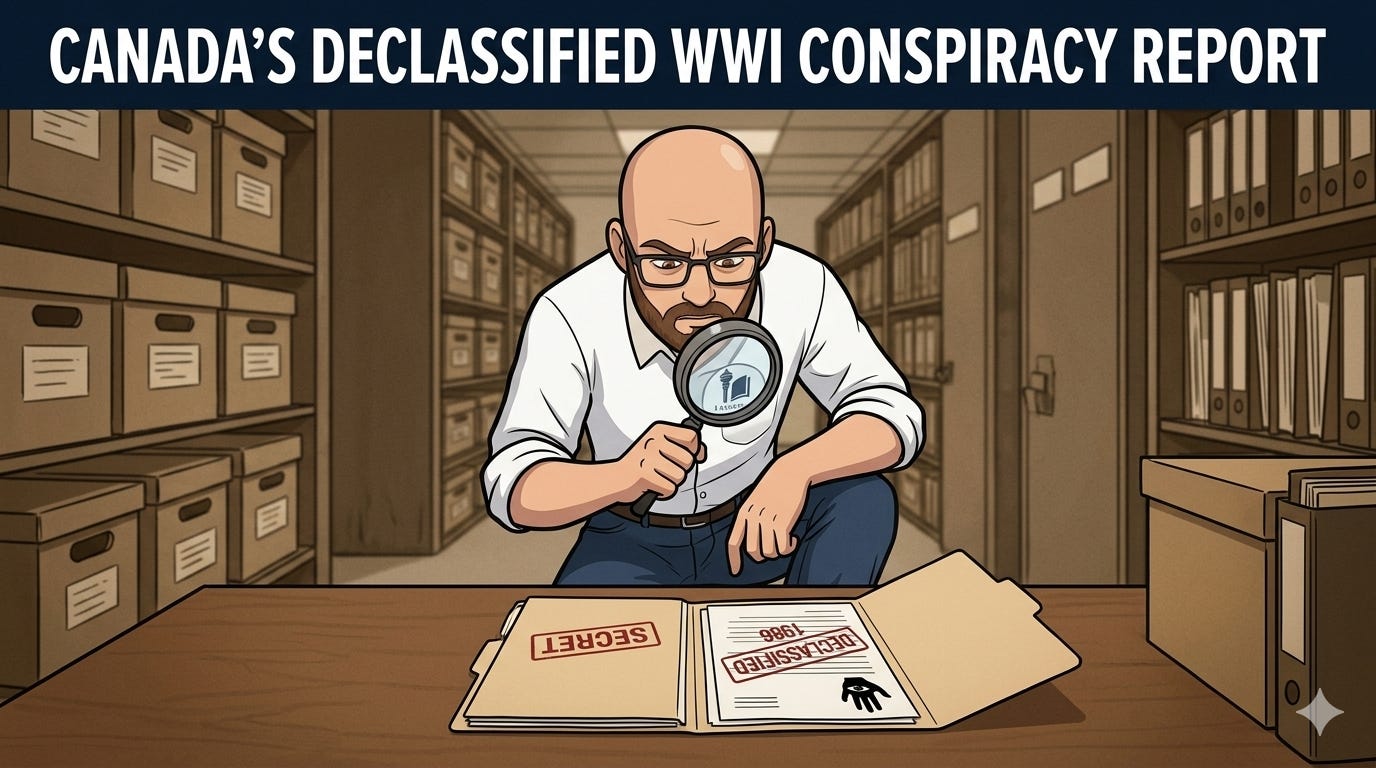
On a Sunday morning in June 1914, the heir to the Austro-Hungarian throne, Archduke Franz Ferdinand, was bleeding to death on the backseat of a car in Sarajevo. His assassination is the standard opening scene in every history textbook regarding the origins of World War I. But a formerly SECRET report, declassified by the Canadian Directorate of History in 1986, reveals that the true mechanics of the catastrophe were far more sinister than the acts of a lone fanatic.
Report No. 99, compiled by the Historical Section of the Army Headquarters, does not merely recount the diplomatic failures; it indicts the deep-state terrorism that precipitated them. It paints a portrait of a Europe so predicated on violence that the assassination was not a tragedy, but a pretext. At the center of this web was not just Gabriel Princip, but the “Black Hand”—a secret society that had infiltrated the Serbian government, terrified its King, and orchestrated the murder with the precision of a modern intelligence agency.
For the modern reader, the report offers a chilling corrective to the “German guilt” narrative. While Berlin’s aggression is undeniable, this Canadian investigation exposes how the Allied powers—Britain, France, and Russia—remained fatally naive to the fact that their Serbian protégé was running a state-sponsored assassination bureau.
The Rise of the Regicides
To understand why the world went to war in 1914, one must look back to a gruesome night in Belgrade in 1903. The Canadian report details how King Alexander Obrenovitch and Queen Draga were hacked to death by their own officers, their mutilated bodies tossed from the palace windows. The coup was not a spontaneous uprising but a calculated purge by a clique of extremists who would eventually form Ujedinjenje ili Smrt—”Union or Death,” commonly known as the Black Hand.
By 1914, this organization was no longer a fringe group; it was a “government within a government”. Its leader, Colonel Dragutin Dimitrievich, served simultaneously as the President of the Black Hand and the head of the Serbian Army Intelligence Service. This dual role is the critical pivot point in the origins of World War I. When the Archduke was murdered, the weapon didn’t just come from a radical student; it came from the Serbian military arsenal at Karagujevac, supplied by officers answering to Dimitrievich.
The Black Hand had effectively captured the Serbian state. King Peter, brought to the throne by the very regicides who butchered his predecessor, was paralyzed by fear, unable to withstand their demands. The terror network controlled the police, the frontier guards, and the army. When the Archduke visited Sarajevo, he wasn’t walking into a protest; he was walking into a military operation launched from Belgrade.
The Naivety of the Entente
One of the most damning assessments in Report No. 99 is the diplomatic blindness of the Allied powers. Following the assassination, France, Britain, and Russia accepted the Serbian Government’s protestations of innocence without question. The report describes this as a “fateful naivety”.
The Allies were ill-equipped to see the truth. The British ambassador-designate had not yet arrived in Belgrade, and the chargé d’affaires was ill; the French ambassador suffered a nervous breakdown upon hearing the news. In this vacuum of intelligence, the Entente powers rallied around a “victim” nation that was, in reality, harboring the architects of the crime.
Austria-Hungary, conversely, had no illusions. They had managed to keep one of the assassins alive for questioning. The interrogation revealed the conspiracy’s reach, tracing the plot directly to the Narodna Odbrana and the Black Hand. For Vienna, this was not a matter of crime and punishment; it was an existential struggle. The Empire recognized that Serbian propaganda and terrorism were a menace to its very existence. As Count Berchtold, the Austrian Foreign Minister, told his Hungarian counterpart: “If we should compromise with Serbia, [the Germans] would accuse us of weakness... and the future policy of Germany” would turn against them.
The Ultimatum: A Blueprint for War
The Austrian response, drafted with German backing, was designed to be rejected. Delivered on July 23, 1914, the ultimatum contained ten specific demands that would effectively dismantle Serbian sovereignty.
The specific clauses, detailed in the report, show exactly what Austria knew:
Demand 2: Dissolve the Narodna Odbrana and all terrorist societies.
Demand 4: Remove all military officers and officials guilty of anti-Austrian propaganda.
Demand 6: Allow Austrian officials to participate directly in the judicial investigation of the murder on Serbian soil.
This sixth demand was the breaking point. Serbia accepted most terms but refused to allow Austrian police to operate within its borders, citing constitutional violations. However, the report suggests a darker motive for this refusal. An impartial investigation involving Austrians would almost certainly have exposed the Black Hand’s infiltration of the Serbian General Staff and compromised the monarchy itself. The refusal was not just about sovereignty; it was about survival for the regicides in Belgrade.
The Serbian reply was drafted with deceptive skill. It was conciliatory in tone, designed to win sympathy from the Great Powers, but it conceded nothing of substance regarding the root of the terror network. It promised to suppress hatred but offered no guarantee of action. Crucially, when Austria demanded the arrest of Major Voja Tankovich—a key conspirator and regicide—Serbia replied he had already been arrested, but that his accomplice, Ciganovitch, was “not available”. In reality, the Serbian Prime Minister had personally ordered Ciganovitch into hiding and kept him on the state payroll throughout the war.
The Mechanism of Escalation
The mechanics of the alliance system turned a Balkan crisis into a continental slaughter. The report highlights that the division of Europe into two armed camps—the Triple Alliance and the Dual Entente—was the fundamental historical cause that allowed the assassination to metastasize.
Germany, fearing the loss of its only reliable ally, pushed Austria toward immediate offensive action. The Kaiser, a personal friend of the murdered Archduke, viewed the Serbian state as a product of “regicide and murder” and urged Vienna not to let matters drift. Meanwhile, Russia, humiliated by previous diplomatic defeats in the Balkans, felt it could not stand by while Serbia was crushed.
When Austria declared the Serbian reply unsatisfactory and mobilized eight army corps, the clock ran out. Serbia had already ordered general mobilization hours before even delivering their reply, moving their government from Belgrade to Nish. The machinery of war, lubricated by decades of secret treaties and military timetables, began to turn.
The Verdict of History
The report concludes with a somber reflection on the tragedy. Western civilization, which in 1914 looked forward to a “brilliantly victorious” campaign, by 1918 looked back on a continent ravaged and uncounted millions dead. The tragedy is compounded by the lack of inevitability; no single event or person guaranteed the war. It was the accumulation of “ancient greeds unsatisfied” and “prides unrepented”.
Perhaps the most bitter irony lies in the aftermath. The Black Hand, the organization that set the world on fire to create a Greater Serbia, eventually achieved its goal. The new Kingdom of Yugoslavia, born from the ashes of Versailles, corresponded almost exactly to their ideal. And in 1920, on the Sarajevo street where the Archduke died, the victors placed a bronze plaque. It did not commemorate the victims of the assassination. It commemorated Gabriel Princip.
Hansard Files exists to unearth documents like Report No. 99—histories that governments lock away in ‘Secret’ archives. To support this independent investigative work, please subscribe below.
Source Documents
Directorate of History, National Defence Headquarters. (1986, July). The Origins of the First World War (Report No. 99). Government of Canada.
It seems oddly fitting that "the war to end all wars" was started on a false premise.