


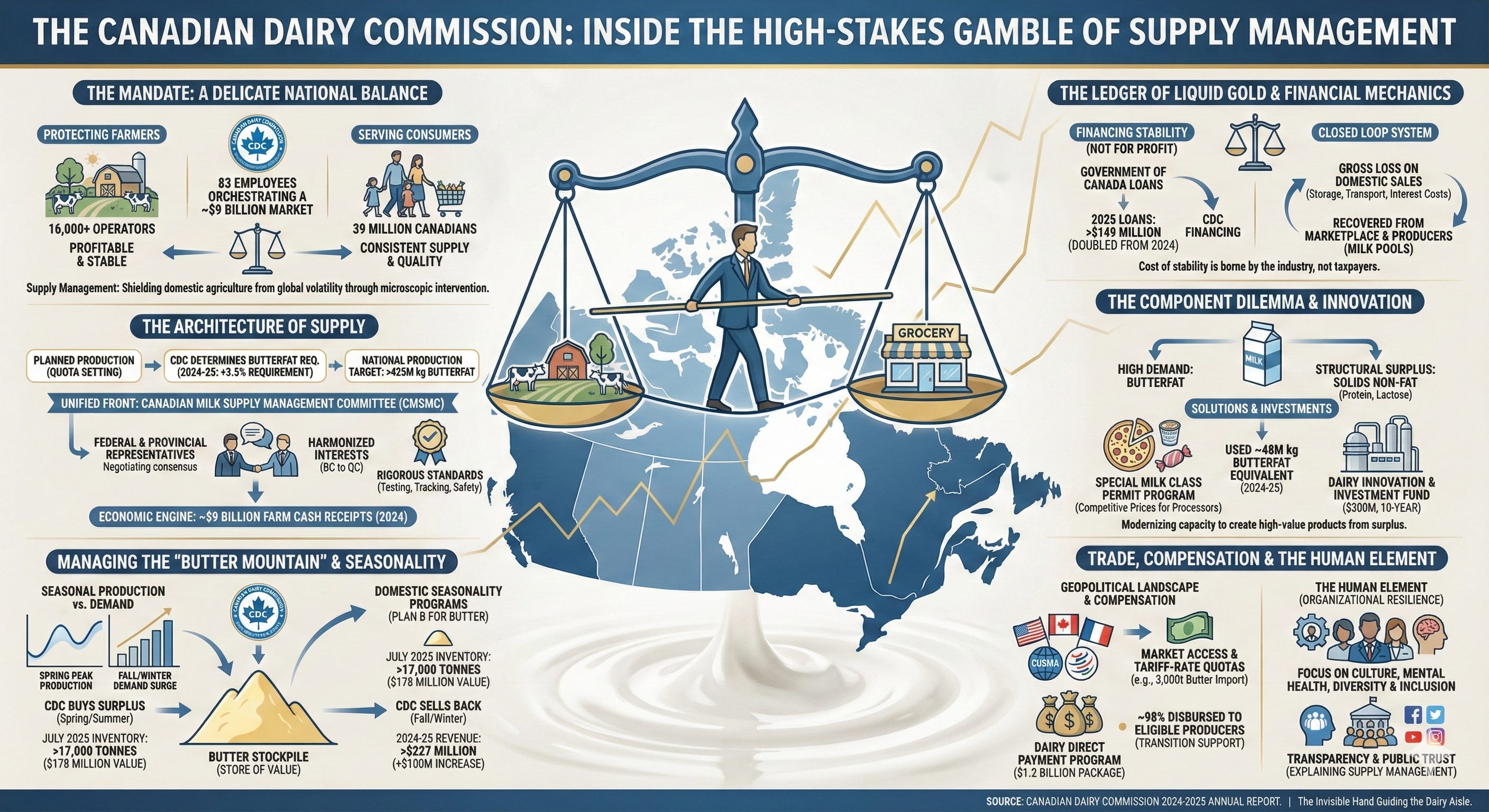
In the quiet administrative corridors of the Central Experimental Farm in Ottawa, a small group of eighty-three employees orchestrates a market worth nearly nine billion dollars. This is the Canadian Dairy Commission, a federal entity operating with the precision of a central bank but dealing in perishable goods rather than currency. Their mandate is a high-wire act of economics and logistics: they must ensure that over nine thousand farms remain profitable while guaranteeing that thirty-nine million consumers never face a shortage of milk, cheese, or butter. It is a system known as supply management, a mechanism that shields domestic agriculture from the volatility of the global market, yet requires constant, microscopic intervention to prevent collapse.
The recently released 2024-2025 Annual Report reveals an organization under increasing pressure. As the industry faces shifting consumer habits and the lingering effects of inflation, the Commission has had to leverage its financial tools more aggressively than in previous years. They are managing a delicate equilibrium where a single miscalculation in the national production target can lead to costly surpluses or empty grocery store shelves. The stakes are national in scale, involving a complex web of provincial boards, processing plants, and international trade obligations that requires the Commission to act as both a regulator and a market maker.
The Architecture of Supply
The foundation of the Canadian dairy sector is built on strict control. Unlike other agricultural sectors where production is dictated by the weather and the whims of the open market, dairy in Canada is planned. The Canadian Dairy Commission sets the quota, determining exactly how much butterfat the nation requires. In the 2024-2025 dairy year, the total requirements for butterfat grew by nearly three and a half percent. To meet this demand, the national production quota was adjusted to over four hundred and twenty-five million kilograms of butterfat.
This system relies on a unified front. The Commission acts as the chair of the Canadian Milk Supply Management Committee, the body where federal and provincial representatives negotiate the delicate balance of the market. Decisions here require consensus, a necessity in a country as vast and regionally diverse as Canada. The goal is to harmonize the interests of a farmer in British Columbia with a processor in Quebec, ensuring that the milk produced in one region can find a market, or a processing plant, in another.
The report highlights that unity is not merely a slogan but an operational requirement. The industry generated farm cash receipts of nearly nine billion dollars in the 2024 calendar year, supporting over sixteen thousand operators. This economic engine is fueled by rigorous standards. Canadian milk is tested and tracked with an intensity that rivals the pharmaceutical industry, ensuring that compliance with safety and animal welfare standards remains among the highest in the world. However, the rigidity of supply management also creates unique challenges, particularly when the cows produce more than the market can immediately absorb.
The Butter Mountain
Seasonality is the silent adversary of the dairy industry. Cows produce milk according to biological cycles that rarely align with consumer buying habits. Production peaks in the spring and early summer, while demand for high-fat products like butter and heavy cream surges in the fall and winter baking seasons. To bridge this gap, the Commission operates the Domestic Seasonality Programs, specifically Plan B for butter.
This program allows the Commission to purchase excess butter from processors during periods of surplus and store it. When demand spikes, they sell it back into the market. It is a massive logistical operation that effectively uses butter as a store of value. The financial data from the 2024-2025 report indicates a significant escalation in this activity. Revenue from the sale of Plan B butter reached over two hundred and twenty-seven million dollars, a sharp increase of nearly one hundred million dollars compared to the previous year.
This surge in sales was matched by a significant accumulation of inventory. By July 31, 2025, the Commission held over seventeen thousand tonnes of butter in storage, valued at one hundred and seventy-eight million dollars. This represents an increase of more than six thousand tonnes from the previous year. This stockpile serves as the industry’s buffer against volatility, ensuring that despite seasonal fluctuations, the domestic market remains supplied. However, carrying this much inventory requires substantial capital.
The Ledger of Liquid Gold
The financial mechanics of the Canadian Dairy Commission are distinct from a typical corporation. They do not operate to generate a profit in the traditional sense. Their goal is to break even while stabilizing the market. To finance the purchase of millions of kilograms of butter and cheese, the Commission relies on loans from the Government of Canada.
The balance sheet for 2025 shows a dramatic shift in these liabilities. The outstanding loans from the government more than doubled, rising from roughly sixty-nine million dollars in 2024 to over one hundred and forty-nine million dollars in 2025. This increase correlates directly with the rising inventory of butter and the financing of the Plan C cheese repurchase agreements. Under Plan C, the Commission buys cheese from processors during surpluses, holding it as a financial asset until the processor buys it back.
Despite the massive revenue figures—total sales revenue jumped to two hundred and fifty-three million dollars—the Commission reported a gross loss on domestic sales. This is a structural feature of their seasonality programs. The Commission buys and sells at the support price, but the costs of transport, storage, and interest erode the margins. These losses are not absorbed by the taxpayer but are recovered from the marketplace and producers through the milk pools. It is a closed loop where the cost of stability is borne by the industry itself.
The Component Dilemma
A persistent structural challenge facing the Canadian Dairy Commission is the imbalance between the demand for butterfat and the demand for solids non-fat, such as protein and lactose. When milk is processed to extract cream for butter, the remaining skim milk components often exceed market demand. This structural surplus forces the industry to find innovative ways to utilize the entire volume of milk produced.
To address this, the Commission manages the Special Milk Class Permit Program. This system allows further processors to access dairy ingredients at competitive prices for use in products ranging from frozen pizzas to confectionery. In the 2024-2025 dairy year, processors utilized the equivalent of nearly forty-eight million kilograms of butterfat through this program, utilizing surplus components that might otherwise go to waste.
Furthermore, the Commission has launched aggressive investment strategies to solve the solids non-fat equation. The Dairy Innovation and Investment Fund, a ten-year program with a budget of over three hundred million dollars, aims to modernize processing capacity. The goal is to create high-value products from the surplus protein and lactose, transforming a waste management problem into a revenue stream. Simultaneously, the Market Growth Program provides incentives for investments that increase the utilization of these components, ensuring the long-term sustainability of the sector.
Compensation and Trade
The dairy sector operates within a complex geopolitical landscape. Recent international trade agreements, such as the Canada-United States-Mexico Agreement, have opened a portion of the domestic market to foreign competition. To mitigate the financial impact on Canadian farmers, the federal government committed to a compensation package of one point two billion dollars.
The Canadian Dairy Commission is the delivery agent for these funds through the Dairy Direct Payment Program. The report confirms that the distribution of these funds is nearing completion for the current phase. By the end of the fiscal year, nearly ninety-eight percent of the allocated funds had been disbursed to eligible producers. This injection of capital is intended to help farmers transition and remain competitive in an environment where the protective walls of supply management have been slightly lowered.
In addition to direct payments, the Commission manages the import of tariff-rate quotas. Under World Trade Organization commitments, Canada must import specific quantities of butter. The Commission acts as the receiver for over three thousand tonnes of butter annually, largely from New Zealand, which is then directed to the further processing sector. This controlled importation ensures that Canada meets its international obligations without crashing the domestic price of butterfat.
The Human Element
Behind the millions of hectolitres and billion-dollar ledgers lies a profound human element. The report emphasizes a renewed focus on organizational culture within the Commission. With a staff of only eighty-three people, the pressure to execute flawlessly is immense. The Commission has implemented new frameworks for mental health, diversity, and inclusion, recognizing that the resilience of the supply chain is dependent on the resilience of the people managing it.
Town halls and strategic planning sessions have become regular occurrences, fostering a sense of shared purpose. The Commission is also looking outward, engaging with the public through social media to explain the often-misunderstood mechanics of supply management. In an era of high food prices, transparency regarding how milk prices are set—based on the cost of production and the consumer price index—is critical for maintaining public trust.
The Canadian Dairy Commission stands at a crossroads. It must modernize its tools to handle data-driven decision-making while upholding a mandate established in 1966. As the 2025-2026 dairy year approaches, the Commission remains the invisible hand guiding the dairy aisle, balancing the ledger between the farm gate and the kitchen table, ensuring that the flow of milk, like the flow of capital, never stops.
Source Documents
Canadian Dairy Commission. (2025). 2024-2025 Annual Report.