


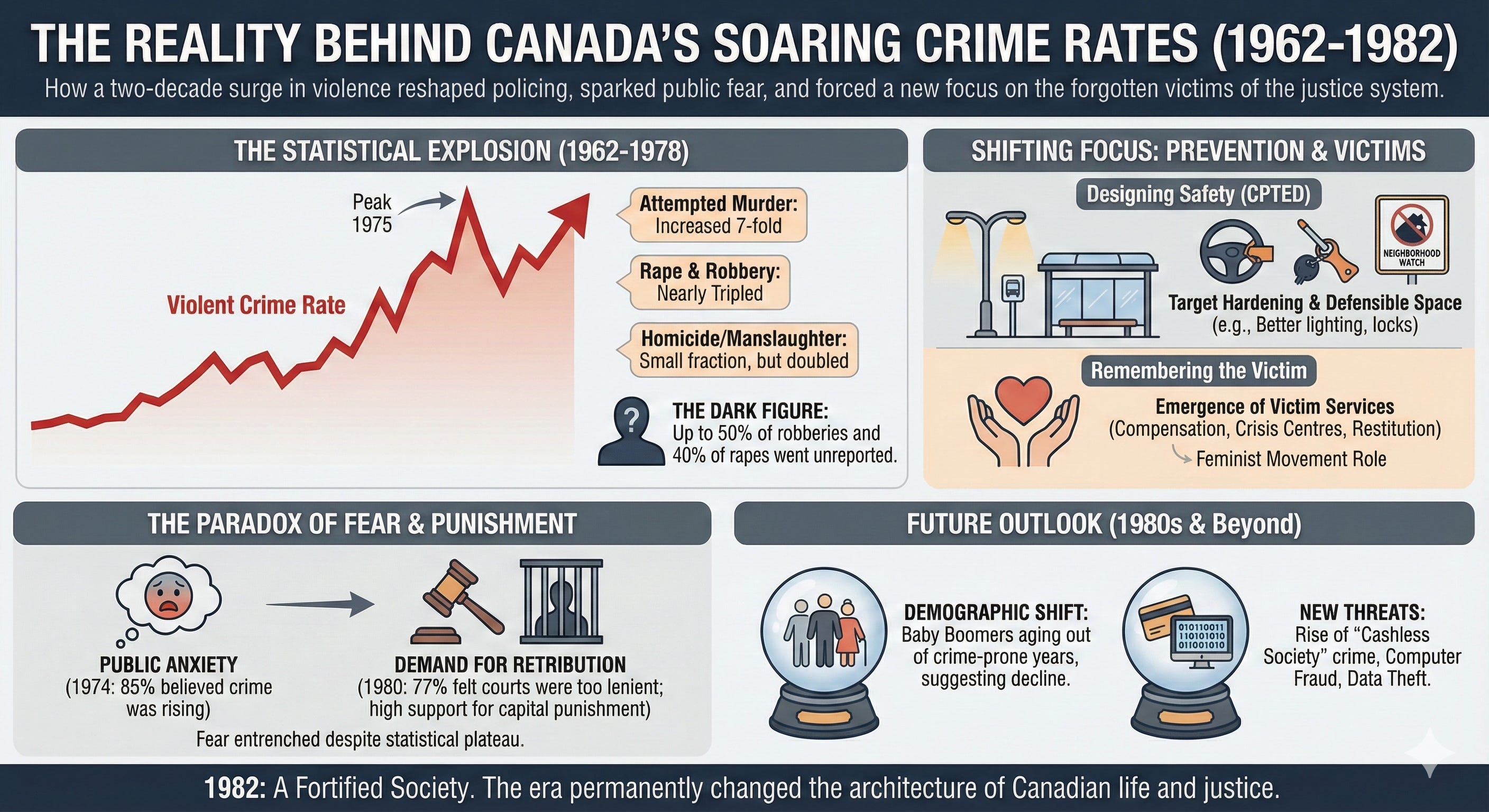
The year was 1982 and the Canadian public was looking over its shoulder. For two decades the nation had watched the statistical landscape of safety erode with terrifying speed. Between 1962 and the mid-1970s the comfortable assumption of Canadian order had been challenged by a relentless upward trajectory in violence and theft. By the time the Ministry of the Solicitor General released its comprehensive analysis of the situation the numbers were undeniable. Canadian crime rates had not merely risen. They had exploded.
The official data painted a picture of a society undergoing a fundamental shift. From 1962 to 1978 the rate of attempted murder in Canada had increased sevenfold. Rape and robbery had nearly tripled. While the curve for violent crime had finally begun to plateau and even dip slightly after hitting a peak in 1975 the psychological damage was done. The public perception of danger had detached itself from the streets and lodged itself in the collective psyche. The government found itself grappling not just with criminals but with a citizenry that felt increasingly besieged by an abstract and encroaching chaos.
This period marked a critical turning point in the history of Canadian justice. It was the moment when the system stopped looking exclusively at the offender and began to stare uncomfortably at the environment that enabled them and the victims they left behind.
The Anatomy of the Surge
To understand the atmosphere of the early 1980s one must look at the raw data that fueled the anxiety. The climb began in earnest around 1966. For the next nine years the lines on the graphs climbed steeply and without pause. By 1978 the statistics revealed a grim transformation. Murder rates had more than doubled since 1962. Break and enter offences had nearly tripled.
The violence was not distributed evenly. Robbery accounted for a massive 78 percent of the violent crime index while homicide and manslaughter remained a small statistical fraction of the total. Yet the severity of the shift was impossible to ignore. In 1962 the rate of attempted murder was 0.4 per 100,000 people. By 1978 it was 3.2. This was not a statistical anomaly. It was a trend that redefined police work and public policy.
However the official numbers told only half the story. The Solicitor General’s report acknowledged a dark figure of crime that never reached police blotters. Victimization surveys from the era suggested that official channels were capturing a fraction of the reality. Studies indicated that 40 percent of rapes and 50 percent of robberies went unreported. For property offences the silence was even deeper with up to 60 percent of incidents never making it into the official record.
This gap between the official count and the street-level reality created a policy nightmare. Police activity and bookkeeping practices varied wildly from city to city making comparisons fraught with error. Vancouver reported violent crime rates nearly double those of Toronto yet it was unclear if this reflected a more violent city or simply a more aggressive police force. In this fog of data the government attempted to forge a path forward while the public demanded answers.
The Paradox of Fear and Punishment
While the crime rates began to level off in the late 1970s public fear did not recede. It entrenched itself. Opinion polls from the era revealed a Canadian public that was deeply anxious and increasingly punitive. When asked if they believed crime was rising a staggering 85 percent of Canadians in 1974 said yes. This belief persisted even when the statistics suggested the surge had broken.
This anxiety translated into a hardening of attitudes toward justice. The public mood was shifting away from rehabilitation and toward retribution. In 1966 only 43 percent of Canadians believed the courts were too lenient. By 1980 that number had surged to 77 percent. The demand for harshness was explicit. Seven out of ten Canadians favoured capital punishment for the killing of innocent persons and support for the death penalty in cases involving the murder of police officers or prison guards hovered near 75 percent.
Yet a closer look at the data revealed a complex contradiction. While Canadians expressed high levels of concern about “crime” as a national issue they were surprisingly optimistic about their own safety. When asked about their personal lives few listed crime as a primary worry compared to inflation or unemployment. In Toronto only a small fraction of residents reported worrying frequently about burglary or assault.
The fear was abstract. It was a fear of strangers and a fear of societal decay rather than a specific fear of one’s neighbour. This disconnect posed a unique challenge for legislators. They were governing a population that felt unsafe in principle even if they felt secure in practice. The demand was for a restoration of order and the government had to respond with something more tangible than reassuring statistics.
Engineering Safety Through Environmental Design
Faced with a public that had lost faith in the rehabilitative ideal the justice system began to pivot. If changing the criminal was impossible perhaps the answer lay in changing the world around them. The concept of “positive” prevention which focused on social programs and counselling was being eclipsed by “defensible” approaches. The new philosophy was mechanical and architectural. It sought to harden the target.
This shift gave rise to Crime Prevention Through Environmental Design or CPTED. The theory was rooted in the idea that the physical layout of a community could either invite crime or repel it. Architects and urban planners began to speak of “defensible space” and “territoriality.” The goal was to design housing and streets where residents naturally surveyed their surroundings making it impossible for an intruder to move unseen.
Experiments in Portland and Hartford tested these theories on a grand scale. In Portland a massive commercial corridor was retrofitted with improved lighting and bus shelters while public awareness campaigns urged citizens to hide their cash. In Hartford residential streets were narrowed to restrict traffic and yards were fenced to define private space.
The results were promising but ambiguous. Burglary rates dropped in the target areas but it was unclear if the physical changes were responsible or if the sheer volume of attention from police and community groups had temporarily suppressed the activity. Furthermore the cost of restructuring entire neighbourhoods was prohibitive.
A more pragmatic “situational approach” began to take hold. Rather than redesigning cities authorities focused on specific crimes. In Britain the simple act of installing steering column locks on new cars dramatically reduced auto theft. In Seattle a program encouraging neighbours to watch each other’s homes and mark their valuables led to a 48 percent drop in residential burglaries for participating households. The focus had shifted from the soul of the offender to the lock on the door.
The Forgotten Victim Emerging from the Shadows
As the system hardened its infrastructure it also began to recognize a glaring human omission. For decades the criminal justice machine had processed offenders while treating victims as mere evidence. The victim was the “forgotten person” of the system often suffering financial ruin and emotional trauma with no recourse while the state poured resources into the offender’s trial and incarceration.
By 1982 this was beginning to change. The realization that the state’s monopoly on justice left the victim with nothing but a subpoena was becoming politically untenable. Compensation programs began to appear across the provinces funded by government revenue. In some American jurisdictions a new model emerged where offenders were fined specifically to fund victim services shifting the burden from the taxpayer to the criminal.
The feminist movement played a crucial role in this awakening. The establishment of rape crisis centres and transition houses for battered women forced the system to acknowledge that justice required more than a conviction. It required care. Police forces began to experiment with family consultant services realizing that a uniform and a badge were often ill-equipped to handle the complex dynamics of domestic violence.
This era saw the seeds of a “victim justice system” planted alongside the criminal justice system. The concept of restitution where an offender repays the victim directly began to gain traction. In Ontario the number of probation cases involving restitution orders soared from a statistical anomaly to over 10 percent of the total. The system was slowly admitting that a crime was not just an offence against the Crown but a debt owed to a human being.
Predicting the Future of Crime
As the Solicitor General’s office looked toward the remainder of the 1980s their forecasts were a mix of demographic determinism and technological prophecy. They recognized that the “baby boom” generation was aging out of the crime-prone years of 16 to 24. Demographics alone suggested a coming decline in violence a prediction that would eventually prove prescient.
However the experts also foresaw new threats born of progress. They predicted the rise of the “cashless society” where paper money would be replaced by credit cards and electronic transfers. This they warned would not eliminate theft but merely displace it. The target would shift from the cash register to the data stream. They anticipated a rise in computer fraud and the theft of information crimes that would require a level of sophistication that the average street thief lacked.
They also predicted a displacement of traditional burglary. As commercial sectors hardened their targets with better alarms and security technologies criminals would be forced to turn their attention to softer targets: private homes. The experts warned that gold and portable valuables in affluent residential areas would become the new currency of theft.
The report concluded with a warning about the “blurring of distinctions” between civil and criminal liability. It pointed to the prosecution of corporations for negligent design citing the Ford Pinto case as a harbinger of a future where industrial decisions could be treated as homicide.
In 1982 Canada stood at a crossroads. The naive optimism of the post-war era had been shattered by the crime wave of the 1960s and 70s. The response was a harder more fortified society that locked its doors watched its neighbours and began finally to listen to those who had been hurt. The soaring rates of the past two decades had not just changed the statistics. They had changed the very architecture of Canadian life.
Source Documents
Bertrand, F. (1982). Public Opinions About Criminal Justice Issues: Some Cautions about Poll Data. IMPACT, 1(1), 11–19.
Leger, G. J. (1982). The Victim of Crime. IMPACT, 1(1), 32–41.
Petrunik, M. (1982). Crime and Delinquency Prevention: An Overview of Current Approaches. IMPACT, 1(1), 21–31.
Scanlon, R. L. (1982). Canadian Crime Rates: Sources and Trends. IMPACT, 1(1), 2–10.
Shuster, S. (1982). Crime and the Community: Some Possible Future Directions. IMPACT, 1(1), 42–51.
I have noticed in Edmonton that when the police budget is under consideration, news reports of crime on TV increase. Once the ever-increasing budgets are approved the reporting of crimes decreases. This is not to say that the police force does not need increased funding since it is being asked to take on responsibilities, such as mental health rescues that would be better performed by trained professionals.