


This October, a legal filing at Canada’s Competition Tribunal quietly marked a pivotal moment for our country’s democracy. For the first time, a private citizen is using newly minted powers in the Competition Act to challenge the conduct of corporate giants in the public interest. The application, brought by independent video game developer Alexander Martin, targets Alphabet (Google’s parent company) and Apple. It alleges their multi-billion dollar agreements create a stranglehold on the general search engine market in Canada.
This case moves beyond the abstract headlines of global antitrust battles. It offers a direct, evidence-based look at the architecture of our daily digital experience. The core problem you face as a citizen is not just that a few companies are dominant. The problem is that the mechanics of this dominance are intentionally opaque, making it nearly impossible to distinguish between a company’s genuine success and a market meticulously engineered to prevent competition. This filing provides the intellectual ammunition to see the difference.
The Digital Tollbooth Strategy
At the heart of this application is a simple, powerful idea. We tend to believe we use Google because it is the best product. The evidence presented in this filing suggests a different reality. Google’s dominance is not left to chance or merit alone. It is secured through what can be called a Digital Tollbooth Strategy.
Think of the internet’s entry points—your phone’s browser, your laptop’s operating system—as gates to a city. In a competitive market, multiple well-paved roads would lead from those gates. The Digital Tollbooth Strategy works differently. Instead of competing on the quality of its road, Google pays the gatekeepers—companies like Apple, Samsung, and even Canadian carriers like Rogers and Bell—billions of dollars to make Google the only default, pre-paved superhighway. Every other option is an unmarked, unpaved back road you have to actively seek out. Google is not just winning the race; it is paying to ensure it is the only one with a car on the starting line.
The filing alleges this is not a minor expense. It is a core business strategy backed by staggering sums of money.
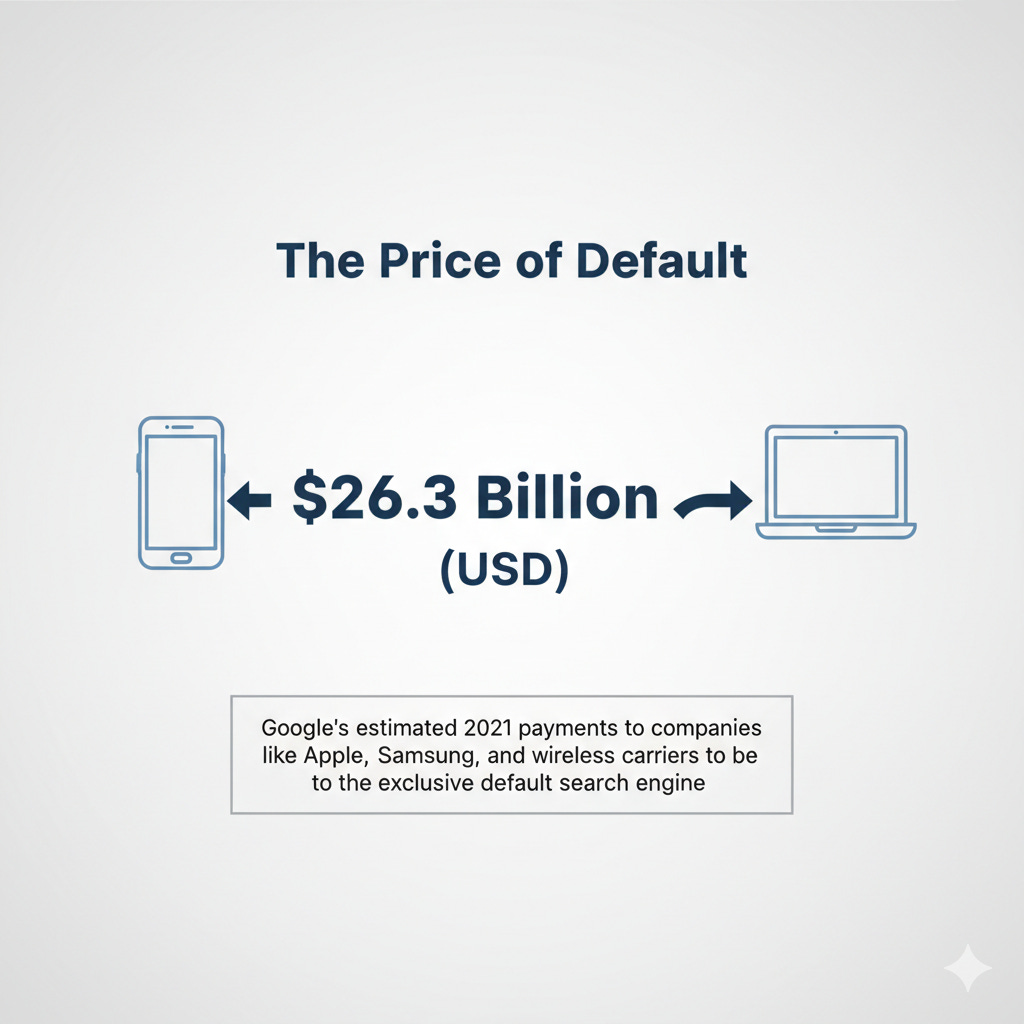
In 2021, Google paid approximately $26.3 billion USD to its distribution partners in accordance with its revenue sharing agreements. The lion’s share of these payments—approximately $20 billion USD—were made to Apple.
This points to a critical question: If your product is truly superior, why spend over twenty-six billion dollars in a single year to prevent users from easily choosing an alternative? Google’s own internal documents, cited in the filing, reveal a clear understanding of the answer. They call defaults a “powerful strategic weapon in the Search battle.” The data supports this. As many as 60% of Google’s total queries are made through these default settings.
The Four Effects of a Frozen Market
The application argues that this strategy is not just aggressive business; it is anti-competitive conduct that has substantially lessened or prevented competition in Canada. The harm manifests in four distinct ways.
Foreclosing Competitors: By locking up the default position on nearly every major device and browser for multi-year periods, Google allegedly denies rivals access to the most critical distribution points.
Denying Scale: Search engines improve with more data. By securing the vast majority of search queries through defaults, Google continuously refines its product while simultaneously starving competitors of the query volume needed to improve their own. A Google employee explained it bluntly in a 2009 email: “If Microsoft had the same traffic we have their quality will improve
significantly, and if we had the same traffic they have, ours will drop significantly. That’s a fact.”
Discouraging Investment: The strategy creates a vicious cycle. Knowing the default positions are bought and paid for, potential competitors are discouraged from investing. As a Microsoft executive testified in the U.S. case, it was “uneconomical” for Microsoft to invest more in Bing’s mobile search because “no amount of investment without securing some way to do distribution in mobile will result in any share gain.”
Creating Stagnation: The result is a market that has been effectively frozen for over a decade. With no serious competitive pressure, the incentive for innovation in quality, consumer choice, or privacy diminishes.
The Agreement That Neutralized a Competitor
The application’s focus narrows in on the “Information Services Agreement” (ISA) between Google and Apple. Here, the Digital Tollbooth Strategy is most potent because Apple is not just a gatekeeper; it is also one of the few companies on the planet with the resources, expertise, and user base to be a formidable competitor to Google in search.
The filing argues the ISA was designed to neutralize this threat. In exchange for the estimated $20 billion USD annually, Apple agrees to make Google the exclusive default search engine on Safari. But the terms go further. The agreement allegedly prohibits Apple from offering a “choice screen” that would let users easily select a default search engine when setting up their device.
Here’s the detail I find most revealing. The payments create a powerful disincentive for Apple to even try to compete. An Apple executive, Eddy Cue, reportedly testified that he could not disagree with the statement that “it was a disincentive for [Apple] to do a search engine based on the payments that [it] w[as] receiving from Google.” An internal Apple analysis from 2018 calculated that if it launched its own search engine and captured 80% of queries on its own devices, it would still lose over $12 billion in revenue over five years because it would have to forfeit Google’s payments. It is more profitable for Apple not to compete with Google.
The Principle on Trial: Public Interest vs. Corporate Power
This specific case connects to a much larger, foundational principle of Canadian governance. Parliament recently amended the Competition Act precisely to empower private citizens to bring forward applications like this one, recognizing that a single public regulator cannot police every corner of the economy. This case is the first major test of that intent.
The applicant, Alexander Martin, is an independent video game developer who relies on search engines for his small business and for navigating the internet, just like millions of other Canadians. The respondents argue he is not a suitable applicant, claiming he lacks specialized expertise and is acting in his own self-interest. They propose a high bar for who can bring a public interest case, suggesting requirements that are not in the Act itself.
This is more than a procedural debate. It is a direct challenge to the principle of private enforcement. The law was changed to provide access to individuals, not just to resource-heavy organizations or industry insiders. How the Competition Tribunal interprets the “genuine interest” of an applicant like Mr. Martin will set the precedent for whether this new avenue for accountability is a real tool for citizens or a path blocked by procedural hurdles only corporations can navigate.
The Cost of an Engineered Reality
The evidence laid out in this filing forces you to confront an uncomfortable truth. Much of our digital reality is not an organic ecosystem shaped by consumer choice but a carefully constructed environment shaped by hidden, multi-billion dollar agreements. The default settings on your devices are some of the most valuable real estate on earth, and they have been bought and paid for in ways that directly limit competition. The true cost is not measured in dollars, but in the lost innovation and reduced choice that result from a market frozen in place. This case is not just about search engines; it is a test of whether our laws are capable of looking behind the curtain.
Sources:
Berger Montague (Canada) PC. (2025, October 1). Applicant’s Reply Written Submissions (Pursuant to section 103.1 (1) of the Competition Act) (Competition Tribunal File No. CT-2025-004). Competition Tribunal.