


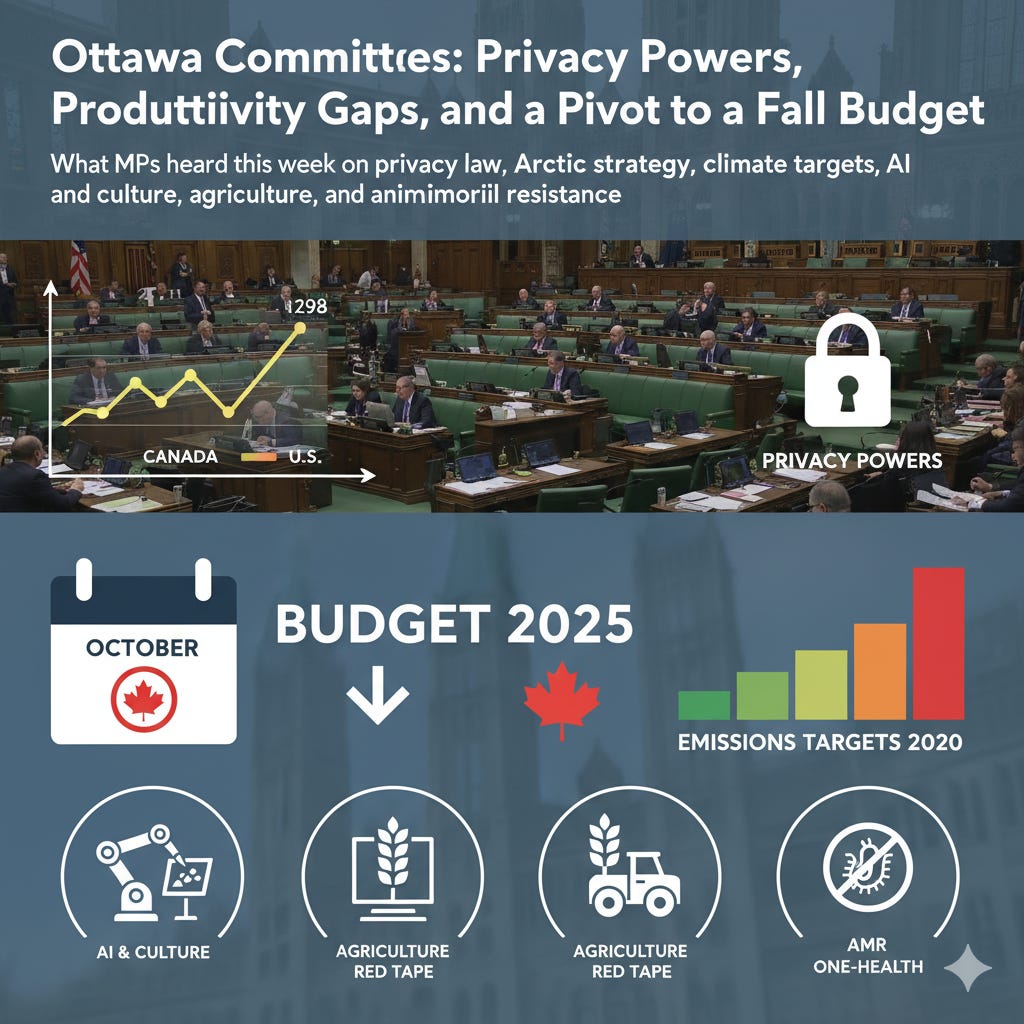
Canada’s committees came back with a full slate. Privacy watchdogs warned about sweeping secrecy powers. Manufacturers pressed MPs on tax and regulatory drag. Finance signalled a structural shift to a fall budget cycle. Climate economists said emissions progress has stalled. Culture groups asked for guardrails on AI. Farmers detailed red tape. Scientists urged a one-health plan on drug resistance. Here is what matters and why.
Privacy: Secrecy powers under Bill C-8 face a necessity test
Conservative MPs pressed Privacy Commissioner Philippe Dufresne on cabinet authority to secretly cut individuals’ phone or internet access and to bar disclosure of such orders. Dufresne repeated his framework: any new state powers must pass necessity and proportionality tests, and secrecy, if used, should be coupled with structured oversight and reporting to appropriate bodies. He signalled “more to be done” on reporting mechanisms and the necessity standard as his office reviews the bill.
What does this mean for you? Expect the committee to probe for amendments that explicitly bake in necessity, proportionality, and independent reporting, rather than leaving them to policy.
Industry & Productivity: Tax, transport, and regulation are the choke points
Canadian Manufacturers & Exporters told MPs that Canada’s labour productivity trails the United States by nearly 30 percent, business investment per worker is about half of U.S. levels, and the gap exposes the economy. CME’s Ryan Greer pointed to three levers: a simpler and more competitive tax system, targeted trade-enabling infrastructure, and systemic regulatory reform. He cited recent U.S. tax changes in the “One Big Beautiful Bill Act,” including immediate expensing and more favourable R&D and international rules, as shifting capital south. CME urged statutory growth mandates for regulators, closing loopholes in the one-for-one rule, and independent grading of cost-benefit analyses, modelled on the U.K.’s Regulatory Policy Committee.
How would this look in practice? Parliament could legislate a competitiveness duty for federal regulators and create an external assessor for regulatory impact analyses to curb optimistic assumptions that mask real costs.
Foreign Affairs: A four-pillar Arctic strategy and a new ambassador
Officials briefed MPs on Canada’s Arctic foreign policy, finalized in December 2024, which responds to a more contested region after Russia’s invasion of Ukraine. The four pillars are: asserting sovereignty alongside defence; advancing interests through pragmatic diplomacy with the U.S. and Nordic partners, including opening consulates in Nuuk and Anchorage; leadership in Arctic governance via stronger Arctic Council engagement; and a more inclusive diplomacy that brings territorial governments and Indigenous partners into international work. The Prime Minister appointed Virginia Mearns as Arctic ambassador, with an office in Iqaluit.
Bottom line: Expect more Canada-U.S.-Nordic alignment on security and rules, plus visible federal presence in the North through new posts.
Finance: Affordability bill now, fall budgets going forward
Finance Minister François-Philippe Champagne defended Bill C-4’s affordability measures, stressing a middle-class tax cut, GST relief for first-time buyers up to 1 million dollars, and repeal of the federal consumer fuel charge from statute. He previewed Budget 2025 for November 4 and announced two structural shifts: adopting a capital budgeting framework to distinguish investments from operations, and moving to a fall budget cycle aligned with Main Estimates and the construction season. He reiterated fiscal anchors of balancing the operating budget within three years and a declining deficit-to-GDP ratio, while fielding opposition questions about higher projected deficits and growth risks.
Why it matters: A fall budget could improve execution timing for infrastructure and give provinces, municipalities, and builders earlier certainty on funding.
Environment: Progress is “real but fragile,” emissions have stalled
Economist Dave Sawyer told MPs that national emissions flatlined in 2024 at around 694 megatonnes, roughly 8 percent below 2005 levels, leaving Canada well off the 2030 target. Gains in electricity are being offset by rising oil sands emissions, now about one-third of national totals. He warned that policy rollbacks and delays, plus new LNG projects, are pushing momentum the wrong way, reducing the expected 2030 reduction to roughly 20 to 25 percent versus the 40 percent goal. His prescription: steady, coordinated federal-provincial policy and a focus on every tonne, not just headline targets.
Takeaway: The policy architecture exists, but without consistent implementation across jurisdictions, the math will not add up to 2030.
Heritage & AI: Creators push “ART” rules for the AI era
Cultural organizations urged MPs to keep copyright human-centred and to regulate generative AI with three pillars: authorization, remuneration, and transparency (ART). The Coalition for the Diversity of Cultural Expressions argued that Canada’s Copyright Act already requires authorization for use of protected works and that purely AI-generated outputs should not get copyright. Witnesses asked for training-data transparency and synthetic content labelling, and flagged the absence of culture sector voices on the new AI strategy expert panel.
Policy implication: Watch for committee recommendations on text-and-data mining, labelling obligations, and inclusion of cultural expertise in federal AI governance.
Agriculture: Make agriculture a cross-government priority, fix labour pathways
Farm groups asked to make agriculture a national priority inside the Cabinet Directive on Regulation, so rulemaking explicitly weighs food security, producer competitiveness, and timelines at PMRA and CFIA. The Canadian Federation of Agriculture urged faster re-evaluations and better international alignment to speed access to pest control products and technologies. Cattle feeders highlighted chronic labour shortages, the complexity of the Temporary Foreign Worker Program, and the cancellation of the Agri-Food Pilot as barriers to moving needed workers to permanent residency.
What would help now? Restore a permanent PR pathway for year-round ag jobs and set service standards at PMRA and CFIA tied to competitiveness metrics.
Science & Research: A one-health plan for antimicrobial resistance
Clinicians and researchers called AMR a growing crisis that already causes more annual deaths globally where it plays a role than HIV, TB, and malaria combined. They urged a one-health approach that integrates human, animal, and environmental surveillance, noting that about 70 percent of global antibiotic consumption is in agricultural animals. Canada’s surveillance is fragmented and often phenotypic; witnesses asked for molecular monitoring, wastewater and hospital surveillance, and a policy framework with a lead body coordinating across jurisdictions.
If you run a hospital, a farm, or a city utility: expect proposals for shared data standards, funding for genomic surveillance, and clearer stewardship rules that span sectors.
The Data Brief
Privacy powers: Commissioner signals gaps on necessity, proportionality, and reporting in Bill C-8’s secrecy regime.
Productivity levers: Manufacturers want statutory growth mandates for regulators, a stronger one-for-one rule, and an independent rater of regulatory impact analysis.
Arctic posture: Four-pillar strategy plus a resident ambassador to deepen North American and Nordic alignment.
Budget shift: Fall budgets and capital budgeting to reweight toward investment, with affordability measures moving now through Bill C-4.
Emissions math: 2024 emissions flat at ~694 Mt; oil sands growth offsets other gains, putting 2030 reductions nearer 20–25 percent.
AI & culture: Push for ART: authorization, remuneration, transparency; no copyright for purely AI-generated content.
Farming red tape: Embed competitiveness in regulation, speed PMRA/CFIA timelines, and reopen a PR stream for ag workers.
AMR plan: Build a coordinated one-health surveillance and stewardship system with genomic monitoring and cross-jurisdiction leadership.
Source Documents
Standing Committee on Access to Information, Privacy and Ethics. Evidence No. 07, October 6, 2025. House of Commons of Canada.
Standing Committee on Industry and Technology. Evidence No. 06, October 6, 2025. House of Commons of Canada.
Standing Committee on Foreign Affairs and International Development. Evidence No. 05, October 7, 2025. House of Commons of Canada.
Standing Committee on Finance. Evidence No. 05, October 6, 2025. House of Commons of Canada.
Standing Committee on Environment and Sustainable Development. Evidence No. 06, October 6, 2025. House of Commons of Canada.
Standing Committee on Canadian Heritage. Evidence No. 05, October 6, 2025. House of Commons of Canada.
Standing Committee on Agriculture and Agri-Food. Evidence No. 06, October 6, 2025. House of Commons of Canada.
Standing Committee on Science and Research. Evidence No. 07, October 6, 2025. House of Commons of Canada.