


The Canadian government recently published its “Retrospective Report on the 45th General Election,” a document detailing the inner workings of the task force charged with protecting our democracy from foreign threats. On the surface, it reads like a standard bureaucratic post-mortem, full of acronyms and carefully worded conclusions. But if you look closer, the report tells a more compelling story. It reveals a quiet, but significant, evolution in how our national security apparatus views both the problem of foreign interference and the role you play in solving it.
For years, the battle against foreign interference has felt like something that happens elsewhere, fought by nameless officials in secure buildings. It’s an abstract threat. The report, however, peels back a layer of this secrecy. It provides a candid look at the specific threats Canada faced in the 2025 election and, more importantly, signals a move away from a strategy of pure secrecy toward one of public engagement. The government is beginning to acknowledge that a resilient democracy cannot be defended by bureaucrats alone.
The Problem: An Alphabet Soup of Secrecy
To understand the shift, you first need to understand the system. The core of Canada’s election defense is the Critical Election Incident Public Protocol (CEIPP). This protocol is administered by a non-partisan group of five senior public servants known as the Panel. Its members include the Clerk of the Privy Council and the Deputy Ministers of Justice, Public Safety, Foreign Affairs, and the National Security and Intelligence Advisor.
During an election, the Panel receives intelligence from the Security and Intelligence Threats to Elections (SITE) Task Force, an operational group with experts from CSIS, the RCMP, Global Affairs Canada, and the Communications Security Establishment. The Panel’s primary job is to decide if an incident is severe enough to threaten a free and fair election, and if so, to make a public announcement.
For the average citizen, this structure is a source of frustration. It is a complex and opaque system of committees and task forces, operating largely in secret. This leaves you, the voter, as a passive spectator in a fight for the integrity of your own democratic process.
The Pathogen: Making the Threat Concrete
The 2025 election report moves beyond abstract warnings by detailing specific interference campaigns. For the first time, the threat has a name and a face.
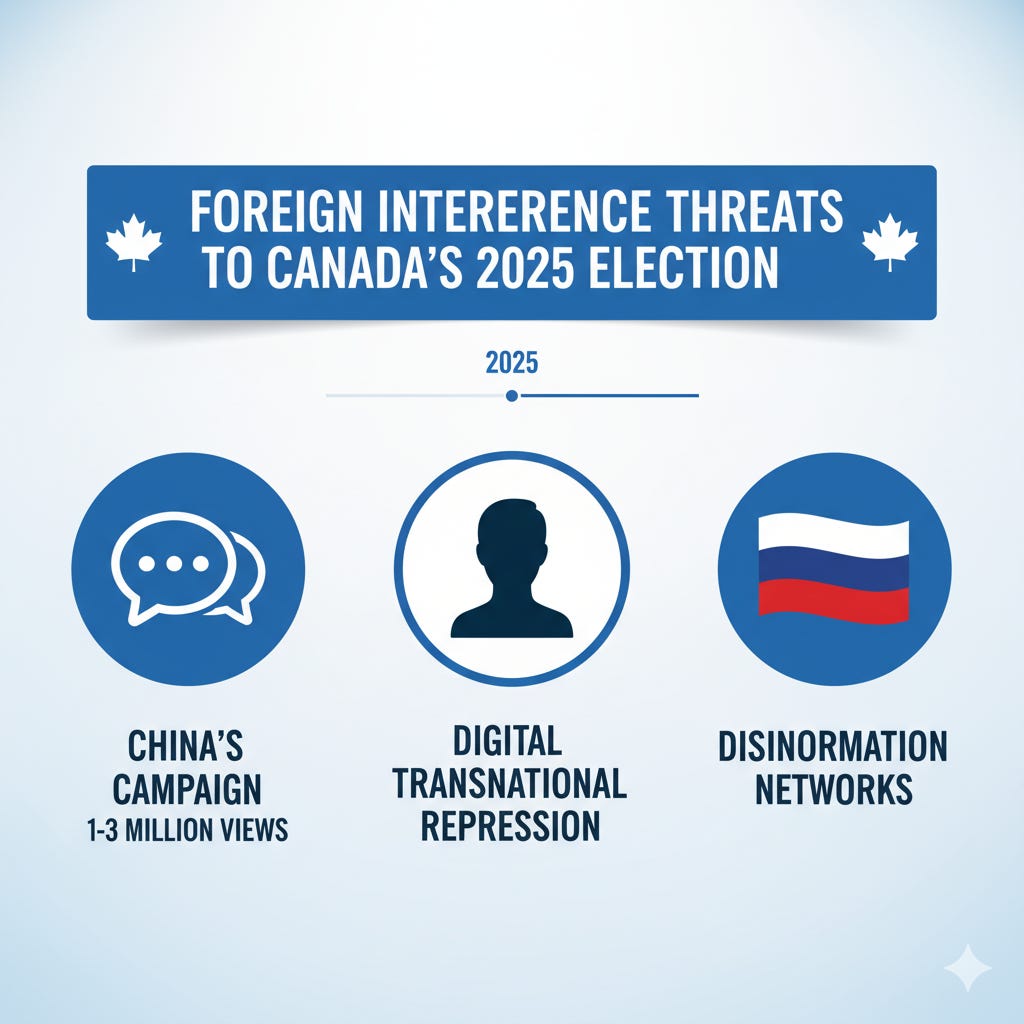
The SITE Task Force report, included as an annex, identifies the People’s Republic of China (PRC) as a primary actor. During the election, a sophisticated information operation targeted then-Prime Minister Mark Carney on WeChat, a social media platform widely used by Chinese-speaking communities. The report notes the campaign’s significant reach:
Amplified articles received between 85,000 and 130,000 interactions, and an estimated one to three million views.
Intelligence linked the main WeChat account behind the campaign to the PRC’s Central Political and Legal Affairs Commission. A foreign government was actively trying to shape the narrative around Canada’s head of government during an election.
Another campaign of digital transnational repression (TNR) targeted Conservative candidate Joseph Tay in the Toronto riding of Don Valley North. Mr. Tay, an activist known for supporting pro-democracy efforts in Hong Kong, was the subject of an arrest warrant and a bounty issued by Hong Kong Police in late 2024. During the election, the SITE Task Force observed “inauthentic and coordinated amplification of content related to the bounty and arrest warrant” alongside content questioning his fitness for office.
The report also identifies efforts by the Russian Federation to leverage a network of websites to “launder and amplify Russian government-controlled media outlets’ aggregated items about Canadian candidates.” While these posts received low engagement, the machinery of disinformation was active and pointed at our election. These were not theoretical threats. They were specific, documented operations aimed at manipulating Canadian voters.
The Prescription: Democratic Inoculation
Faced with these concrete threats, the government’s response in 2025 was different. The report makes it clear that after years of criticism from inquiries and independent reviews, officials recognized the old model of quiet containment was not enough. The new strategy is not just to counter attacks but to build public resilience. Think of this new approach as a form of Democratic Inoculation.
An immune system fights pathogens internally and silently. A public health campaign, however, works by educating the population, explaining the threat, and providing the tools (inoculations) for individuals to build their own immunity. For GE45, the government started a public health campaign for our democracy. The primary tool was a new initiative: weekly technical briefings with the media.
Instead of waiting for a threat to reach a crisis point worthy of a formal Panel announcement, officials from CSIS, the RCMP, and other agencies held regular briefings throughout the campaign. They proactively shared information on the tactics used by foreign actors, from transnational repression to the risks of disinformation, spearphishing, and hack-and-release operations. This was a deliberate effort to arm you with the knowledge needed to recognize and resist manipulation. It was an admission that the strongest defense against disinformation is a public that is too well-informed to fall for it.
The Balancing Act: Transparency vs. Amplification
This new transparency is not absolute. Here’s the detail I find most revealing: the report shows the Panel struggling with the difficult trade-off between raising awareness and inadvertently amplifying the very disinformation they are trying to fight.
In the case of the Russian disinformation network, officials observed low user engagement. A big public announcement naming the specific websites could have driven traffic to them, effectively doing the Kremlin’s work. The Panel’s solution was to use the technical briefings to discuss the tactics “generally,” educating the public on the methods without amplifying the specific message.
The response to the targeting of Joseph Tay was even more nuanced. The Panel spent considerable time deliberating. Their initial action was a technical briefing focused on the general threat of digital TNR, avoiding Mr. Tay’s specific case to protect his privacy and avoid amplifying the campaign. Only after further developments and an “accumulation of incidents” did they conclude that a public notification specifically about the operations targeting Mr. Tay was warranted. This careful, multi-step process demonstrates a sophisticated understanding of the modern information environment. It is a balancing act, and understanding this trade-off is part of being an informed citizen.
Your Role in the Immune Response
The government’s 2025 election report is a document about bureaucracy, but its underlying message is about agency. The shift toward transparency and public education is a tacit admission that a handful of officials in Ottawa cannot be the sole guardians of our democracy. The strategy of “Democratic Inoculation” is an invitation for you to become an active participant. By explaining the threats and the tactics, the government is treating you not as a passive victim to be protected, but as an essential part of the nation’s democratic immune system.
A well-defended democracy is not one where threats are absent, but one where citizens are armed with the clarity to render them irrelevant.
Sources:
Government of Canada. (2025). Retrospective Report on the 45th General Election: Critical Election Incident Public Protocol. Privy Council Office.
Security and Intelligence Threats to Elections Task Force. (2025). Threats to Canada’s 45th general election, after-action report. In Retrospective Report on the 45th General Election: Critical Election Incident Public Protocol. Privy Council Office.