


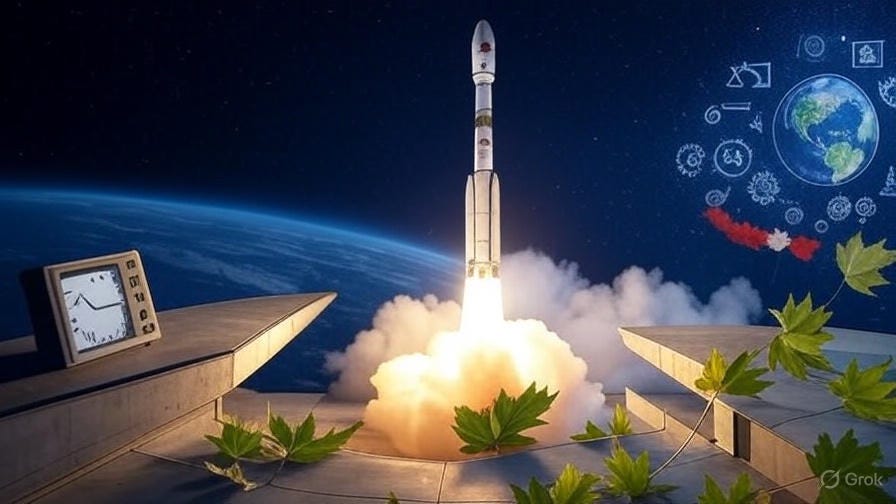
Did you know that while the global space economy races toward $1 trillion by 2040, Canada's space revenues are actually shrinking, ranking us 12th globally and risking an "Avro Arrow moment" where we lose sovereignty and talent forever? In 2023, the Canadian Space Agency (CSA) consulted Canadians on modernizing space regulations, but with 2024-2025 updates like new satellite frameworks and spaceport investments, the urgency has only grown. This affects everyday Canadians through jobs, GPS, climate data, and national security—making it a timely debate amid Starlink expansions and international rivalries.
The Outdated Rules Holding Canada Back
Picture Canada's space regulations as an old smartphone—functional but unable to handle today's apps like satellite mega-constellations or moon mining. The CSA's 2023 consultation, drawing 49 submissions from industry, academia, and the public, highlighted a consensus: modernization is essential to avoid falling behind.
Key insights:
Economic Risks: Outdated rules deter investors and drive companies abroad. A polarizing view, supported by recent expert discussions: Canada's stricter remote sensing regulations compared to the US are fueling a "brain drain," with skilled workers leaving for better opportunities—verified in 2025 departmental reports and X conversations noting our 22nd place in GDP share for space spending.
Global Landscape: As the only G7 nation without sovereign launch capabilities, Canada misses out on the commercial space rush. Recent progress includes the 2024 US-Canada Technology Safeguards Agreement, enabling sensitive tech sharing for launches.
It's like outdated highway rules blocking electric vehicles—stifling innovation in areas like in-orbit servicing.
This builds on the 2019 national space strategy, with 2025 updates emphasizing debris mitigation and satellite coverage.
Priorities for a Modern Framework: Innovation, Sustainability, and Speed
Feedback outlined a flexible, comprehensive approach to cover emerging tech while adapting quickly.
Standout recommendations:
Boost Innovation: Use "regulatory sandboxes" for testing new tech, with lighter rules for low-risk projects like student satellites.
International Alignment: Harmonize with partners to curb "regulation shopping" and lead on space safety.
Sustainability Focus: Mandate debris reduction and environmental protections, including climate monitoring via space systems. Controversial element: Satellite constellations like Starlink could disrupt Indigenous views of the "dark sky"—prompting calls for consultations, as seen in ongoing 2025 debates.
Risk Management: Proportional requirements, emphasizing cybersecurity and accountability.
Security Balance: Update for dual-use tech without hindering growth.
Administrative Efficiency: Online portals and clear timelines to aid small businesses.
Did You Know? Recent 2025 consultations on space debris and satellite mobile coverage show progress, but participants warn delays could cost 650 jobs and $2.5 billion in economic growth from projects like Spaceport Canada.
Specific Activities: Launches, Satellites, and Beyond
Consultants provided targeted input, now amplified by 2024-2025 developments.
Launches: Prioritize safety, environment, and communities. With NordSpace's $5 million spaceport investment and the US agreement, Canada eyes its first sovereign launch—potentially creating hundreds of jobs but sparking debates over provincial regulations.
Remote Sensing: Revise the 2005 Act for current threats; US leniency gives them an advantage.
Satellite Constellations: Address light pollution; 2025 frameworks for supplemental coverage aim to expand rural connectivity.
Space Resource Utilization: Enact national laws, informed by UN work.
Spectrum and More: Improve access for testing; even medical licensing for spaceflight pros was raised.
These align with 2025 departmental plans accelerating SMRs and nuclear tech for space.
Broader Vision: Policy, Governance, and Inclusion
Beyond regs, calls for a national policy and governance body persist.
National Policy: Focus on strengths like robotics and geography for leadership in sustainability.
Governance: A Canadian Space Council, modeled on the US, for coordination.
Industry Support: Funding and partnerships to retain talent amid brain drain concerns.
Traffic Management: Collision avoidance in low Earth orbit.
Diversity: Engage Indigenous and equity groups.
Youth Inspiration: STEM opportunities to build the next generation.
Without action, Canada faces permanent loss of capabilities, as echoed in 2025 expert analyses.
Launching Forward: Time for Action
Canada's space future hinges on modern rules fostering growth while ensuring sustainability—delays risk economic and sovereign setbacks, but updates like 2025 satellite frameworks offer hope. Controversial yet fact-based: Stricter regs than peers could exacerbate talent flight, but leading on "dark sky" protections might position us as ethical innovators.
Share if you believe Canada should reclaim its space legacy! Follow @OnHansard for policy insights, and explore more at onhansard.substack.com. Informed citizens drive change in our tech-driven world.
Sources: Canadian Space Agency. (2024). What We Heard Report: Consulting Canadians on a modern regulatory framework for space. ST99-87/2024E-PDF. Innovation, Science and Economic Development Canada. (2025). Decision on a Policy, Licensing and Technical Framework for Supplemental Mobile Coverage by Satellite. https://ised-isde.canada.ca/site/spectrum-management-telecommunications/en/learn-more/key-documents/consultations/decision-policy-licensing-and-technical-framework-supplemental-mobile-coverage-satellite
Innovation, Science and Economic Development Canada. (2025). Consultation on Changes to Licensing Requirements and Conditions of Licence for Space Debris Mitigation. https://ised-isde.canada.ca/site/spectrum-management-telecommunications/en/learn-more/key-documents/consultations/consultation-changes-licensing-requirements-and-conditions-licence-space-debris-mitigation
Natural Resources Canada. (2025). Natural Resources Canada Science and Technology Strategy 2025. https://natural-resources.canada.ca/corporate/natural-resources-canada-science-technology-strategy-2025
The Hub. (2024). Canadians need space regulation, government report suggests. https://thehub.ca/2024/02/21/canadians-want-space-regulation-government-report-suggests