


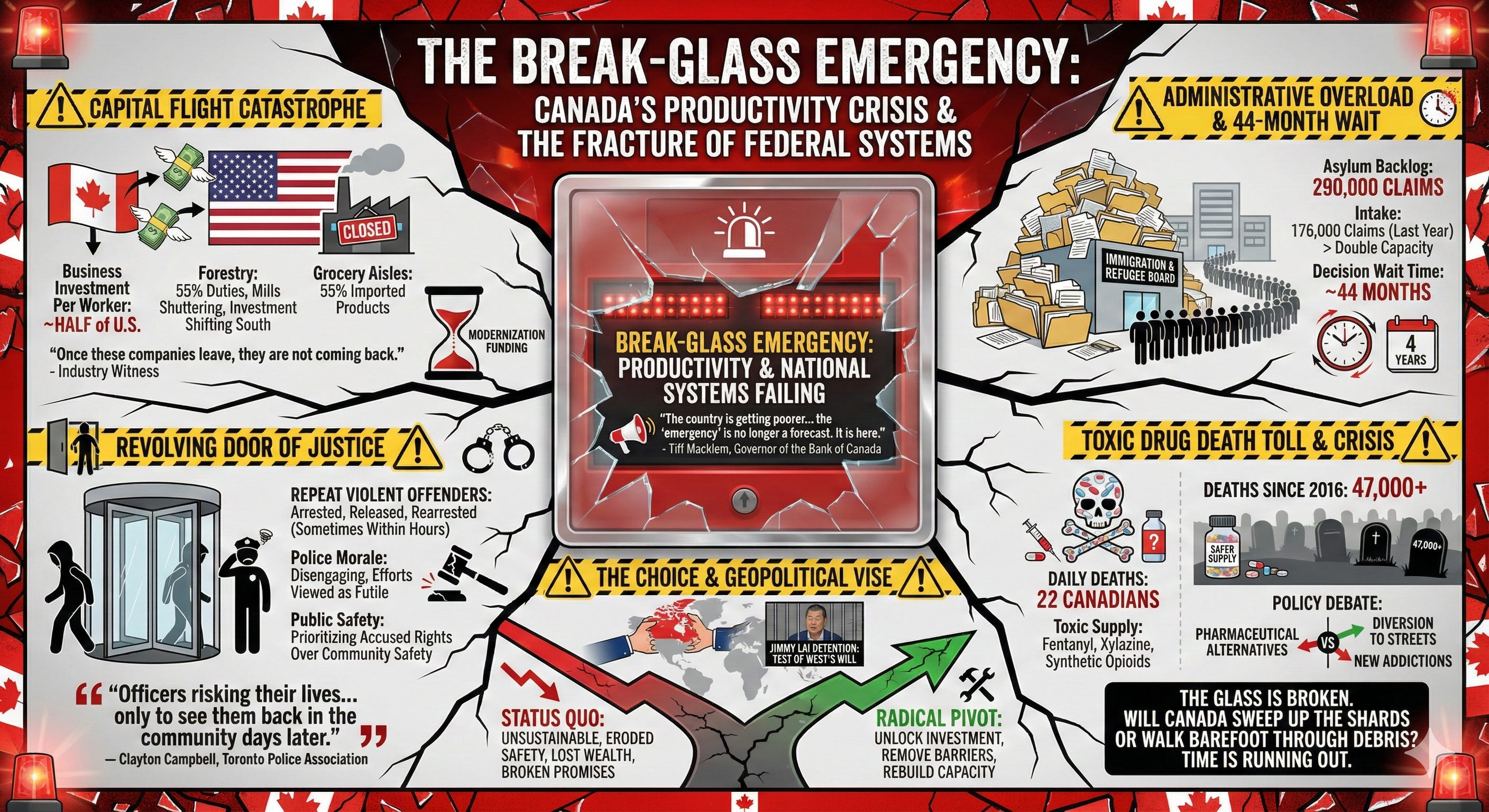
It began with a warning that should have stopped the presses. Carolyn Rogers, Senior Deputy Governor of the Bank of Canada, did not mince words when she sat before the Standing Committee on Finance. She described the nation’s economic trajectory not as a slump, but as a “break-glass emergency.” For forty years, economists have politely nudged governments to address the widening gap between Canadian and American output. That time is over. The polite nudges have been replaced by flashing red lights. Governor Tiff Macklem, sitting beside her, delivered a sombre forecast: without a radical pivot, Canada’s standard of living will not just stagnate—it will settle onto a permanently lower path. The country is getting poorer relative to its peers, and the “emergency” is no longer a forecast. It is here.
This economic attrition is not happening in a vacuum. It is the backdrop against which every other federal system is beginning to buckle. Over the course of dozens of committee meetings this session, witness after witness—from police chiefs to forestry executives, from refugee adjudicators to grieving mothers—painted a portrait of a nation where the core functions of governance are being overwhelmed by volume, complexity, and a lack of capacity. The productivity crisis is not just about GDP; it is about the eroding ability of the state to deliver on its most basic promises: prosperity, security, and justice.
The Capital Flight Catastrophe
The warning signs in the industrial sector are flashing neon. In the Committee on Industry and Technology, the testimony was a litany of missed opportunities and capital flight. Theo Argitis of the Business Council of Canada diagnosed the productivity ailment as, fundamentally, an “investment crisis.” Canadian industries are “capital starved,” and for more than a decade, the country has failed to attract the private sector money needed to modernize. The numbers are damning: business investment per worker in Canada is roughly half that of the United States.
The consequences are visceral. In the forestry sector, witnesses described a “perfect storm” of punitive U.S. tariffs, regulatory paralysis, and fiber supply shortages that are shuttering mills and devastating rural communities. Andrew Rielly, a lumber executive, described the “financial and emotional strain” on small operators who are paying millions in duties to the U.S. government—money that should be reinvested in Canadian operations but is instead sitting in American accounts. The industry is contracting, with companies like Canfor paying 55% duties and shifting investment south of the border. As one witness bluntly put it, once these companies leave, “they are not coming back.”
This is the “tipping point” described by Michael Graydon of Food, Health & Consumer Products of Canada. Manufacturing capacity has quietly migrated south for decades, driven by a regulatory environment that he described as “outdated, inflexible, and out of step.” The result? Fifty-five percent of products in the center aisles of Canadian grocery stores are now imported. We are losing the ability to make things, and with it, the high-wage jobs that sustain the middle class.
The 44-Month Wait
While the economic engine sputters, the administrative state is groaning under the weight of unprecedented demand. Nowhere is this more evident than in the immigration system. Manon Brassard, Chairperson of the Immigration and Refugee Board (IRB), revealed a statistic that stopped the Citizenship and Immigration Committee cold: the backlog of asylum claims has reached 290,000.
The system is overwhelmed. Intake has exploded, with 176,000 claims in the last year alone—more than double the funded capacity. For a refugee claimant arriving today, the wait for a decision is approximately 44 months. That is nearly four years of limbo, of waiting to know if they can build a life or if they will be sent back.
The strain is forcing the government to contemplate drastic measures. Bill C-12 proposes to fundamentally alter the asylum landscape, introducing provisions that would bar claims from individuals who have been in Canada for more than a year or who entered irregularly. Legal experts warned the committee that these changes could violate the Charter and international obligations, potentially creating a new class of people in “legal limbo”—unable to claim asylum, yet coming from moratorium countries like Haiti or Venezuela to which they cannot be deported. The proposed “mass cancellation” powers for visa applications raised further alarms about arbitrary executive power and the erosion of due process.
The Revolving Door of Justice
If the immigration system is clogged, the justice system is accused of being dangerously porous. In the Justice Committee, the frustration of law enforcement leaders was palpable. They described a “revolving door” where repeat violent offenders are arrested, released on bail, and rearrested—sometimes within hours.
Clayton Campbell of the Toronto Police Association brought the reality of the streets into the committee room. He spoke of officers risking their lives to apprehend armed gang members, only to see them back in the community days later. He recounted the tragic murder of an eight-year-old boy, shot in his bed, noting that one of the youths arrested was already out on release for firearm offences. The “principle of restraint” in bail provisions, intended to address the over-incarceration of marginalized groups, is being viewed by police as a failure that prioritizes the rights of the accused over the safety of the community.
The system’s failure is also measuring in morale. Police leaders warned of officers “disengaging”—choosing not to be proactive because they view their efforts as futile. The justice system, they argued, has swung too far, losing sight of the victim in its attempt to be fair to the offender.
The Toxic Drug Death Toll
Perhaps the most harrowing testimony came from the Health Committee’s study on the opioid epidemic. The numbers are staggering: 47,000 Canadians dead since 2016. That is more than the population of many towns represented by the members around the table.
Witnesses described a “toxic drug supply” that has become a weapon of mass destruction. Fentanyl, xylazine, and other synthetic opioids are killing twenty-two Canadians every day. The testimony revealed a deep philosophical and policy divide on how to stop the bleeding. Some advocated for “safer supply”—providing pharmaceutical alternatives to the toxic street drugs—arguing that dead people cannot recover. Others, including addiction specialists, warned that government-funded drugs are being diverted to the street, creating new addictions and fueling the very crisis they are meant to solve.
Dr. Sharon Koivu testified that she is seeing patients seeking treatment not for fentanyl, but for the hydromorphone provided by safer supply programs. The committee heard heart-wrenching stories of parents who lost children, not to a back-alley deal, but to drugs that originated in a pharmacy. The consensus was non-existent; the despair was absolute.
The Geopolitical Vise
While domestic systems strain, Canada’s standing on the world stage is being tested by the detention of Jimmy Lai. The 77-year-old pro-democracy campaigner and British citizen has been held in solitary confinement in Hong Kong for nearly five years. His son, Sebastien Lai, appeared before the Foreign Affairs Committee to plead for his father’s life.
The testimony painted a picture of a man being slowly crushed by a regime intent on making an example of him. International legal counsel described his treatment as “inhuman and degrading,” a violation of international law. The committee heard that engaging with Canadian parliamentarians was listed as part of the “criminal” activity in Lai’s charges—a direct affront to Canadian sovereignty. Witnesses urged the government to use its G7 presidency to lead a coalition demanding Lai’s release, framing it not just as a human rights issue, but as a test of the West’s willingness to stand up to authoritarian overreach.
The Choice
The composite image formed by these transcripts is of a nation at a crossroads. The “productivity crisis” is not an abstract economic theory; it is the root cause of the resource scarcity that is breaking other systems. Without the wealth generated by a productive economy, there is no money to clear the asylum backlog, to fix the bail system, to treat addiction, or to project power globally.
As economists warned, the “messy house” cannot be cleaned with a single gesture. It requires a relentless, sector-by-sector focus on unlocking investment and removing barriers. But time is the one resource Canada is running out of. The buffer provided by past prosperity is wearing thin. The message from the witnesses—whether they were talking about lumber, refugees, or bail—was identical: the status quo is unsustainable. The glass has been broken. The question now is whether the country has the will to sweep up the shards and rebuild, or if it will continue to walk barefoot through the debris.
Source Documents
Anani, N. (2025, November 17). Evidence. Standing Committee on Industry and Technology.
Argitis, T. (2025, November 17). Evidence. Standing Committee on Industry and Technology.
Barber, T. (2025, November 6). Evidence. Standing Committee on Agriculture and Agri-Food.
Bawden, M. (2025, November 6). Evidence. Standing Committee on Agriculture and Agri-Food.
Bizzarro, M. (2025, November 6). Evidence. Standing Committee on Human Resources, Skills and Social Development and the Status of Persons with Disabilities.
Blanchard, D. (2025, November 6). Evidence. Standing Committee on Government Operations and Estimates.
Brassard, M. (2025, November 6). Evidence. Standing Committee on Citizenship and Immigration.
Breton, D. (2025, November 6). Evidence. Standing Committee on Environment and Sustainable Development.
Campbell, C. (2025, September 25). Evidence. Standing Committee on Justice and Human Rights.
Chartrand, R. (2025, November 17). Evidence. Standing Committee on Indigenous and Northern Affairs.
Cheff, E. (2025, November 6). Evidence. Standing Committee on Agriculture and Agri-Food.
Côté, P. (2025, November 5). Evidence. Standing Committee on Canadian Heritage.
de Vries, A. (2025, November 6). Evidence. Standing Committee on Natural Resources.
Donald, F. (2025, November 17). Evidence. Standing Committee on Industry and Technology.
Drapeau, M. (2025, November 6). Evidence. Standing Committee on National Defence.
Dubois, M. (2025, November 6). Evidence. Standing Committee on Official Languages.
Enders, S. (2025, November 5). Evidence. Standing Committee on Canadian Heritage.
Fortier, M. (2025, November 6). Evidence. Standing Committee on Environment and Sustainable Development.
Fowler, R. (2025, November 6). Evidence. Standing Committee on National Defence.
Gallagher, C. (2025, November 6). Evidence. Standing Committee on Foreign Affairs and International Development.
Ghosh, A. (2025, November 5). Evidence. Standing Committee on Canadian Heritage.
Graydon, M. (2025, November 17). Evidence. Standing Committee on Industry and Technology.
Green, D. (2025, November 6). Evidence. Standing Committee on Environment and Sustainable Development.
Green, J. (2025, November 6). Evidence. Standing Committee on Citizenship and Immigration.
Gull-Masty, M. (2025, November 17). Evidence. Standing Committee on Indigenous and Northern Affairs.
Gullo, M. (2025, November 17). Evidence. Standing Committee on Industry and Technology.
Haakstad, K. (2025, November 6). Evidence. Standing Committee on Natural Resources.
Hornby, C. (2025, October 27). Evidence. Standing Committee on Environment and Sustainable Development.
Hussan, S. (2025, November 6). Evidence. Standing Committee on Human Resources, Skills and Social Development and the Status of Persons with Disabilities.
Kovrig, M. (2025, November 6). Evidence. Standing Committee on Foreign Affairs and International Development.
Kyriazis, J. (2025, November 6). Evidence. Standing Committee on Environment and Sustainable Development.
Lai, S. (2025, November 6). Evidence. Standing Committee on Foreign Affairs and International Development.
LaRush, L. (2025, November 6). Evidence. Standing Committee on Agriculture and Agri-Food.
Larocque, M. (2025, November 6). Evidence. Standing Committee on Official Languages.
MacKenzie, M. (2025, November 6). Evidence. Standing Committee on National Defence.
Macklem, T. (2025, November 5). Evidence. Standing Committee on Finance.
Mailloux, N. (2025, November 6). Evidence. Standing Committee on Agriculture and Agri-Food.
Miller, D. (2025, October 27). Evidence. Standing Committee on Environment and Sustainable Development.
Morrow, J. (2025, November 4). Evidence. Standing Committee on Official Languages.
Penner, B. (2025, November 6). Evidence. Standing Committee on Environment and Sustainable Development.
Power, M. (2025, November 4). Evidence. Standing Committee on Official Languages.
Rainville, E. (2025, October 27). Evidence. Standing Committee on Environment and Sustainable Development.
Rielly, A. (2025, November 6). Evidence. Standing Committee on Natural Resources.
Rogers, C. (2025, November 5). Evidence. Standing Committee on Finance.
Sauvé, B. (2025, September 25). Evidence. Standing Committee on Justice and Human Rights.
Savage, S. (2025, October 27). Evidence. Standing Committee on Environment and Sustainable Development.
Silver, B. (2025, November 6). Evidence. Standing Committee on Foreign Affairs and International Development.
Skuterud, M. (2025, November 6). Evidence. Standing Committee on Human Resources, Skills and Social Development and the Status of Persons with Disabilities.
Smith, M. (2025, November 6). Evidence. Standing Committee on Environment and Sustainable Development.
Stamatakis, T. (2025, September 25). Evidence. Standing Committee on Justice and Human Rights.
St-Amour, N. (2025, November 4). Evidence. Standing Committee on Government Operations and Estimates.
Stivers, J. (2025, November 6). Evidence. Standing Committee on Foreign Affairs and International Development.
St.John, B. (2025, November 6). Evidence. Standing Committee on Natural Resources.
Swampy, D. (2025, October 27). Evidence. Standing Committee on Environment and Sustainable Development.
Thériault, L. (2025, November 6). Evidence. Standing Committee on Natural Resources.
Veall, M. (2025, November 17). Evidence. Standing Committee on Industry and Technology.
Wallace, S. (2025, November 6). Evidence. Standing Committee on Citizenship and Immigration.
Williamson, J. (2025, November 4). Evidence. Standing Committee on Official Languages.