


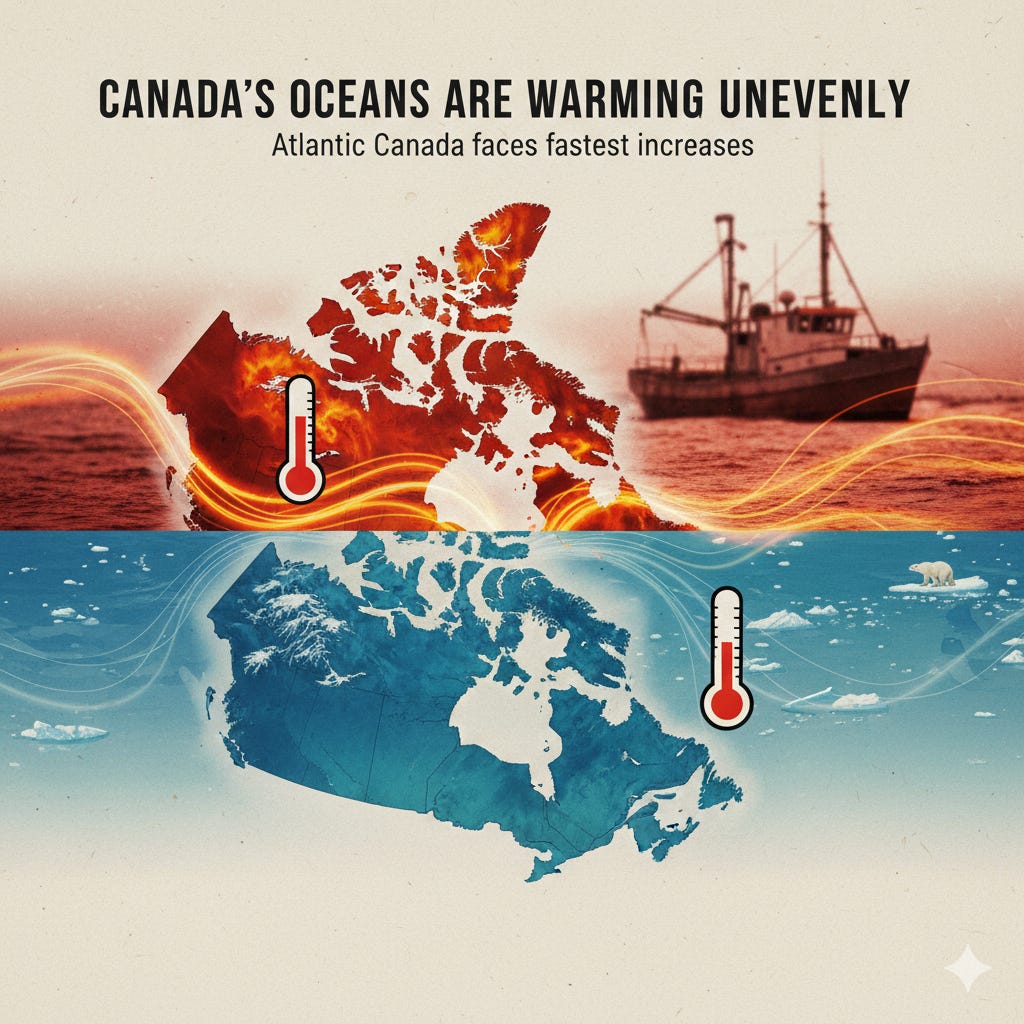
A new technical report published by Fisheries and Oceans Canada in 2025, titled Past and future sea surface temperature changes in the oceans surrounding Canada, offers a sober and data-rich analysis of the country’s vast marine environments. For a nation with the world’s longest coastline, understanding the thermal shifts in the Atlantic, Pacific, and Arctic oceans isn’t an abstract scientific exercise. It’s a critical look into the future of our fisheries, coastal communities, and marine ecosystems. The report combines historical data stretching back to the 1950s with advanced climate model projections to paint a picture of a country whose surrounding waters are changing, but not all in the same way or at the same pace.
The Big Picture: A Clear Warming Trend
The report begins by confirming a broad, undeniable trend: the oceans are warming. Analyzing data from 1950 to 2022, the authors show that both the North Atlantic and North Pacific oceans have experienced stronger warming trends than the global average. The North Atlantic, for instance, warmed at a rate per decade between 1970 and 2022, more than double the global ocean trend per decade.
This long-term warming is punctuated by significant multi-decadal swings, particularly in the Atlantic and Pacific basins. The report notes that these natural variations can make it challenging to isolate human-caused trends over shorter periods. However, the overall trajectory since the mid-20th century is clear. This finding sets the stage for a more detailed look at how this large-scale warming is playing out in Canada’s own backyard.
A Tale of Three Coasts: Stark Regional Divides
The most striking finding in the report is the significant variation in warming across Canadian waters. The story is not one of uniform temperature rise; instead, it is a narrative of regional hotspots and slower-changing areas.
Atlantic Canada: The Epicentre of Change
The waters off Atlantic Canada are warming dramatically faster than other regions. The report identifies the Gulf of Maine, Scotian Shelf, Gulf of St. Lawrence, and the southern Newfoundland Shelf as the areas with the largest historical sea surface temperature (SST) increases.
When comparing the recent decade (2012-2022) to a mid-century baseline (1955-1980), the Scotian Shelf stands out with a stunning annual average temperature increase. The Gulf of Maine, Gulf of St. Lawrence, and southern Newfoundland Shelf all saw increases. The report suggests this intense warming is linked to the complex interplay between the cold Labrador Current and the warm Gulf Stream.
The Pacific and Arctic: A More Muted Story
In contrast, Canada’s Pacific and Arctic waters show more moderate changes. The British Columbia Shelf saw its SST warm by a rate similar to that of the Labrador Shelf in the north Atlantic.
Further north, the influence of sea ice remains a dominant factor. Baffin Bay experienced the smallest historical warming of all 10 regions studied. The southern Beaufort Sea, while still an Arctic environment, showed slightly more warming. This highlights how the presence of ice cover significantly limits SST increases, though this is changing rapidly, especially during the summer months.
Future Projections: The Gaps Widen
Looking ahead to the middle of this century (2040-2059), the report uses a 22-member ensemble of global climate models to project future SST changes under various emissions scenarios. The projections confirm that the regional disparities observed historically are set to continue and, in some cases, intensify.
Under a medium emissions scenario (SSP2-4.5), the Gulf of St. Lawrence is projected to have the largest annual temperature increase. The Gulf of Maine and Scotian Shelf are not far behind. At the other end of the spectrum, Baffin Bay is projected to see the smallest annual increase.
The projections for summer (July-September) are even more alarming, particularly in the north. Freed from winter ice cover, the southern Beaufort Sea is projected to see the largest summer SST increase. This reveals how declining sea ice will expose Arctic waters to unprecedented atmospheric warming during the summer, a change with profound ecological implications. The report does caution that the climate models tend to underestimate the observed warming on the Scotian Shelf, suggesting that future projections for that specific region may be conservative.
The Data Brief
Atlantic Warming Hotspot: The Scotian Shelf has experienced the largest historical warming.
National Disparities: Southern Atlantic Canada regions (Gulf of Maine, Scotian Shelf, Gulf of St. Lawrence) have warmed significantly more than the Pacific, Arctic, and northern Atlantic regions.
Future Projections (Annual): By mid-century (2040-2059), the Gulf of St. Lawrence is projected to see the largest annual warming across four different emissions scenarios.
Future Projections (Summer): The southern Beaufort Sea is projected to experience the most extreme summer warming by mid-century.
Model Limitations: The report notes that global climate models tend to underestimate the observed warming on the Scotian Shelf, meaning future changes there could be even greater than projected.
A Future of Regional Divergence
This federal analysis moves the conversation about climate change from a single national narrative to a more complex and urgent story of regional divergence. The data makes it clear that the consequences of a warming planet will not be distributed evenly across our coastlines. Atlantic Canada is on the front line, facing a future where its marine ecosystems will be forced to adapt to thermal conditions far outside their historical norms. Meanwhile, the rapid opening of the Arctic during summer heralds a fundamental transformation of that environment. Canada’s climate challenge is not one problem, but many, each demanding a unique, regionally-focused understanding.
Source Documents
Wang, Z., Greenan, B.J.W, Hannah, C.G., & Layton, C. (2025). Past and future sea surface temperature changes in the oceans surrounding Canada. Canadian Technical Report of Hydrography and Ocean Sciences 404. Fisheries and Oceans Canada.