


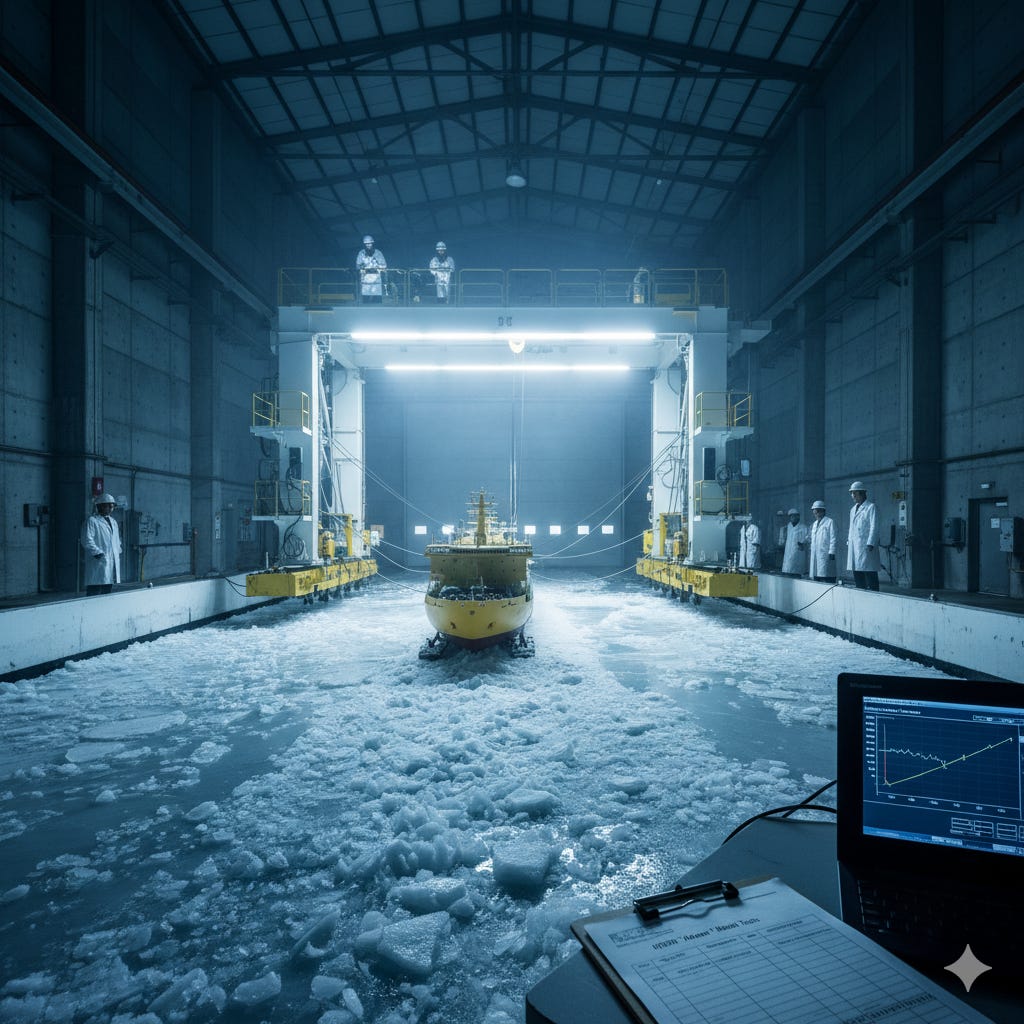
A modern icebreaker is a marvel of engineering, a multi-million-dollar vessel designed to conquer one of the planet’s most hostile environments. But how do you ensure such a ship can actually perform its duties-crashing through thick ice, maneuvering in packed floes, and maintaining power in extreme cold-before it ever leaves the shipyard? The answer, as revealed in a detailed 2011 technical report from Canada’s National Research Council (NRC), lies in a specialized laboratory in St. John’s, Newfoundland. The report, titled KORDI “Araon” model tests in ice using the Planar Motion Mechanism, documents the exhaustive testing of a scale model of the Korean research icebreaker Araon. It offers a rare look inside the world of high-stakes naval architecture, where miniature ships in controlled environments provide the critical data needed to build the real thing.
This process is a collaboration between the NRC’s Institute for Ocean Technology (IOT) and international partners like the Maritime and Ocean Engineering Research Institute of Korea. By shrinking a massive icebreaker down to a 1:20 scale model and putting it through its paces in a refrigerated test tank, Canadian researchers can predict a full-scale ship’s performance with remarkable accuracy. This isn’t just an academic exercise; it’s a crucial step in de-risking massive infrastructure projects and advancing the science of Arctic navigation for countries around the world.
The Floating Laboratory
The heart of the operation is the IOT Ice Tank. At 90 metres long, it is the longest facility of its kind in the world, as detailed in the report. This unique environment allows engineers to create customized, scaled-down ice sheets under controlled conditions. The tank’s main towing carriage is a massive piece of equipment designed to pull or guide ship models through the ice at precise speeds, ranging from a barely perceptible crawl of 0.0002 m/s to a brisk 4.0 m/s.
Inside the tank, researchers don’t just freeze tap water. They grow sophisticated model ice, specifically a type referred to as CD-EG/AD/S ice, which is infused with air bubbles to correctly scale its density and elastic properties. Throughout the testing period for the Araon, scientists frequently measured the ice’s flexural, compressive, and shear strengths to ensure the model’s environment accurately simulated full-scale conditions. For this project, ice sheets of 20 mm, 40 mm, and 60 mm were grown, corresponding to full-scale ice thicknesses of 0.4 m, 0.8 m, and 1.2 m, respectively.
Building a Miniature Icebreaker
The model itself, IOT Model 850, is a perfect 1:20 scale replica of the Korean icebreaker Araon. At 5.36 metres long, it was constructed with exacting detail, down to the hull’s yellow paint, which was chosen to provide a specific hull-ice friction coefficient of 0.05. The model was outfitted with fully functional, scaled-down azimuthing podded propulsors-a modern propulsion system where the propellers are mounted on steerable pods, eliminating the need for a traditional rudder.
These miniature pods are not just for show; they are complex instruments in their own right. Each pod unit contains a dynamometer with six load cells to measure forces and moments, along with separate sensors for propeller thrust and torque. This allows researchers to capture a complete performance picture of the propulsion system as it interacts with the water and ice.
Putting the Araon to the Test
With the model and the ice sheet prepared, the Araon was subjected to a battery of tests using a Planar Motion Mechanism (PMM). This apparatus controls the model’s surge, sway, and yaw, guiding it along pre-programmed paths-like straight lines, zig-zags, and circles-while measuring the forces exerted on the hull. This allows for a systematic study of resistance, propulsion, and maneuverability.
A key part of the analysis involved breaking down the total resistance a ship experiences in ice into four distinct components:
Breaking resistance ($R_{br}$): The force required to fracture the ice sheet.
Clearing resistance ($R_c$): The force needed to push the broken ice pieces out of the ship’s path.
Buoyancy resistance ($R_b$): The force from submerging the ice pieces under the hull.
Open water resistance ($R_{OW}$): The standard hydrodynamic drag.
To isolate these forces, researchers conducted tests in both solid “level ice” and in channels of “pre-sawn” ice. The pre-sawn tests cleverly eliminate the breaking component, allowing engineers to measure the forces associated with clearing and submerging ice independently. By systematically testing across different ice thicknesses and concentrations (from 6/10ths to 9/10ths pack ice), the team built a comprehensive performance profile.
One of the report’s most significant contributions is its prediction of the full-scale power requirements using what is known as the Overload Method. This involves determining the hydrodynamic torque needed to generate thrust equal to the ice resistance and then applying a correction factor for propeller-ice interaction. The analysis produced a clear, actionable conclusion:
To break 1-m level ice at 3.0 knots, the Araon requires a delivered power of 9.45 MW. This contrasts with the open water delivered power of 225.17kW.
From Physical Model to Digital Twin
Beyond physical testing, the project also involved numerical simulations using DECICE (Discrete Element Code for ICE-related problems), a proprietary NRC software. This tool creates a “digital twin” of the icebreaker and simulates its transit through a virtual ice sheet. The report shows that the predictions from the DECICE software agreed well with the physical model test data. For example, in 1.2-metre-thick ice, the model test predicted an ice resistance of 1.065 MN at a speed of 2.68 m/s, while the DECICE simulation predicted 1.030 MN-a close match that validates both methodologies. This dual approach of physical and numerical modeling represents the state-of-the-art in naval architecture, providing a robust check on performance predictions.
A Legacy of Arctic Expertise
The testing of the Araon is a powerful illustration of how deep institutional knowledge, specialized infrastructure, and meticulous scientific method combine to solve immense real-world challenges. While the report focuses on a single Korean vessel, its findings and the methodologies it employs are a testament to Canada’s quiet but essential role as a global leader in the science of the cold. The work done at the Institute for Ocean Technology ensures that ships operating in the polar regions are not just designed to survive, but engineered to perform. In the quiet precision of a St. John’s test tank, the future of safe passage through the world’s iciest waters is written, one miniature ice floe at a time.
Sources
Lau, M., & Akinturk, A. (2011). KORDI “Araon” model tests in ice using the Planar Motion Mechanism (LM-2011-04). National Research Council of Canada, Institute for Ocean Technology.
URL Slug
canadas-ice-lab-tests-ships
Word Count
895
What a fascinating read! Thank you for revealing this incredible engineering. It's truly amazing how they simulate such extreme conditions with scale models to ensure these massive icebreakers are fit for purpuse. Such a clever approach for de-risking big projects and advancing our Arctic navigation knowlege. Brilliant!