


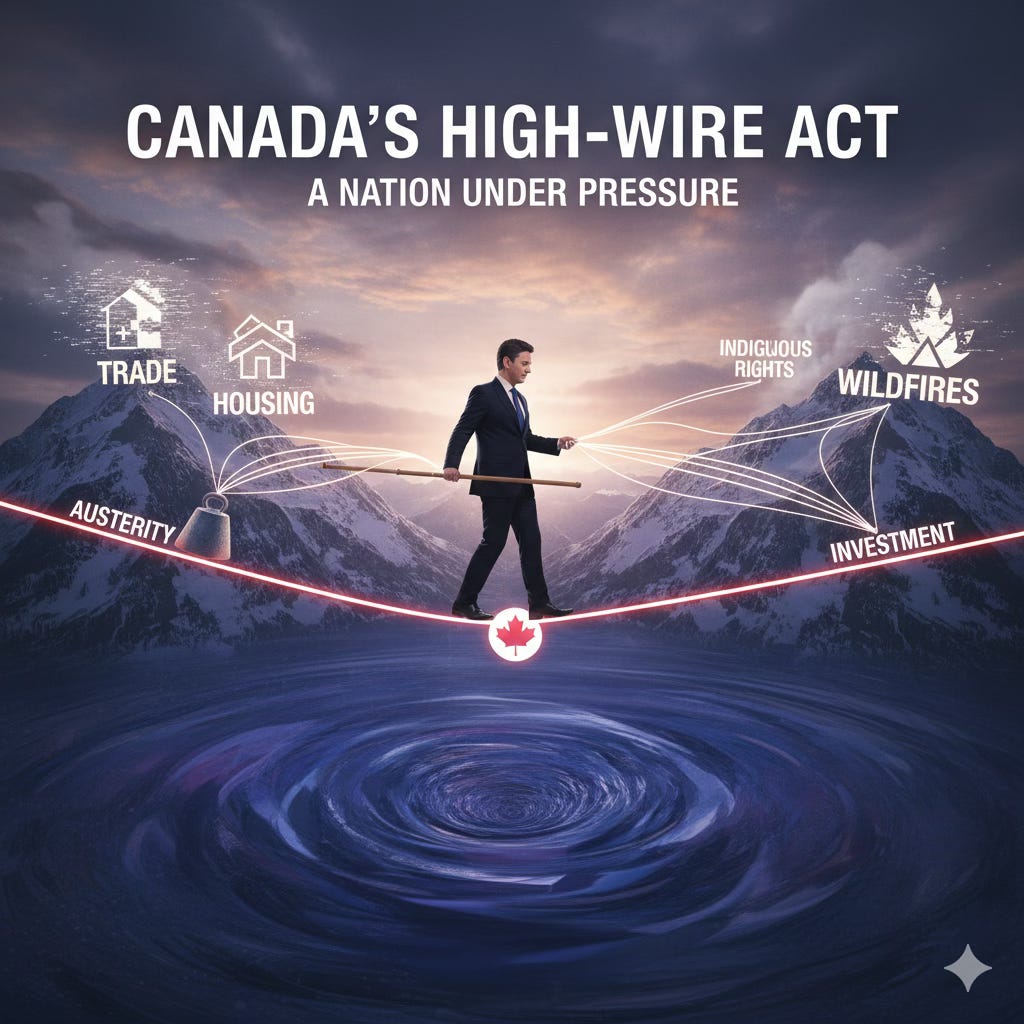
Welcome to your daily briefing. The federal government is currently navigating one of the most challenging periods in recent memory, caught between the conflicting demands of fiscal austerity and the urgent need for massive new investments. Testimony from a series of Senate committees this past week reveals a government grappling with a fundamentally changed relationship with the United States, a domestic housing crisis of historic proportions, and deeply rooted social issues demanding immediate and comprehensive action. Officials and experts describe a government with its foot on both the brake and the gas, steering through a narrow and treacherous road at high speed. This isn’t just about the next budget; it’s about reimagining Canada’s economy and social contract in an era of unprecedented pressure.
The Fiscal Straitjacket
The backdrop for every government decision is what the Parliamentary Budget Officer (PBO), Jason Jacques, described to the National Finance Committee as a “very challenging fiscal situation”. The numbers paint a stark picture. The PBO projects the debt service ratio—the amount of government revenue spent just on interest payments—will rise from 10.3% to 13.7% by 2030-31. This tightening fiscal environment comes just as new spending pressures are mounting.
Witnesses highlighted the immense difficulty of the government’s current task: simultaneously pursuing “significant austerity” while making “significant investment or expansion in certain areas, like defence spending” and responding to new trade realities. Jimmy Jean, Chief Economist at Desjardins Group, was even more blunt, telling senators that the government’s mission to triple defence spending, launch ambitious infrastructure projects, and cut program spending by 15% is a “near-impossible mission”. The government’s borrowing limit, which was raised last year and intended to last until 2026-27, may not be high enough, potentially forcing an earlier-than-expected return to Parliament to ask for even more borrowing authority.
Navigating the New World (Dis)order
A primary source of this pressure is the dramatic shift in Canada’s trade relationship with the United States. Before the Foreign Affairs and International Trade Committee, Minister Dominic LeBlanc acknowledged that this relationship has “fundamentally changed” and that the old model of stability “can no longer be taken for granted”. The unilateral imposition of U.S. tariffs has thrown major Canadian industries into uncertainty, from steel and aluminum to softwood lumber, an issue so perennial that one senator recalled discussing it in Washington on 9/11.
This new reality forces a two-pronged strategy. First, the government is pursuing diversification through its 15 free trade agreements, which cover 61% of global GDP. Minister LeBlanc pointed to a new agreement with Indonesia and upcoming trade missions to Mexico as key examples. Second, Ottawa is attempting to redefine its relationship with Washington, seeking what some have called a “grand bargain” that might involve deeper North American integration in exchange for relief from tariffs. However, officials admit it’s difficult to even figure out what, exactly, the Americans want in these negotiations. This complex dance involves defending Canadian industries while simultaneously exploring new areas of cooperation on defence, energy, and critical minerals to find leverage.
Crises at Home: Housing and Wildfires
While navigating global headwinds, the government faces acute crises at home that also demand massive investment and coordination.
The Housing Gap
In testimony before the Banking, Commerce and the Economy Committee, the PBO presented a stark analysis of Canada’s housing crisis, projecting a “housing gap” of 3.2 million net new units by 2035. This requires building roughly 290,000 units per year for the next decade, a pace that would consistently surpass Canada’s all-time record.
The crisis is multifaceted. Witnesses pointed to a severe imbalance between supply and demand, exacerbated by high immigration levels since 2022 that supply simply couldn’t match. At the same time, builders now face a market where high costs and interest rates mean “the deals don’t pencil,” leading to project cancellations and layoffs in the construction sector. Layers of government taxes and fees, particularly municipal development charges, add another static cost that doesn’t move with the market, further squeezing affordability. In response, the government has launched Build Canada Homes, a new federal agency with an initial capitalization of $13 billion, tasked with directly building affordable housing and modernizing the construction industry, with a focus on modular and prefab homes.
The Burning Questions
Meanwhile, the Standing Senate Committee on Agriculture and Forestry heard that Canada’s emergency management framework is “no longer sufficient” to handle the “new normal” of record-breaking wildfire seasons. The Federation of Canadian Municipalities (FCM) is calling for a national emergency management agency and a national fleet of Canadian-made water bombers to improve coordination between governments. Municipalities, often with volunteer firefighters and water systems not designed for firefighting, are on the front lines coordinating evacuations and supporting stretched provincial resources. The FCM stressed that every dollar invested in climate adaptation, such as forest management and fire breaks, saves up to $15 in future disaster recovery costs, arguing for proactive investment rather than reactive spending after towns have been destroyed.
The Unfinished Business of Rights
Beyond these immediate crises, committees also examined long-standing issues of discrimination that challenge Canada’s commitment to human rights and add another layer of complexity to government action.
The Indian Act’s Discriminatory Legacy
The Standing Senate Committee on Indigenous Peoples heard powerful testimony on Bill S-2, a bill intended to fix remaining registration inequities in the Indian Act. National Chief Cindy Woodhouse Nepinak described the Act as “undoubtedly racist” and condemned the government’s “piecemeal approach” of only making minimal changes when forced by litigation. Witnesses argued that the “second-generation cut-off,” which restricts the ability to pass on status, amounts to a “mathematical genocide” and a policy of “legal extinction” for First Nations. The core demand is for First Nations’ right to self-determination over their own citizenship, to move away from a colonial system where Canada is the only country in the world that legislates who First Nations people are.
An Invisible Disease
In the Social Affairs Committee, witnesses detailed the systemic neglect of sickle cell disease, a condition that disproportionately affects Black Canadians. Ulysse Guerrier, who lives with the disease, described it as a “lifeline” and highlighted the devastating physical, financial, and psychological toll. A key demand of Bill S-201 is to have sickle cell officially recognized as a disability, which would unlock access to the Disability Tax Credit and other benefits currently denied to many patients because of the disease’s episodic nature. Witnesses pointed to glaring inequities, noting that cystic fibrosis, another inherited disease, receives more than 10 times the funding for clinical care and research. They also highlighted systemic racism in healthcare, where patients in excruciating pain are often dismissed as “drug seekers” and discriminatory blood donation policies prevent the most compatible donors from giving blood.
The Data Brief
Fiscal Outlook: The government faces a “challenging fiscal situation,” with rising debt service costs constraining its ability to respond to new pressures.
Trade Realignment: The Canada-U.S. relationship has fundamentally changed, forcing Ottawa to pursue diversification while simultaneously negotiating tariff relief and a new economic partnership.
Housing Crisis: Canada has a projected housing gap of 3.2 million units by 2035, requiring unprecedented levels of construction amid high costs and financing challenges.
Wildfire Response: Municipalities are calling for a national emergency management agency and a federally owned fleet of water bombers to combat longer and more intense wildfire seasons.
Human Rights: Advocates are demanding an end to “piecemeal” legislative fixes and are calling for comprehensive action to end discrimination in the Indian Act and address systemic neglect of sickle cell disease.
Digital Regulation: Efforts to protect children from online pornography (Bill S-209) highlight the difficult balance between safety, privacy, and freedom of expression in the digital age.
Source Documents
Standing Senate Committee on Agriculture and Forestry. (2025, October 2). Transcripts & Minutes (45th Parliament, 1st Session). Parliament of Canada.
Standing Senate Committee on Banking, Commerce and the Economy. (2025, October 1). Transcripts & Minutes (45th Parliament, 1st Session). Parliament of Canada.
Standing Senate Committee on Banking, Commerce and the Economy. (2025, October 2). Transcripts & Minutes (45th Parliament, 1st Session). Parliament of Canada.
Standing Senate Committee on Foreign Affairs and International Trade. (2025, October 2). Transcripts & Minutes (45th Parliament, 1st Session). Parliament of Canada.
Standing Senate Committee on Indigenous Peoples. (2025, October 1). Transcripts & Minutes (45th Parliament, 1st Session). Parliament of Canada.
Standing Committee on Internal Economy, Budgets and Administration. (2025, October 2). Transcripts & Minutes (45th Parliament, 1st Session). Parliament of Canada.
Standing Senate Committee on Legal and Constitutional Affairs. (2025, October 1). Transcripts & Minutes (45th Parliament, 1st Session). Parliament of Canada.
Standing Senate Committee on Legal and Constitutional Affairs. (2025, October 2). Transcripts & Minutes (45th Parliament, 1st Session). Parliament of Canada.
Standing Senate Committee on National Finance. (2025, October 1). Transcripts & Minutes (45th Parliament, 1st Session). Parliament of Canada.
Standing Senate Committee on Social Affairs, Science and Technology. (2025, October 1). Transcripts & Minutes (45th Parliament, 1st Session). Parliament of Canada.
Standing Senate Committee on Social Affairs, Science and Technology. (2025, October 2). Transcripts & Minutes (45th Parliament, 1st Session). Parliament of Canada.