


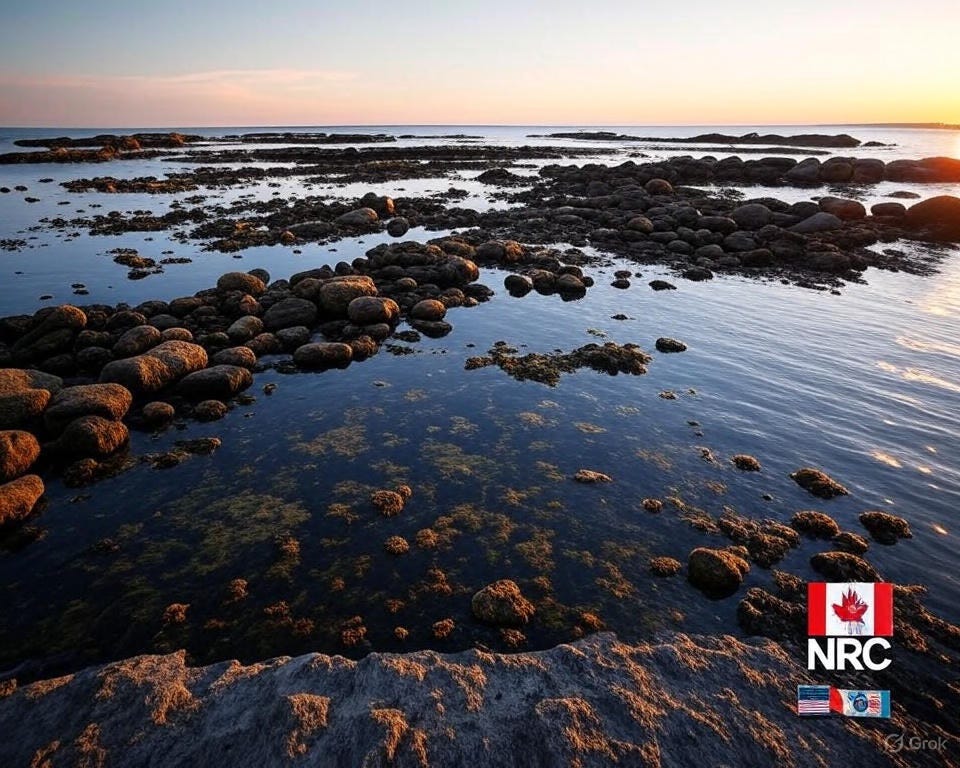
Did you know that after Superstorm Sandy devastated Staten Island in 2012, killing 24 people and causing billions in damage, a innovative project turned to Canadian expertise for help? The Living Breakwaters initiative isn't just about building walls against waves—it's a smart blend of engineering and ecology. As Canadians, this matters because it highlights how our government-funded research at the National Research Council (NRC) contributes to international climate adaptation, mirroring efforts to protect our own coasts from rising seas and storms.
What Are Living Breakwaters?
Think of traditional breakwaters like giant underwater speed bumps that slow down crashing waves to protect shorelines. But "living" breakwaters go further—they're designed like artificial reefs that not only block storm surges but also create homes for marine life, boosting biodiversity.
Project Goals: Located in Raritan Bay off Staten Island's Tottenville area, the mile-long system aims to reduce wave damage, reverse beach erosion, enhance ecosystems, and build community resilience. It's part of the U.S. Rebuild by Design competition post-Sandy, with a $111 million budget.
Key Features: These aren't plain rock piles. They include "reef streets" (gaps for water flow and habitat), ridges for marine growth, crenulated (wavy) crests to allow some water through, specialized stone sizes, and eco-friendly concrete units with tide pools for oysters and fish.
Why Innovative?: Unlike rigid barriers that can worsen erosion elsewhere, these balance wave attenuation with natural sediment flow. Analogy: It's like a permeable fence in your garden—stops the wind but lets pollinators through.
The project addresses real threats: Historical erosion rates up to 1.1 meters per year in parts of the area, and 100-year storm waves reaching 1.6 meters high.
The Science: How Modeling Shaped the Design
Designing something this complex isn't guesswork—it's backed by advanced simulations to predict how waves, sediments, and tides interact. Engineers used a mix of numerical (computer-based) and physical (scaled-down lab) models to test everything from stability to environmental impact.
Wave and Shoreline Modeling: Using tools like SWAN (for wave transformation over 30 years of data) and GENESIS (for shoreline changes), they simulated how breakwaters would reduce erosion over 20 years. Result: Erosion trends reversed, with beach accretion in key areas.
Storm and Sediment Simulations: FUNWAVE modeled 100-year storms, showing wave heights drop below 1 meter behind the barriers—even with 0.8 meters of sea level rise. Delft3D analyzed sediment transport, confirming reduced bed stress near shores and no major navigation channel impacts.
Near-Field Details: FLOW-3D (a fluid dynamics model) fine-tuned reef streets to prevent scour (erosion) while allowing nutrient flow for habitats. Analogy: Like testing a car's aerodynamics in a wind tunnel, but for water and sand.
Did You Know? Without the breakwaters, models predicted continued shoreline retreat; with them, critical neighborhoods gain protection without down-drift erosion.
Canada's Key Contribution Through NRC
While the project is American-led (by SCAPE Landscape Architecture and partners), Canada's National Research Council played a pivotal role in physical modeling—building and testing scaled replicas to verify designs.
NRC's Role: At their Ottawa labs, researchers like Scott Baker created 1:20 scale models for individual sections and 1:80 for the full system. Tests assessed armor stability, wave transmission, and features like ECOncrete® units (bio-enhancing concrete).
Outcomes: Models confirmed structures survive waves beyond 100-year events, with tweaks to toe stones and tide pool placement. This hands-on verification ensured ecological benefits without compromising safety.
Broader Impact: NRC, a federal agency under Innovation, Science and Economic Development Canada, excels in coastal engineering. This collaboration aligns with Canada's National Adaptation Strategy (2023), which emphasizes nature-based solutions for our 243,000 km coastline facing similar erosion and flooding risks.
It's a prime example of Canadian innovation exporting knowledge—NRC has supported similar projects globally, fostering international partnerships on climate resilience.
Real-World Results and Why It Matters
The Living Breakwaters are nearing completion (as of 2024), with early signs of success: Reduced wave energy, habitat creation for oysters (natural filters), and community engagement through education programs.
Human Impact: For Staten Island residents, it means safer homes and revived beaches. In Canada, think of parallels—like erosion in Prince Edward Island or flooding in British Columbia—where similar tech could apply.
Lessons Learned: Balancing protection with ecology works; modeling prevents costly mistakes. Surprising stat: The project slows long-term erosion while creating marine habitats, proving "grey" infrastructure can go "green."
This showcases how government research drives practical solutions, enhancing Canada's reputation in environmental tech.
Conclusion
In essence, the Living Breakwaters demonstrate that smart, nature-inspired designs—bolstered by Canadian modeling expertise—can combat climate threats effectively. Key takeaways: Breakwaters reduce risks while boosting ecosystems; NRC's work exemplifies federal innovation at play. Stay informed by following official sources like NRC or Environment Canada. Share this if you believe in collaborative climate action—being an informed citizen starts with understanding these global efforts. What's one way Canada can apply this at home?
Sources:
Marrone, J., Zhou, S., Brashear, P., Howe, B., & Baker, S. (2019). Numerical and physical modeling to inform design of the living breakwaters project, Staten Island, New York. In N. Goseberg & T. Schlurmann (Eds.), Coastal Structures 2019 (pp. 1044-1054). Bundesanstalt für Wasserbau. https://doi.org/10.18451/978-3-939230-64-9_105
National Research Council Canada. (2021, November 16). Living breakwaters. https://nrc.canada.ca/en/stories/living-breakwaters
SCAPE Landscape Architecture. (n.d.). Living Breakwaters. https://www.scapestudio.com/projects/living-breakwaters-project/
Government of Canada. (2023). Canada's National Adaptation Strategy. Environment and Climate Change Canada. https://www.canada.ca/en/services/environment/weather/climatechange/climate-plan/national-adaptation-strategy.html