


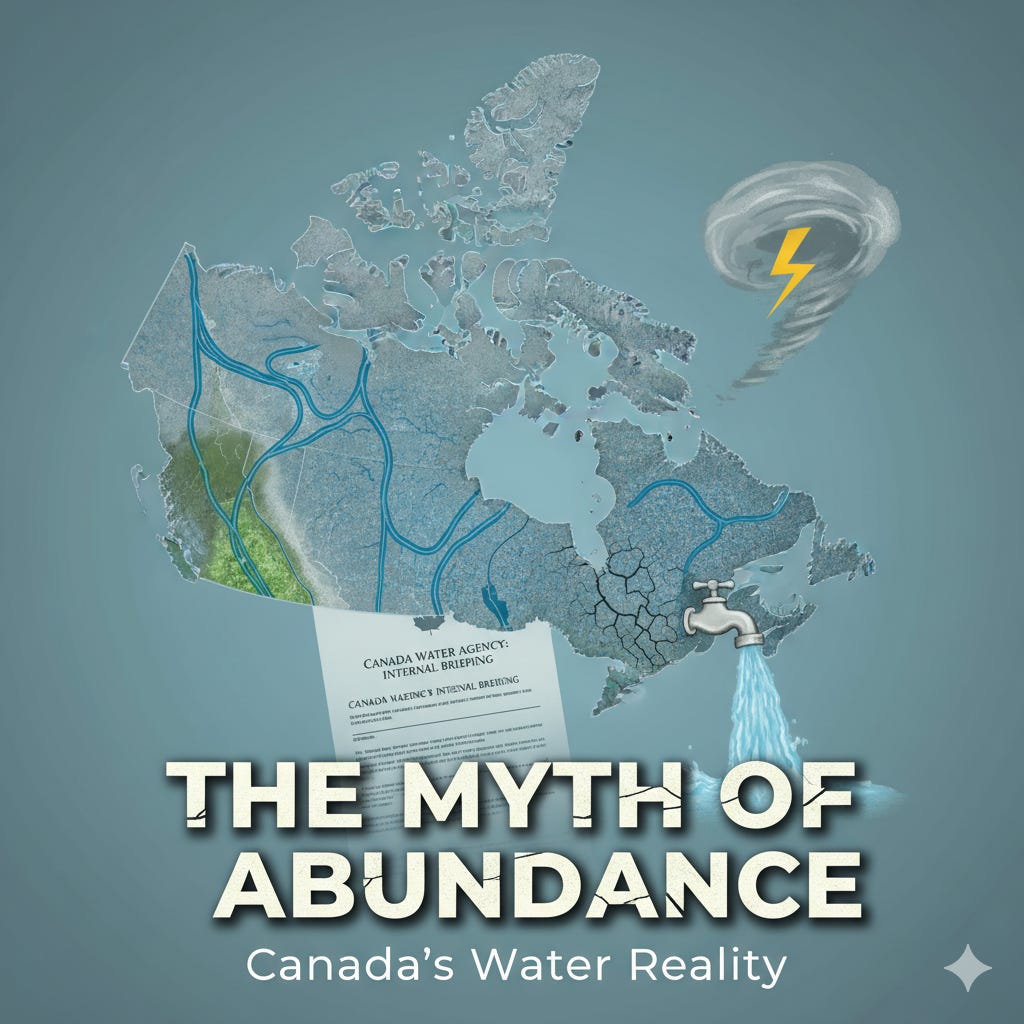
A recent government briefing document outlines a stark reality: Canada’s fresh water is not as abundant or secure as you might think. The material, prepared for the incoming minister responsible for the Canada Water Agency, serves as an internal guide to the nation’s most pressing water challenges. It details a landscape of escalating risks from pollution, climate change, and overuse that threaten Canada’s economy, ecosystems, and way of life. What does this internal assessment mean for how you should think about Canada’s most vital natural resource?
The Myth of Abundance
The idea that Canada holds 20% of the world’s fresh water is a common misconception that masks a more complicated truth. According to the report, only one-third of that water is renewable, meaning it is replaced annually by precipitation. To make matters more challenging, 60% of this renewable water drains northward, far from the southern regions where most of the population lives and where the majority of economic activity occurs.
This geographic mismatch between supply and demand is compounded by high consumption. The average Canadian household uses over 220 litres of water per day, double the amount recommended by the World Health Organization to meet basic needs. This pattern of use, rooted in a false sense of limitless supply, places unnecessary stress on a resource that is finite and increasingly unpredictable.
A System Under Pressure
The document identifies two clear and interlinked challenges facing the country’s freshwater systems: degrading quality and uncertain quantity. These are not future problems. They are happening now.
Declining Water Quality
While national data from 2021 to 2023 shows that water quality was rated ‘fair to excellent’ at 83% of monitored sites, the story changes in the most populated areas. In the Great Lakes, St. Lawrence River, and Pacific Ocean regions, a significant portion of monitoring sites registered ‘marginal or poor’ water quality.
The economic consequences are substantial. For example, algal blooms in Lake Erie cost the Canadian economy an estimated $412.5 million annually. These issues disproportionately affect Indigenous peoples, who depend on clean water for sustenance and cultural practices. The watersheds home to the majority of Canada’s population and economic activity face the greatest risks, but the report warns that northern regions are now facing new stressors from permafrost degradation and melting ice.
Unpredictable Water Quantity
Climate change is making it harder to manage water quantity. Floods have become the most common and costly natural disasters in Canada, with average residential costs from basement flooding ranging from $20,000 to $43,000. At the same time, droughts are becoming more severe, impacting key economic sectors. A 2021 drought, for instance, led to an estimated $833 million in lost crop insurance payments in Manitoba alone.
These extremes of flood and drought create a volatile new normal, requiring a more proactive and coordinated approach to managing water supplies.
A Coordinated Federal Response
Historically, freshwater governance in Canada has been fragmented. The federal government is now positioning the Canada Water Agency (CWA) as the solution to this lack of coordination.
The Role of the Canada Water Agency
The CWA’s mandate is to improve freshwater management by leading collaboration between federal departments and working more closely with provinces, territories, and Indigenous peoples. Its vision is simple: for fresh water in Canada to be “clean and well managed for today and the future.”
The agency’s work is enabled by a legislative framework that includes the Department of the Environment Act and the Canada Water Act. This legal foundation gives the federal government the authority to enter into agreements and establish programs for the conservation and management of water resources. How would this look in practice? The CWA is tasked with developing integrated approaches that use science and data to achieve measurable results, moving Canada from a reactive to a proactive stance on water security.
The Data Brief
Misconception: Canada has access to 20% of the world’s surface fresh water, but only one-third is renewable, and 60% of that drains north.
Consumption: Average household water use is over 220 litres per capita daily, double the WHO’s recommended amount for meeting basic needs.
Economic Impact: The Great Lakes basin supports 40% of Canada’s economic activity. Algal blooms in Lake Erie alone cost the economy over $412 million annually.
Regional Risks: 28% of monitored river sites in the Great Lakes and St. Lawrence region have marginal or poor water quality.
Climate Costs: Floods are Canada’s costliest natural disasters. The 2021 drought caused an estimated $833 million in crop insurance losses in Manitoba.
A Resource at a Crossroads
Canada’s relationship with its fresh water is based on a foundational belief in its infinite supply. The government’s own analysis shows this belief is no longer sustainable. Securing the country’s freshwater future requires moving beyond jurisdictional squabbles and regional ad-hoc responses. It demands a unified, national effort to manage a shared resource that is, and always has been, irreplaceable.
Source Documents
Government of Canada. (2025). Securing Canada’s freshwater future. Canada.ca. Retrieved October 29, 2025.
Beautifully done. We in Canada are far too confident in our supposed “abundance of water.” Anyone who looks closely finds a very different story — one of uneven distribution, degraded quality, and policy gaps that have lingered too long. Unfortunately, too few do look closely.
This is an essential contribution to the national conversation, and I hope it reaches a wide audience. Thank you for bringing such clarity and urgency to an issue that’s been hiding in plain sight.
A helpful and informative essay. Thank you.