

Have you ever wondered what Canada's vast forests really do for the country? We see them from airplane windows and drive past them on highways, but their true impact often feels distant. It's easy to think of forestry as just cutting down trees. But what if I told you that in 2023, Canada's forests contributed $27 billion to our economy and supported nearly 200,000 jobs?
This isn't just about lumber. It’s about innovation, community survival, and fighting climate change. The government's latest "State of Canada's Forests" report for 2024 is packed with numbers and technical terms, but the story it tells is simple: our forests are a powerhouse.
So, how does it all work? Let's break it down, Feynman-style, as if we're explaining it for the first time. No spin, just the facts.
What Does a $27 Billion Contribution Mean?
When we hear that the forest sector contributed $27 billion to Canada's nominal Gross Domestic Product (GDP), it sounds impressive, but what is GDP?
Think of Canada's economy as one giant cash register for a year. GDP is the final tally of everything the country produced and sold—from cars and coffee to software and, yes, wood products. So, the forest sector's $27 billion is its slice of that national economic pie.
But this number isn't just from selling 2x4s. It’s a combination of three main activities:
Forestry and Logging: This is the first step—sustainably harvesting trees. In 2023, this part contributed about $4.9 billion.
Wood Product Manufacturing: This is where raw logs are turned into lumber, panels for houses, and other building materials. This is the largest piece of the puzzle, contributing over $13.3 billion.
Pulp and Paper Manufacturing: This involves making paper, packaging, and even tissue products. This added another $8.8 billion.
Together, these activities create a powerful economic engine.
It’s Not Just About the Money, It's About People
Behind that $27 billion figure are nearly 200,000 Canadians with jobs. These aren't just lumberjacks; they are scientists, engineers, mill workers, truck drivers, and tech innovators.
What's really important is where these jobs are. The report highlights that about 300 communities across Canada depend on the forest sector for their livelihoods. For many rural and Indigenous communities, forestry isn't just
an employer; it's often the main employer, providing stability and opportunity far from big city centers. In 2021, over 11,000 Indigenous people worked in the forest sector.
This makes the health of our forests a matter of community survival.
Are We Running Out of Trees? The Myth of Deforestation
A common concern is that all this economic activity must mean we're clearing our forests at an alarming rate. The data tells a different story.
First, let's define our terms.
Harvesting is not Deforestation: In Canada, forestry laws require that all harvested areas on public land be regenerated. Think of it like a garden. You harvest the vegetables, but you plant new seeds for the next season. The forest remains a forest.
Deforestation is the permanent conversion of forest land to something else, like a farm, a mine, or a new subdivision.
So, what are the numbers?
Canada has 369 million hectares of forest, which is about 9% of the world's total.
In 2022, only 668,735 hectares were harvested—that's less than 0.2% of our total forest area.
Actual deforestation is even lower. Since 1990, less than half of 1% of Canada's forests have been permanently converted to other uses. The main drivers are agriculture and the oil and gas sector, not forestry.
Our forest area has remained remarkably stable for decades, proving that sustainable management is not just a buzzword; it's a regulated practice.
The Unseen Enemy: Wildfires
While harvesting is carefully managed, the biggest threat to our forests is something we can't fully control: wildfire.
The 2023 fire season was the most destructive ever recorded in Canada.
Area Burned: A staggering 17.2 million hectares burned in 2023. To put that in perspective, the area harvested in 2022 was just 0.67 million hectares. Wildfires burned an area over 25 times larger than what was harvested.
The Cost: The fires triggered more evacuations, produced more smoke, and cost more to manage than any other year. Over 232,000 people were forced from their homes.
The Cause: A dry spring, low snowpack, and high temperatures created the perfect storm for fires to ignite and spread rapidly across the country, from Alberta to Nova Scotia and Québec.
This is a stark reminder that climate change is actively reshaping our forests. In response, the government is investing over $800 million in wildfire resilience, including training, equipment, and satellite monitoring.
From Old-Growth Trees to New-Age Tech
Canada’s forest sector isn't stuck in the past. It's evolving into a high-tech bioeconomy. What does that mean?
Think of a tree as more than just wood. It's a source of biomass—organic material that can be converted into innovative products.
Clean Energy: Wood residues are turned into biofuels and pellets, reducing our reliance on fossil fuels.
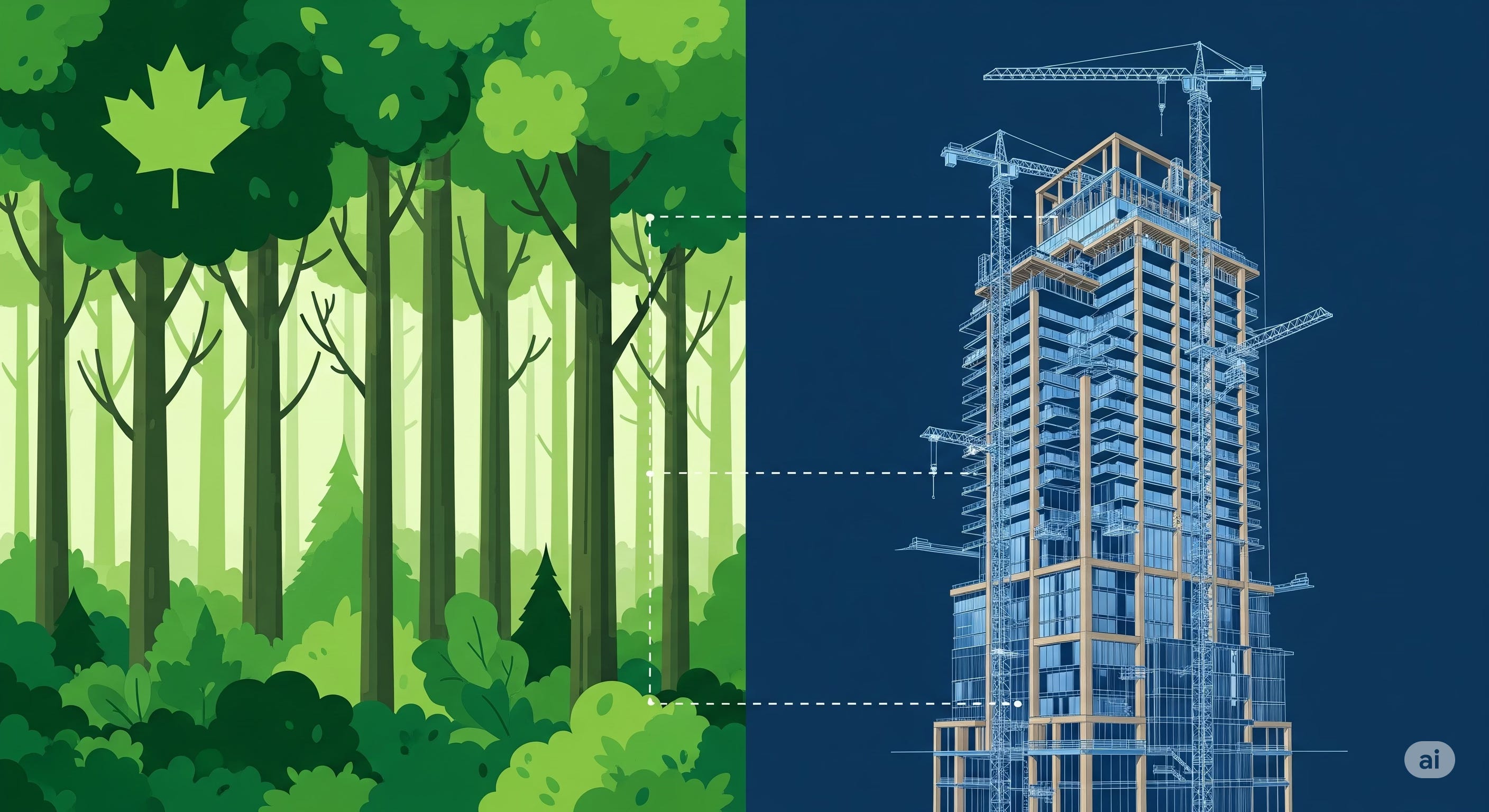
Sustainable Building: Mass timber products like cross-laminated timber are strong enough to build skyscrapers, storing carbon in our cities for decades.
Bioproducts: Forest biomass is used to create everything from bioplastics and textiles to pharmaceuticals.
This transition helps fight climate change in two ways:
Carbon Storage: Wood products lock away carbon that trees absorbed from the atmosphere.
Substitution: When we use wood instead of steel or concrete, we avoid the massive carbon emissions required to produce those materials.
An Informed Citizen is an Empowered Citizen
Canada's forests are a complex and vital part of our national identity, economy, and environment. They are not just a resource to be exploited but a dynamic ecosystem to be managed wisely.
The latest report shows a sector that is both powerful and facing immense challenges, particularly from climate change-fueled wildfires. It also reveals a story of resilience, innovation, and sustainable practices that often goes untold.
Understanding these facts helps us see beyond the headlines and participate in conversations about our country's future. What do you think should be the priority for Canada's forests?
Source: Natural Resources Canada. (2024). The State of Canada's Forests: Annual Report 2024. Ottawa, ON: Canadian Forest Service. Retrieved from StateofForestReport-2024-EN.pdf.