


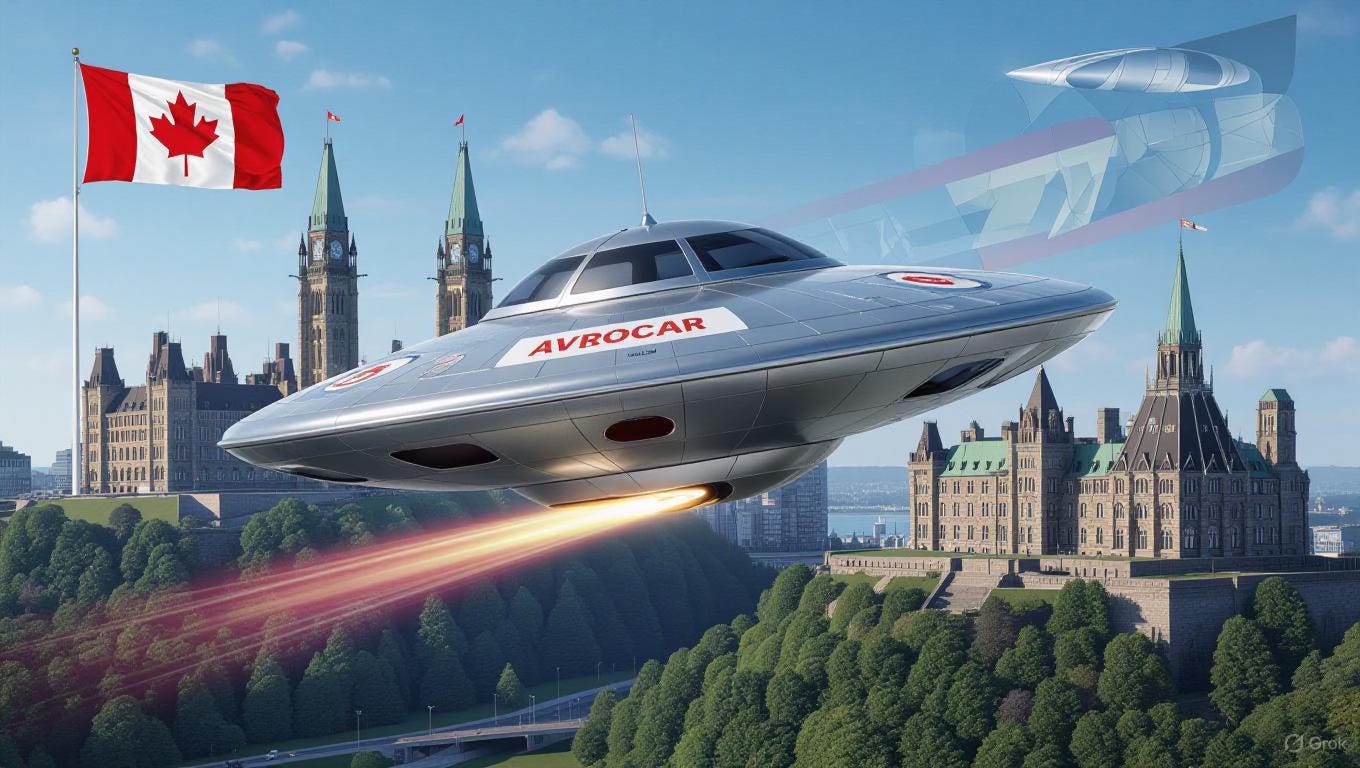
Imagine the Canadian government secretly funding a "flying saucer" during the Cold War—not for alien tech, but for revolutionary military flight. Sounds like sci-fi? It was real: the Avrocar, a disk-shaped VTOL (vertical takeoff and landing) aircraft that promised to redefine warfare. A newly declassified 1962 report from the National Research Council (NRC) reveals technical insights into why it flopped, while highlighting Canada's bold (and controversial) push into aerospace innovation. In an era of modern drone debates and defense spending scrutiny, this forgotten project reminds us how government bets on tech can soar or crash—literally. Why care now? It echoes ongoing discussions about Canadian sovereignty in tech partnerships, especially with the U.S., and the human cost of failed policies.
The Avrocar's Origins: A High-Flying Government Gamble
Let's break it down like a group project gone awry: In the 1950s, amid Cold War tensions, Avro Canada—a powerhouse in Canadian aviation—teamed up with the U.S. military to build the VZ-9 Avrocar. Funded largely by American dollars but rooted in Canadian engineering, it was designed as a supersonic VTOL fighter-bomber, resembling a 18-foot-wide saucer powered by a central fan for lift and propulsion. Think of it as a hovercraft on steroids, meant to zip over battlefields at high speeds without runways.
Key facts from historical records:
Development Timeline: Started in 1952 with Canadian government seed funding of $400,000; scaled up with U.S. Army and Air Force contracts totaling millions.
Tech Specs: A 12-inch fan (in models) created "cross-flow" for forward motion, but real prototypes struggled with stability, hovering only a few feet off the ground.
Cancellation: Axed in 1961 after tests showed it couldn't exceed 35 mph or fly higher than 3 feet—far from the promised Mach 3 speeds.
The project tied into broader Canadian governance: Prime Minister John Diefenbaker's administration supported aerospace as a national pride point, but U.S. influence loomed large. Controversially, the Avrocar's failure followed the 1959 scrapping of the Avro Arrow interceptor, which some historians blame on U.S. pressure to prioritize American tech. This led to 14,000 layoffs at Avro Canada, sparking a "brain drain" where engineers fled south—a polarizing event still debated as a betrayal of Canadian innovation.
Key Findings from the 1962 NRC Report: Fan Performance Under Scrutiny
The declassified report, "Effect of Forward Speed on Fan Performance of a Model of the Avrocar," was a post-mortem by NRC engineers C.K. Rush and H.S. Fowler. They tested a 36-inch model in wind tunnels to simulate "forward speed" (cross-flow) on the fan, trying various intakes like bellmouths, radial vanes, cascades, and even a cockpit mockup. It's like tweaking a vacuum cleaner to see if it sucks better in a breeze—technical, but crucial for VTOL viability.
Simplified takeaways using the Feynman approach:
Core Concept: Forward speed creates asymmetric airflow, reducing fan efficiency (pressure-rise-ratio). The report measured this deficit, finding it worsens at higher speeds.
Surprising Benefit of the Cockpit: Adding a cockpit improved performance by 14-33% in some configs, acting like a deflector to even out airflow. Analogy: It's like adding a spoiler to a car for better handling—unexpected, but effective.
Best and Worst Setups:
Plain bellmouth intakes (rounded lips) outperformed fancier ones with vanes or cascades.
Configuration 6 (radial vanes + deflector) had the highest losses, up to 33% deficit at high flows.
At zero forward speed, all configs were similar, but "cross-flow" exposed weaknesses.
Did You Know? The report notes deficits starting at low speeds, with up to 0.043 (33%) loss at dynamic pressures equivalent to 250 ft/sec winds. This explains why prototypes wobbled like a bad drone—poor fan stability doomed it.
Polarizing perspective: Critics argue the Avrocar was a wasteful boondoggle, siphoning funds from practical defense needs. Verified fact: U.S. audits post-cancellation cited over $10 million spent with little return, fueling debates on foreign influence in Canadian policy. Yet, proponents see it as a bold R&D step, influencing modern VTOL like the F-35—though [Unverified] some conspiracy theorists link it to UFO cover-ups, given its saucer shape inspiring sightings.
Why the Avrocar Still Matters: Lessons for Today's Canadian Policy
Fast-forward to 2025: Canada's government invests billions in aerospace via programs like the Future Fighter Capability Project. The Avrocar saga warns of risks in U.S.-dependent partnerships—echoed in recent parliamentary debates over F-35 purchases amid supply chain woes.
Thousands lost jobs, but it birthed legends. As one X user quipped, "Avrocar: Proof Canada tried to build UFOs before drones were cool." Public discussions on X highlight its cult status, with posts tying it to modern flying cars (e.g., a 2025 U.S. test flight drawing comparisons).
The Arrow/Avrocar cancellations are viewed by some as Diefenbaker's "biggest blunder," eroding Canada's tech edge. A 2022 parliamentary report on innovation cites this as a cautionary tale, urging more sovereign R&D funding to avoid brain drain repeats.
Wrapping Up: From Saucer Dreams to Informed Citizenship
The 1962 NRC report demystifies the Avrocar's fan woes, showing how simple tweaks like a cockpit could help, but ultimate flaws in design and policy led to its demise. Key takeaways: Cockpit good, vanes bad; government innovation needs balance to avoid costly failures. Controversially, it underscores how U.S. ties can clip Canadian wings— a lesson for today's defense debates.
Share this if you're intrigued by Canada's quirky history! Follow @OnHansard on Substack (onhansard.substack.com) for more deep dives into governance gems. Being informed isn't just smart—it's your shield against the "Ottawa fog" of policy mishaps. Who knows, maybe the next flying saucer will actually work.
Sources: Rush, C. K., & Fowler, H. S. (1962). Effect of forward speed on fan performance of a model of the Avrocar (Aeronautical Report LR-342). National Research Council of Canada. https://doi.org/10.4224/40003683
Avro Canada VZ-9 Avrocar. (2023, October 9). In Wikipedia. https://en.wikipedia.org/wiki/Avro_Canada_VZ-9_Avrocar
Zuk, B. (2018). The Avro Arrow story: The revolutionary airplane that changed Canadian aviation. James Lorimer & Company.
Campagna, P. (1997). The UFO files: The Canadian connection exposed. Stoddart Publishing.