


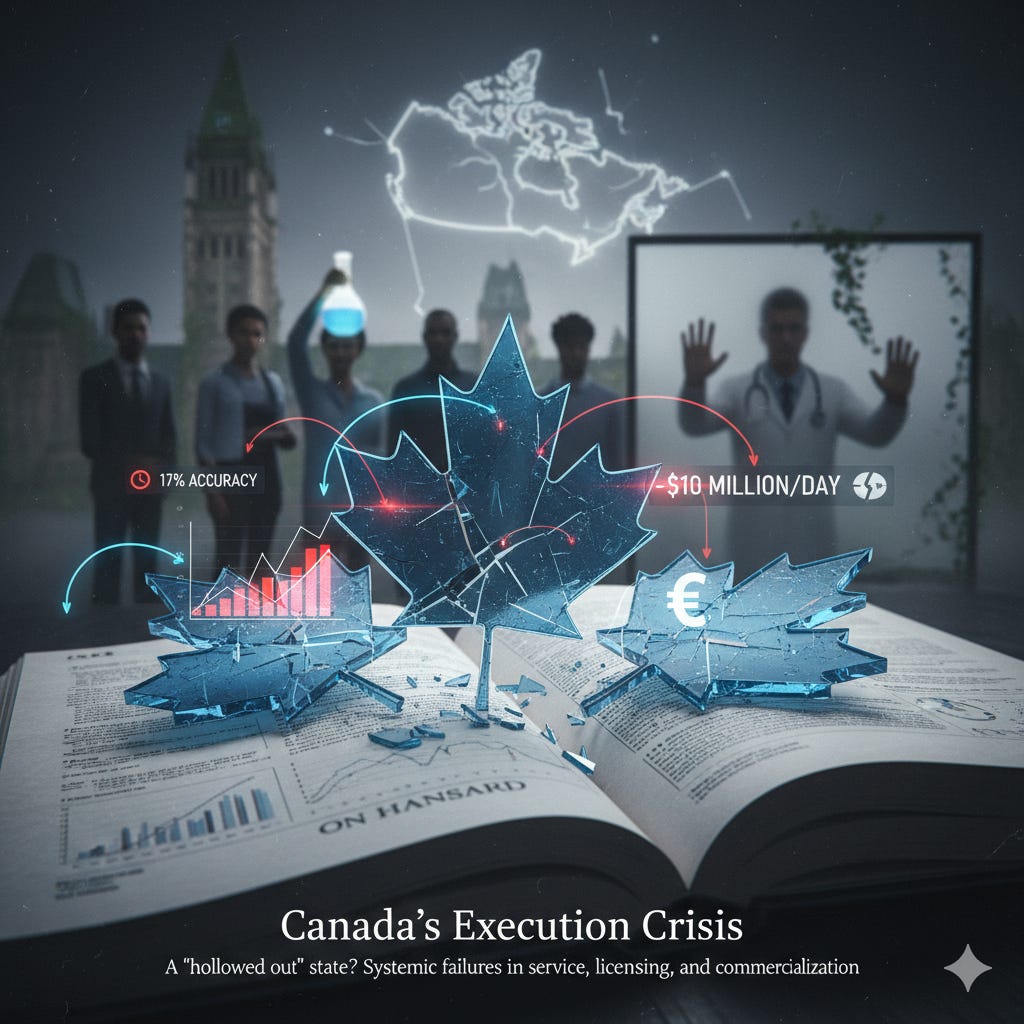
When you look across the landscape of Canadian parliamentary committees from the past few weeks, a single, troubling theme emerges. It’s not about one specific policy or minister. It’s a pattern.
This pattern suggests a “hollowed out” state: a Canada that excels at research but fails to commercialize it, a country that welcomes skilled immigrants but cannot license them to work, and a government whose core services, from delivering mail to answering tax questions, are collapsing.
Witness testimony from multiple, unrelated committees paints a picture of a nation struggling with a profound crisis of execution.
The Service Delivery Collapse
For millions of Canadians, the most tangible interaction with the federal government is the post office and the tax agency. Both, according to recent testimony, are failing.
Canada Revenue Agency (PACP)
At the Public Accounts committee, Auditor General Karen Hogan delivered what MP Gérard Deltell called the most “devastating” report he had seen in 17 years.
Her audit of the Canada Revenue Agency’s (CRA) call centres was a catalog of failures. In 2024-25, only 18% of calls met the 15-minute service standard, against a target of 65%. Worse, the information provided was often wrong. For general questions on individual taxes, agents gave an accurate response only 17% of the time.
As MP Deltell noted, this isn’t a “hamburger that’s missing ketchup”; these errors have real consequences for “seniors” and “families who live from paycheque to paycheque”.
What’s driving this? The OAG found that the CRA’s performance metrics prioritized “how closely [agents] adhered to their schedule for their shifts and breaks than on the accuracy and completeness of information”.
In response, CRA Commissioner Bob Hamilton pointed to a 100-day service improvement plan. However, he acknowledged the work on this plan only began in the fall of 2024, after the OAG’s findings were known. This failure extended to technology. The CRA’s own AI-powered chatbot, tested by the OAG, gave the correct answer only two out of six times, while the public ChatGPT got five out of six correct.
When asked to grade the CRA’s customer service, Commissioner Hamilton gave it a “B or a C with an arrow pointing up”. The Auditor General’s grade was simpler: “far from a passing grade”.
Canada Post (OGGO)
The situation at Canada Post appears even more dire. Testifying before the Government Operations committee, Public Works Minister Joël Lightbound stated the Crown corporation is “effectively insolvent,” losing $10 million every day.
The corporation has lost over $5 billion since 2018 and required a $1 billion cash injection in January 2025 just to “keep it afloat”.
The reason is twofold. First, its anchor business, letter mail, has collapsed, falling from 5.5 billion pieces 20 years ago to 2.2 billion today, while delivery addresses grew by over 3 million.
Second, it has failed to compete in the growing parcel market. Professor Ian Lee of Carleton University testified that Canada Post’s market share in parcels has fallen from 60% to 20%, losing to private couriers and “gigs”. The reason? A structural cost failure. According to Lee’s research, the average operating cost for Canada Post is $65 an hour, compared to $45 for private couriers and just $25 for gig workers.
The government’s solution, which the minister admitted was delayed, is to accept the recommendations of the Kaplan report: end the moratorium on community mailboxes (saving a projected $400 million annually) and lift the 1994 rural moratorium.
However, MP Alexandre Boulerice argued the government was ignoring viable revenue solutions, such as postal banking, which he noted is used by 84% of countries to generate revenue.
The “Valley of Death”
This execution crisis extends to Canada’s core economic potential: our ideas and our people. Committees heard a repeating story of failing to turn assets into outcomes.
1. Research & Development (SRSR)
At the Science and Research committee, witness after witness described a system that is brilliant at invention but terrible at commercialization.
Robert Asselin of U15 Canada noted that Canadian higher education performs twice the OECD average of all R&D in the country.
Yet, witness Ryan Williams (Balsillie School) stated that 95% of publicly funded university research “lies dormant in the valley of death” and 87% of Canadian innovation ends up foreign-owned.
Williams gave a stark example: $4.4 billion in federal AI research funding has resulted in 75% of the resulting patents being foreign-owned.
Dr. Gerry Wright (McMaster University) testified that he has trained over 100 graduate students and post-doctoral fellows in AMR research, but “very few remain in Canada” because the R&D “ecosystem has an opportunity to be fleshed out”.
Grace Lee Reynolds from the MaRS Discovery District confirmed this, reporting that half of Canadian founders who raise over $1 million do so in the United States.
A key structural problem identified was data sovereignty. Williams testified that 80% of Canadian data is hosted on U.S. servers, making it subject to American laws like the U.S. CLOUD Act.
2. Internationally Trained Professionals (HESA)
The exact same “valley of death” pattern appeared at the Health committee, this time for people. The system is adept at attracting skilled immigrants but fails to license them.
Dr. Christopher Watling (Royal College of Physicians and Surgeons) estimated there are 13,000 internationally trained physicians (ITPs) in Canada who are not practicing.
Dr. Therese Bichay, herself an ITP from Egypt, provided harrowing testimony that she has spent approximately $60,000 trying to get licensed in Canada. She is still not licensed and must periodically fly back to Egypt to perform clinical work just to maintain the “recency of practice” requirement.
Dr. Carrie Bernard, president of the College of Family Physicians of Canada, stated that Canada is short 23,000 family doctors.
Witnesses from anesthesiology, nursing, and family medicine all pointed to fragmented, inconsistent provincial pathways and a lack of bridging programs. Dr. Watling noted that practice-ready assessments (PRAs) for specialists are underused and offered in only three provinces.
When asked if the federal immigration department had consulted the medical colleges on its immigration levels plan, the representatives from the Royal College, the College of Family Physicians, and the Canadian Anesthesiologists’ Society all gave the same answer: No.
The Strategic Divide
This gap between intent and outcome is now defining Canada’s most critical files, from climate to defence.
1. The Energy & Climate Stalemate (ENVI)
The Environment committee meetings highlighted a complete breakdown in federal-provincial consensus on the 2030 Emissions Reduction Plan.
Premier Danielle Smith of Alberta stated her goal is to double oil production and called federal policies like the oil and gas cap, the clean electricity regulations (CERs), and Bill C-69 “investment killers”. She reported that $20 billion in capital has fled to the U.S. in the last 120 days. She also pointed to the near-failure of Alberta’s grid in January 2024 as proof that renewables (solar and wind) are unreliable without natural gas backup.
Think tank leaders like Merran Smith (New Economy Canada) and Rachel Doran (Clean Energy Canada) argued the opposite. They testified that global investment in clean energy ($3 trillion) now doubles investment in fossil fuels; EV sales are 1 in 4 globally; and renewables are the cheapest new power source. They identified Alberta’s own moratorium on renewables as the real investment killer.
2. Defence & Sovereignty (NDDN & FAAE)
At the Defence and Foreign Affairs committees, experts argued Canada’s problem isn’t sovereignty, which it has, but “defence and security,” which it lacks.
David Perry (Canadian Global Affairs Institute) testified that Canada is “15 to 20 years behind the curve” and highlighted Canada’s procurement failures by contrasting our F-35 timeline with Finland’s. Both countries announced their purchase in 2022; Finland will be operational by 2030, while Canada’s Auditor General projects 2033-34 at the earliest.
This confusion was evident in conflicting testimony:
Mixed Fleets: At the Defence committee, Prime Minister Carney was quoted as saying there is “no scale of economy” for a mixed submarine fleet. Yet, Secretary of State for Defence Procurement Stephen Fuhr confirmed the government is reviewing a mixed F-35 fleet.
Spending Targets: The National Defence committee was told the government is committed to 5% of GDP on defence within the next decade, while the Industry committee was told the target was 3.5%.
Procurement Strategy: Witnesses at the Industry committee (INDU) argued the entire procurement model is broken. Matthew Lombardi (The Icebreaker) urged Canada to shift from buying “exquisite billion-dollar weapons systems” to “attritable mass”—cheaper, faster, “good enough” drones and systems that are “cheap enough to risk”. He also noted a key bottleneck: it takes 18 months for an SME to get security clearance to bid on a contract, a process far faster in allied nations.
The Data Brief
17%: The accuracy rate of CRA call centre agents for general individual tax questions in 2024-25.
$10 Million: The amount Canada Post is losing per day, according to the federal minister.
13,000: The estimated number of internationally trained physicians in Canada who are not practicing in their field.
95%: The estimated percentage of publicly funded Canadian university research that “lies dormant” without being commercialized.
$20 Billion: The amount of capital Premier Danielle Smith claims has fled Alberta for the U.S. in the last 120 days.
$60,000: The approximate amount Dr. Therese Bichay, a foreign-trained doctor, has spent trying to get licensed in Canada. She remains unlicensed.
18 Months: The average wait time for a Canadian small business to get security clearance to bid on a defence contract.
32,000: The number of foreign nationals with removal orders who are currently on warrant, meaning the CBSA is looking for them.
The takeaway: Across multiple committees, a clear pattern has emerged. Canada is struggling with a systemic execution crisis. The core government functions of service delivery (CRA, Canada Post), human capital management (licensing foreign-trained professionals), and intellectual property strategy (commercializing research) are failing to meet their objectives, leading to significant economic and social costs.
Source Documents
Evidence of the Standing Committee on Access to Information, Privacy and Ethics, October 22, 2025
Evidence of the Standing Committee on Environment and Sustainable Development, October 23, 2025
Evidence of the Standing Committee on Environment and Sustainable Development, October 27, 2025
Evidence of the Standing Committee on Finance, October 22, 2025
Evidence of the Standing Committee on Finance, October 27, 2025
Evidence of the Standing Committee on Science and Research, October 22, 2025
Evidence of the Standing Committee on Science and Research, October 27, 2025
Evidence of the Standing Committee on Justice and Human Rights, October 23, 2025
Evidence of the Standing Committee on International Trade, October 23, 2025
Evidence of the Standing Committee on Foreign Affairs and International Development, October 23, 2025
Evidence of the Standing Committee on Agriculture and Agri-Food, October 23, 2025
Evidence of the Standing Committee on Citizenship and Immigration, October 23, 2025
Evidence of the Standing Committee on Government Operations and Estimates, October 23, 2025
Evidence of the Standing Committee on Natural Resources, October 23, 2025
Evidence of the Standing Committee on Health, October 23, 2025
Evidence of the Standing Committee on Public Safety and National Security, October 23, 2025
Evidence of the Standing Committee on Procedure and House Affairs, October 23, 2025
Evidence of the Standing Committee on Public Accounts, October 23, 2025
Evidence of the Standing Committee on National Defence, October 23, 2025
Evidence of the Standing Committee on Fisheries and Oceans, October 23, 2025
Evidence of the Standing Committee on Veterans Affairs, October 23, 2025
Evidence of the Standing Committee on Canadian Heritage, October 22, 2025
Evidence of the Standing Committee on Indigenous and Northern Affairs, October 22, 2025
Evidence of the Standing Committee on Industry and Technology, October 22, 2025
Wow, the CRA call center failures really highlight a critical execution problem; it makes me wonder if such systemic logic errors are a feature or bug of large governments.
A grime collection of examples. I would add to this list the elimination of interprovincial trade barriers. Collectively we have been dithering for over 30 years. The Feds have taken the right steps while provincial bravado quickly led to backsliding. The report on progress by provinces next summer will be both amusing and a travesty. Canada should shut up, eliminate the regulatory quagmires, and redevelop high performing systems that support execution.
Canada’s complacent business sector has some explaining to do, most notably by their systematic failure to invest in innovation- some 50% less per work than in the US. The sector needs to demonstrate to Canadians they are doing their part to build our country without whining, grasping at subsidies or looking for public funding to avoid risk.