


In 2021, Canada became the first country to collect and release census data on its transgender and non-binary populations. This was not a minor administrative change. It provided, for the first time, a high-resolution snapshot of the economic lives of gender-diverse Canadians. A new report from Statistics Canada, “Socioeconomic outcomes of transgender and non-binary people in Canada,” analyzes this data, and its findings challenge our conventional understanding of economic fairness.
The report allows us to move past broad assumptions and look at the mechanics of inequality with new precision. What it reveals is a persistent economic disparity that is not fully explained by the factors we typically associate with financial success, like education or hours worked. The data points to a systemic friction, an economic penalty tied to gender identity itself.
The Data’s Initial Signal: Stark Economic Disparities
At first glance, the report confirms what many might expect: gender-diverse people face significant economic challenges. The data shows that the transgender and non-binary population is, on average, considerably younger than the cisgender population. They also report substantially higher rates of disability, work fewer hours, and are more likely to be employed in lower-paid occupations, such as sales and service jobs or in the arts.
These factors correlate with difficult economic outcomes. The report, using 2020 income data, found the age-adjusted poverty rate for non-binary people was 17.8%. For transgender women, it was 11.1%, and for transgender men, 10.5%. In contrast, the rate for both cisgender men and women was 7.0%. The gap in earnings tells a similar story. Among full-time, full-year employees, cisgender men had the highest average annual earnings at $81,900. Every other group earned less, with transgender women earning the least at $64,300.
Beyond the Obvious Explanations
Here is where the analysis gets interesting. It is easy to look at the top-line numbers and conclude that the disparities are unfortunate but understandable consequences of age, work patterns, or career choices. You might argue that a younger population will naturally have lower earnings and higher poverty. But that simple explanation starts to break down when you examine the details.
The detail I find most revealing concerns education. The report shows that non-binary people are the most educated group in the country. Almost four in ten (38.8%) hold a bachelor’s degree or higher. This is a significantly higher rate of educational attainment than cisgender men (25.2%) and cisgender women (29.2%). Yet, despite this educational advantage, non-binary people face the highest poverty rate of any group. This paradox signals that something more profound is at play. Higher education, a traditional pathway to economic security, is not providing the same return for this group.
The Concept of Economic Headwinds
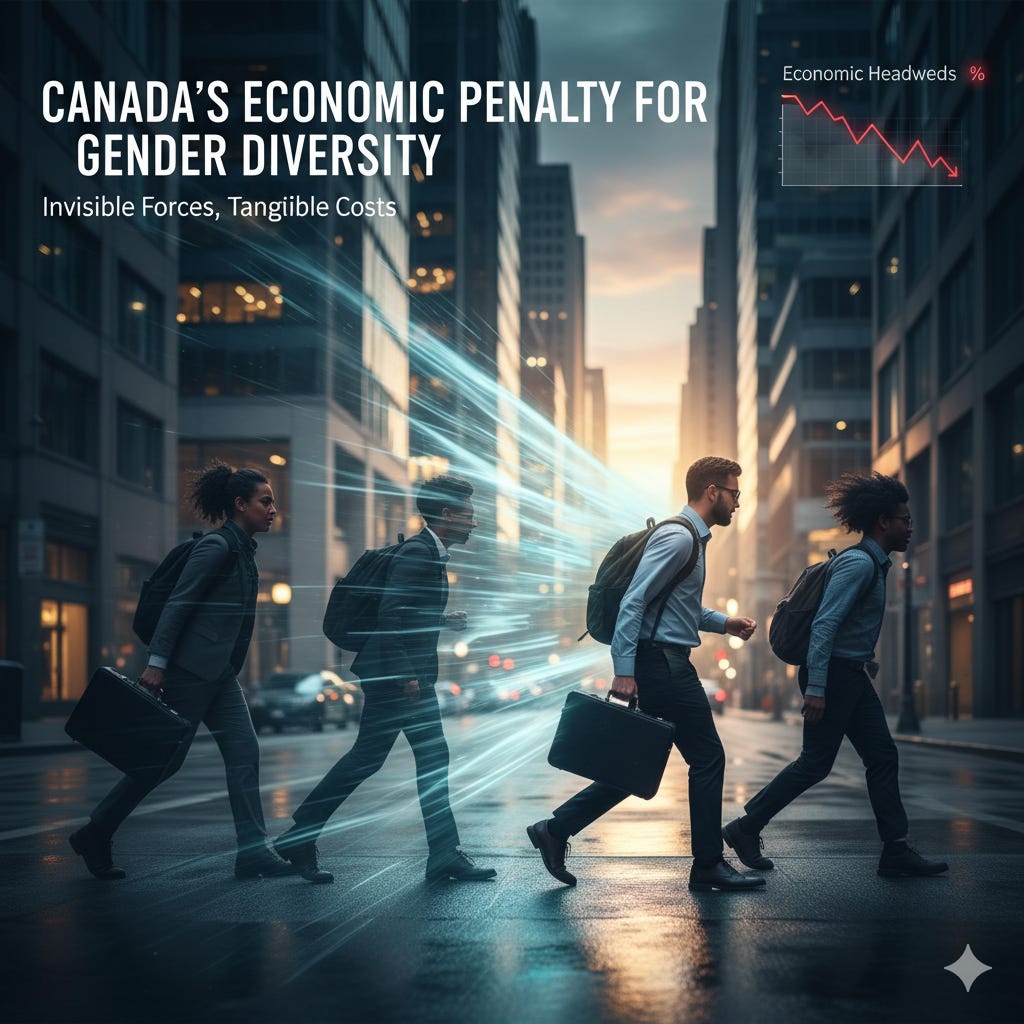
To understand this disconnect, it’s useful to introduce an analogy: Economic Headwinds. Think of this as a persistent, invisible force that makes economic progress more difficult for certain groups. Even if you have the same boat and row with the same effort, you will make less progress if you are rowing into a strong wind.
In this context, education, work experience, and occupation are measures of effort. The headwinds are the systemic disadvantages the census data cannot directly measure but whose effects it clearly reveals. These forces include social stigma, the chronic stress associated with being part of a minority group, and outright employment discrimination. The report notes, for instance, that disabilities related to mental health are far more prevalent among gender-diverse people, a finding often linked to the stress of navigating a world not built for them. These headwinds impose a cost, draining energy and resources that could otherwise be directed toward economic advancement.
Isolating the Force of the Headwinds
The true power of this Statistics Canada report is its ability to statistically isolate the effect of these headwinds. Using a method called age standardization and adjusting for a host of socioeconomic factors, the analysts essentially ask: what would the economic outcomes look like if everyone had the same age profile, education, work activity, occupation, and living arrangement as cisgender men? By leveling the playing field statistically, they can measure the remaining, unexplained gap. That gap is the measurable impact of the headwinds.
The results of this adjustment are striking. While the disparities narrow, they do not disappear.
After accounting for age as well as factors such as educational attainment, work activity, and occupational group, poverty remained higher for transgender women and non-binary people, compared with cisgender men. The adjusted poverty rate for non-binary people was 12.8% and 8.4% for transgender women, still well above the 7.0% for cisgender men.
The earnings analysis reveals a similar persistence. After adjusting for a comprehensive list of sociodemographic and employment characteristics, a significant earnings gap remains for every group compared to cisgender men. The penalty is largest for women, both transgender (19.1% less) and cisgender (19.5% less), followed by non-binary people (12.4% less) and transgender men (6.9% less). These are the numbers that matter most because they represent the portion of the inequality that cannot be explained away by individual choices or qualifications. This is the measured cost of the economic headwinds.
A More Precise Problem
This report provides the intellectual ammunition to have a more informed conversation about economic inequality. It moves the discussion from a vague sense of unfairness to a data-driven analysis of a specific, measurable phenomenon. The problem is not simply that disparities exist. The problem is that they persist even after we control for the primary drivers of economic success. Standard policy levers, such as promoting education or job training, are important, but this analysis suggests they are insufficient to close the gap. To achieve genuine economic equity, we must also find ways to address the headwinds themselves.
True economic equality is not just about removing visible barriers; it is about calming the invisible currents that hold people back.
Sources:
Rauh, K., Ménard, F.-P., Roy, J.-F., & Beall, A. (2025). Socioeconomic outcomes of transgender and non-binary people in Canada. (Catalogue no. 91F0015M). Statistics Canada.