


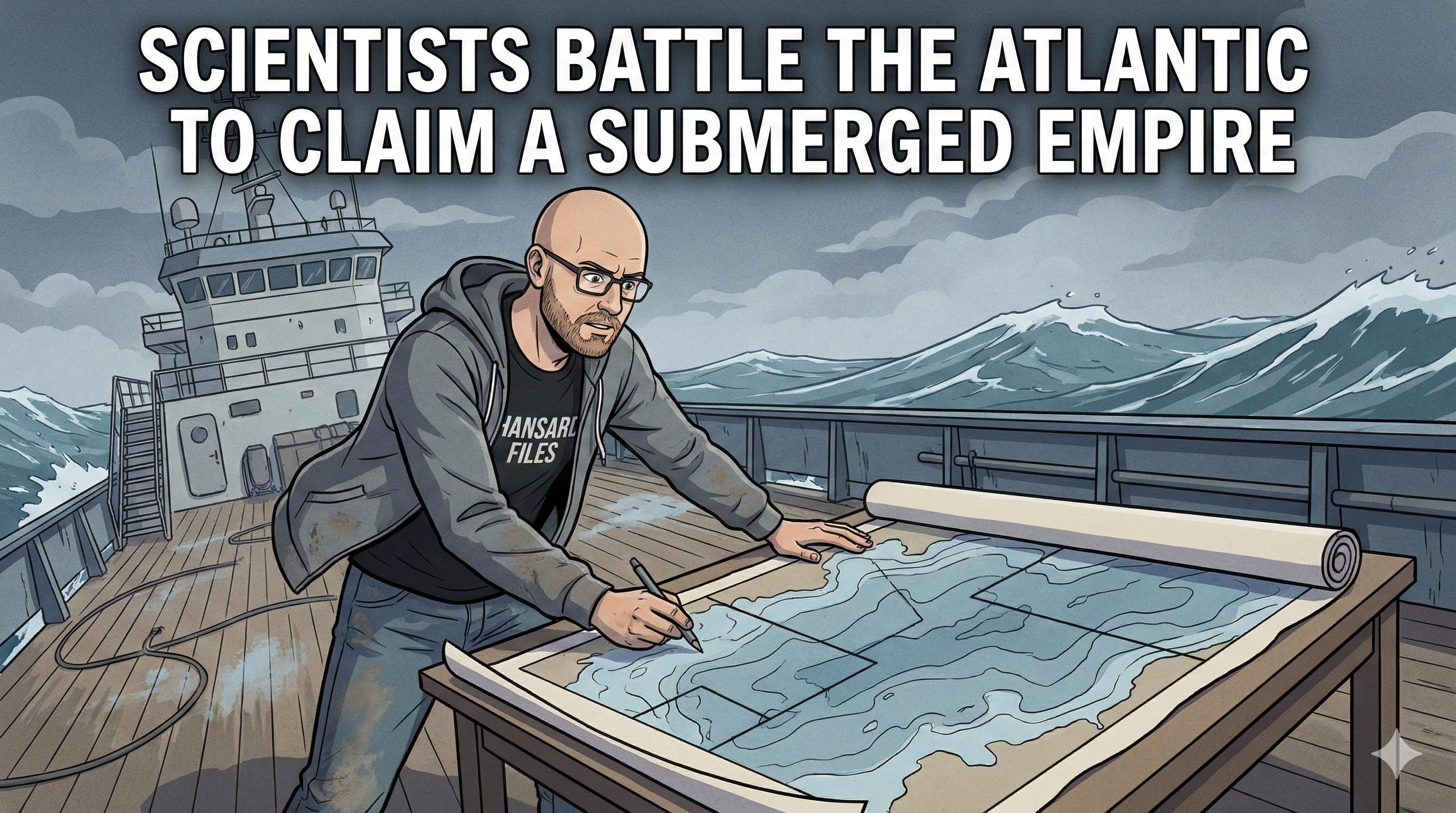
The waves breaking over the bow of the CCGS Hudson are cold, relentless, and unforgiving. Out here in the North Atlantic, far beyond the sight of land, the ocean is a chaotic force. Yet beneath that turbulent surface lies a silent, submerged landscape that could define the future of national sovereignty. This is the new frontier of Canada’s continental shelf, a vast underwater territory that extends hundreds of nautical miles from the coast. It is a realm of drowned plateaus, abyssal plains, and ancient river channels that have not seen the light of day for millions of years.
For the scientists and legal experts aboard the vessel and back in Ottawa, the mission was not merely academic. It was an act of modern cartographic conquest. They were gathering the seismic and bathymetric data required to prove that the seabed far out in the Atlantic is not just open ocean floor but the natural, physical prolongation of the Canadian landmass itself.
The stakes of this endeavour are difficult to overstate. Under the United Nations Convention on the Law of the Sea, a coastal state can claim sovereign rights over the seabed and subsoil beyond the standard 200-nautical-mile limit if they can prove the geology connects to their shore. This document, a partial submission filed in 2013, represents the culmination of that effort for the Atlantic Ocean. It is a claim defined by 732 precise geographic points, encompassing a massive addition to the country’s submerged jurisdiction.
The Ghost of Pangea
To understand the claim, one must look back hundreds of millions of years. The political lines drawn on the ocean surface are arbitrary, but the geological lines on the seafloor are etched in stone and sediment. The submission argues that the continental margin in the Atlantic is the direct result of the violent breakup of the supercontinent Pangea. When the continents ripped apart, they did not break cleanly. They stretched, thinned, and fractured, leaving behind a trailing edge of continental crust that now sits deep underwater.
The scientists from the Geological Survey of Canada and the Canadian Hydrographic Service had to reconstruct this ancient history to satisfy the strict requirements of Article 76 of the Convention. They had to show that the basement rock underlying the shelf is associated with the Appalachian Orogeny and that the sediment piled on top of it was delivered by Canadian glaciers and rivers over epochs.
This is a story of ice as much as rock. During the Pleistocene glacial epochs, massive ice sheets ground their way across the Canadian landmass, pushing vast quantities of earth and stone ahead of them. When these glaciers reached the edge of the shelf, they dumped their load into the deep ocean. This mass transport of debris created the “sediment thickness” that Canada now uses as a legal metric. The Convention allows a state to draw its outer limits where the sedimentary rock is at least one percent of the shortest distance from the foot of the continental slope. In the cold calculus of international law, the mud dumped by ancient ice streams has become as valuable as the land itself.
The Labrador Sea Standoff
The northernmost leg of this Atlantic journey begins in the Labrador Sea. Here, the continental shelf is characterized by a complex, irregular surface that was gouged by ice streams. The data reveals deep troughs crossing the shelf, evidence of where glaciers once marched into the sea. Seaward of these troughs, the sediment fans out, constrained by underwater canyons and channels that eventually feed into the abyss.
One dominant feature in this dark world is the Northwest Atlantic Mid-Ocean Channel, or NAMOC. It is a submarine river system that rivals the great rivers of the terrestrial world, winding its way through the deep basin. Canada’s claim in this region relies heavily on the sedimentary connection to this feature.
However, geology does not respect political boundaries. As the Canadian claim extends eastward from Labrador, it inevitably runs into the claim of another Arctic power: the Kingdom of Denmark, representing Greenland. The two landmasses were once joined, and their underwater prolongations overlap significantly.
The submission reveals a quiet but high-stakes diplomatic maneuver. Canada and Denmark engaged in regular consultations, realizing that their scientific data led them to claim the same patch of seabed. Rather than stalling the process, they reached a “without prejudice” understanding. Canada utilized the 200-nautical-mile limit of Greenland as a reference point for some of its own outer limits, while simultaneously acknowledging that the final line on the map will require a future treaty. It is a placeholder in a polite disagreement, a way to lock in the science while leaving the politics for another day.
The Sediment Trap of the Grand Banks
Moving south, the narrative shifts to the Grand Banks, a region legendary among mariners for its rich fisheries and treacherous fogs. Geologically, it is the centerpiece of the Canadian Atlantic margin. The rifting here was messy and complex, occurring from the Upper Triassic to the Lower Cretaceous periods. As the continents of North America, Iberia, and Europe pulled away from each other, they left behind stretched pieces of crust known as the Orphan Basin and Flemish Pass.
These submerged features are linked to seafloor elevations with names that evoke their isolation: Orphan Knoll, Flemish Cap, and the Newfoundland Ridge. The submission argues that these features are not isolated seamounts but integral parts of the Grand Banks structure.
The sheer volume of data required to prove this is staggering. The Grand Banks region alone is defined by 450 of the 732 fixed points in the submission. Here, the interplay of rifting and glaciation created a perfect storm for territory building. Strong bottom currents have plastered drift deposits along the slopes, and turbidity currents—underwater avalanches of sediment—have spilled over the edges of channels to build up the rise.
This region presents no immediate maritime delimitation issues, making it the most straightforward, albeit technically complex, portion of the claim. It is a massive seaward projection of Canadian rights, secured by the sheer weight of the sediment deposited there over millions of years.
Friction on the Southern Flank
The final piece of this Atlantic puzzle lies off the coast of Nova Scotia. Here, the continental margin began to form when North America tore away from Morocco in the Upper Triassic. The basement rock is Appalachian, familiar to anyone who has hiked the mountains of the American East or the Canadian Maritimes.
But as the Canadian claim extends south, it enters contested waters. The submission notes, with diplomatic understatement, that consultations with the United States of America revealed overlaps in their respective continental shelves. The US is one of the few nations that has not ratified the Law of the Sea Convention, yet it abides by many of its provisions as customary international law.
To manage this overlap, Canada computed a “provisional equidistance line.” This is a mathematical line drawn halfway between the coasts of the two nations. The southernmost point of Canada’s claim, fixed point NS-ECS-732, stops exactly at this intersection. Like the arrangement with Denmark, this is a holding pattern. Canada explicitly states that this line is used without prejudice to any future boundary delimitation. It is a line in the sand—or rather, the silt—drawn to protect Canadian interests while acknowledging that the Americans are right next door.
There is another player in this region, a small but significant anomaly: France. The islands of St. Pierre and Miquelon sit just off the coast of Newfoundland, a remnant of the French colonial empire. France submitted preliminary information to the UN in 2009 regarding its own continental shelf. Canada’s response was swift and firm. The submission cites a diplomatic note sent to the UN Secretary-General rejecting any French claim beyond the area awarded by a court of arbitration in 1992. In the eyes of Ottawa, the French maritime zone is a closed case, a small keyhole in the vast Canadian expanse.
A Line Drawn in the Deep
The result of this massive scientific and legal undertaking is a list of coordinates that few will ever read, but which represent a permanent alteration of the map. The outer limits of the continental shelf in the Atlantic Ocean are defined by 732 fixed points, connected by geodesic lines not exceeding 60 nautical miles in length.
Each point represents a specific triumph of data over the abyss. Some are defined by the “1% sediment thickness” formula, places where the mud is deep enough to justify sovereignty. Others are defined by distance constraints, such as 350 nautical miles from the coast, or depth constraints involving the 2,500-meter isobath.
This submission covers only the Atlantic. The executive summary foreshadows a future submission for the Arctic Ocean, a region where climate change and melting ice are raising the geopolitical temperature. But for now, the focus remains on the turbulent waters of the east.
By documenting the shape of the seabed, the depth of the sediment, and the history of the rocks, Canada has effectively pushed its borders outward, claiming a submerged empire that is rich in potential resources and strategic value. It is a reminder that in the modern world, the work of explorers is done not with flags and muskets, but with multi-beam sonar, seismic arrays, and the precise, unyielding application of international law.
Source Documents
Government of Canada. (2013). Partial Submission of Canada to the Commission on the Limits of the Continental Shelf regarding its continental shelf in the Atlantic Ocean: Executive Summary.
What a fantastic read, Hansard. Two thoughts occurred to me while reading this article. The first unsurprisingly is the US not recognizing the Law of the Sea convention. Superpowers, especially the US, only recognize these international bodies when it suits their interests.
More importantly, the article highlights the importance of Canada undertaking these measures. Like most Canadians, I support the government’s role and this and other myriad efforts undertaken provided our tax dollar investments are spent wisely.