


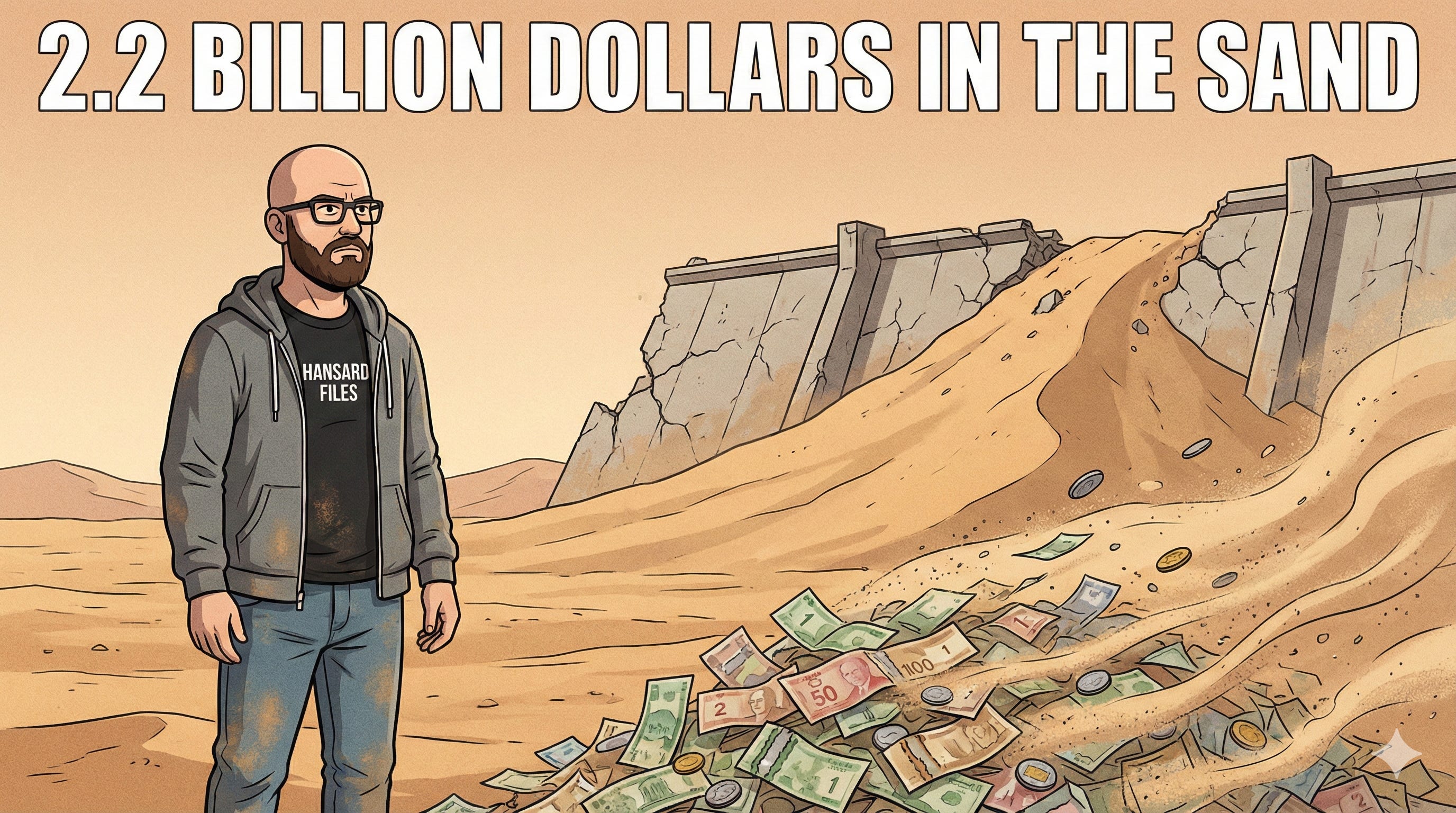
Between the dry heat of Kandahar and the air-conditioned boardrooms of Gatineau, a massive financial disconnect was taking shape. From 2004 to 2013, Canada’s Afghanistan development program poured nearly $2.2 billion into one of the world’s most fractured states. It was the largest country program in the history of the Canadian International Development Agency (CIDA), an unprecedented experiment in “state-building” carried out under the constant threat of rocket fire and roadside bombs.
But when the dust settled and the auditors arrived, they found a paradox. The ledger showed thousands of schools built, dams rehabilitated, and children vaccinated. Yet, the confidential files and evaluation reports painted a different picture: a frantic race to spend money in a war zone, creating a “parallel civil service” that Afghanistan couldn’t afford and infrastructure it couldn’t maintain. The money was real, but the sustainability of what it bought was crumbling before the ink on the cheques was dry.
The Kandahar Crucible
The turning point came in 2008. Following the Manley Report, Ottawa pivoted its strategy. The focus shifted from a broad national approach to a hyper-intense concentration on Kandahar, the spiritual home of the Taliban. This was the era of the “Whole of Government” approach, where diplomats, development officers, and soldiers were meant to move in lockstep.
The pressure to deliver “visible results” was immense. Disbursements to Afghanistan peaked in 2007-08 at $280 million, with a mandate to spend 50% of the budget in Kandahar alone. But the province simply couldn’t absorb that much cash. The local government was hollow, and the security situation was deteriorating.
Canadian officials found themselves operating in a “bubble.” Civilian staff in Kandahar were often confined to base due to security protocols, unable to visit the very projects they were funding. To track progress, they resorted to remote management and “innovative yet costly” methods like analyzing satellite imagery to see if crops were actually growing in the Arghandab Valley. They were trying to build a province from behind blast walls.
The Concrete Mirage
Nothing engaged the Canadian imagination quite like the Dahla Dam. It was the “signature project,” a massive undertaking intended to irrigate the Arghandab Valley and create thousands of jobs. It was the kind of project that looked good on a PowerPoint slide: tangible, industrial, transformative.
The reality was far messier. The evaluation noted that while the “outputs” were achieved—canals were desilted and infrastructure repaired—the long-term outcome was a mystery. Because the area was a red zone, Canadian officials could not verify who was actually benefiting from the water.
More damning was the issue of ownership. The report found “no evidence that the system is being effectively operated.” The Arghandab Sub-Basin Authority, set up to manage the dam, had a “minimal and insufficient budget.” The Water User Associations established to manage the canals “no longer exist.” Canada spent $47 million to rehabilitate a system that the local government had neither the money nor the capacity to maintain. It was a classic case of building a Cadillac for a driver who couldn’t afford gas.
The Schoolyard Paradox
If the dam was the muscle of Canada’s Afghanistan development program, education was its heart. The statistics were dazzling: thousands of schools built, 160,000 teachers trained, and millions of children enrolled. It was the metric cited by every politician to justify the mission.
However, the “Summative Evaluation” reveals a darker narrative beneath the headline numbers. While the physical structures went up, the quality of education inside them was often abysmal. The report highlights a focus on “access” (getting kids in the door) over “quality” (what they learned).
In rural areas, specifically in the south, the “concentration of female teachers... remains a problem.” You could build a school for girls, but if cultural norms and security threats prevented female teachers from working there, the classroom remained empty. Furthermore, the rush to build led to “poor quality of infrastructure.” Schools constructed in Kandahar faced structural problems, and in some cases, were not functioning at all due to insecurity. The report ominously noted that “sustainability of development results... requires more time than foreseen in military stabilization theories.”
The Sustainability Cliff
The most haunting conclusion of the evaluation concerns the “parallel civil service.” To get things done quickly, international donors, including Canada, bypassed the sluggish Afghan bureaucracy. They hired “technical assistants”—often Afghan returnees from the diaspora—and paid them salaries far higher than local civil servants.
This created a dependency trap. The Ministry of Education and the Ministry of Public Health became reliant on this “second civil service” funded by foreign aid. The evaluation warned of a “sustainability cliff”: the moment donor funding dries up, the capacity of the Afghan state collapses because it cannot afford to pay the people running its institutions.
In the health sector, where Canada claimed significant victories including polio vaccination campaigns, the system was entirely dependent on external financing. The Ministry of Public Health’s national priority program estimated a funding gap of $255 million over just three years. The systems Canada helped build were functioning, but they were on life support, paid for by foreign taxpayers with no plan for how the Afghan government would ever pick up the tab.
A Fragile Legacy
By 2014, the “Whole of Government” machinery had been dismantled. The Canadian flag came down in Kandahar, and the development program retreated to a smaller footprint in Kabul.
The evaluation concludes that while Canada was a “consistent and reliable donor,” the overarching goal—a stable, self-reliant Afghanistan—remained elusive. The program succeeded in spending the money and checking the boxes on “outputs.” It failed, however, to solve the “missing middle,” the critical link between the government in Kabul and the people in the districts.
In the end, the files reveal a tragedy of good intentions colliding with the brutal realities of war. Canada built schools, paved roads, and vaccinated children. But without a functioning state to inherit them, these investments serve as a $2.2 billion testament to the limits of nation-building. As the report quietly admits, the program “failed to ensure sustainable, long-term development results.”
Source Documents
Foreign Affairs, Trade and Development Canada. (2015, March). Synthesis Report – Summative Evaluation of Canada’s Afghanistan Development Program Fiscal year 2004-2005 to 2012-2013.
Tragically this could never have succeeded under the circumstances.
It takes a special kind of stoopid to think throwing reconstruction money into an active war zone is a good idea. Keeping in mind that $2.2billion is best-case scenario $3billion today.