


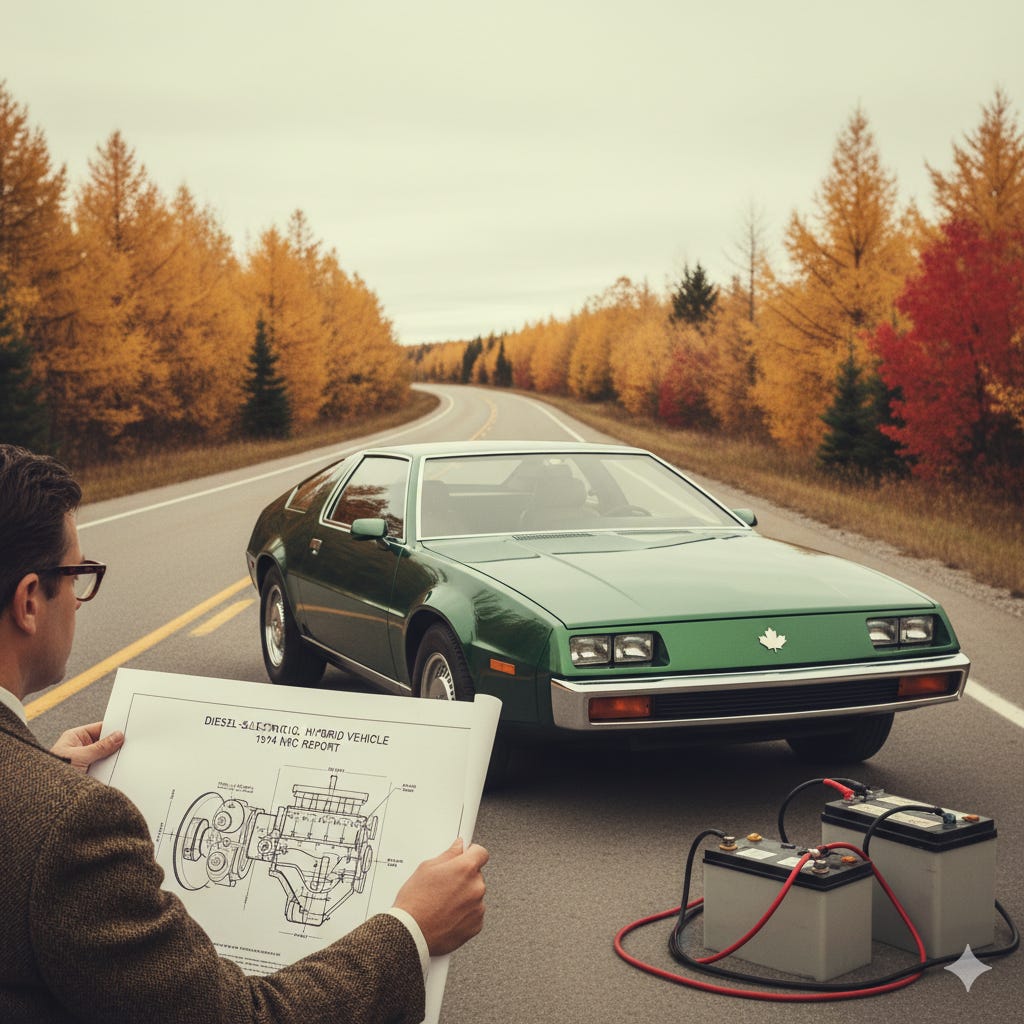
In the spring of 1974, with the memory of the previous year’s oil crisis still fresh, public awareness of finite fuel reserves was at an all-time high. It was in this environment that a researcher at Canada’s National Research Council (NRC) drafted an internal memorandum. The document, titled “The Case for a Diesel-Electric Hybrid Vehicle,” was not just an academic exercise. It was a detailed, pragmatic blueprint for a technology that Canada’s top engineers believed could fundamentally reshape road transportation and slash fuel consumption.
The Inefficiency of the Status Quo
The report opens by identifying a core problem you might still recognize today: the profound inefficiency of the conventional automobile. The author, W.S. Heggie of the NRC’s Engine Laboratory, laid out three main reasons for the poor fuel economy of the typical car and bus.
First, the engine rarely runs at its most efficient load. An engine is optimized for a specific combination of speed and power output, but everyday driving involves constant fluctuation. Second, in urban driving, a staggering amount of energy, as much as 25% of the power generated, is simply wasted. Every time a driver hits the brakes, the kinetic energy of the moving car is converted into useless heat. Finally, the report notes the inherent limitations of the gasoline engine itself. Even under optimized conditions, it simply consumes more fuel to produce the same amount of power as a diesel engine.
A Hybrid Approach to Propulsion
So what was the proposed solution? Not a bigger, better engine, but a smarter, smaller one paired with an electric motor and batteries. This is the essence of the hybrid concept.
The report argues that the internal combustion engine shouldn’t be sized to handle the most demanding task, like rapid acceleration. Instead, it should be sized only for what it does most often: cruising at highway speeds. For a typical 2,500 lb. car of the era, this meant an engine producing just 15 brake horsepower (BHP) was sufficient for cruising at 50 MPH (about 80 km/h).
Where would the extra power for acceleration and climbing hills come from? That’s the job of the electric motor, fed by a surprisingly small battery bank. The battery acts as a storage reservoir, providing a surge of power when needed and then recharging during less demanding periods.
This system introduces another key advantage: regenerative braking. Instead of losing energy as heat, the electric motor can run in reverse during deceleration, acting as a generator to recapture kinetic energy and store it back in the battery. The report estimated that even on the highway, regenerative braking could recover about 10% of the energy lost to routine speed changes and navigating grades.
The Gasoline Hybrid: A Good First Step
The report first analyzes a gasoline-electric hybrid. It calculates that by optimizing the engine for highway cruising and adding an electric drive system, a conventional compact car achieving 35 miles per gallon (MPG) could see its fuel economy jump to nearly 50 MPG. This was a significant improvement, but the analysis didn’t stop there.
The Case for Diesel
The real breakthrough, the report argues, comes from pairing the hybrid electric system with a diesel engine. Small, turbocharged diesel engines of the era were far more efficient, consuming about 35% less fuel than their gasoline counterparts for the same power output.
By combining the efficiency of the diesel engine with the benefits of a hybrid system, the numbers became truly compelling. The report projects that a diesel-electric hybrid could achieve a fuel consumption of nearly 76 MPG. Even after accounting for the added weight of the system, the final conclusion was that a diesel-electric vehicle could realistically achieve 73 MPG, more than double the efficiency of the conventional car it would replace.
From Theory to a Tangible Vehicle
The memorandum moves beyond pure theory to address the practicalities. Why use batteries and not another form of energy storage? The author dismisses alternatives like mechanical flywheels, hydraulics, and compressed gas systems as having “problems of equal magnitude.” In contrast, the report notes that batteries, even with 1974 technology, present “few problems” when used in a hybrid application, where they only need to store enough energy for short bursts of acceleration rather than for the entire journey.
What would this vehicle look like? The report concludes that a 4-passenger diesel-electric vehicle would likely weigh about 500 lbs. more than its gasoline-powered counterpart. The weight of the electric motor would be offset by removing the gearbox and carrying less fuel, leaving the batteries and a slightly heavier diesel engine as the main additions. A conventional 2,100 lb. compact car, the report estimates, would become a 2,700 lb. hybrid.
The Data Brief
1974 Conventional Compact Car: A fuel economy of 35 MPG was assumed as the baseline.
Gasoline-Electric Hybrid: Projected to achieve approximately 52 MPG.
Diesel-Electric Hybrid: Projected to achieve approximately 73 MPG under the same operating conditions.
Vehicle Weight: The hybrid system was expected to add about 500 lbs. to the weight of a conventional compact car.
Performance: The proposed vehicle would have a cruising speed of 60 MPH (97 km/h) and an average acceleration of 6 ft/sec², comparable to conventional cars.
A Vision Ahead of Its Time
This 1974 memorandum is a remarkable document. It shows that decades before the first mass-market hybrid vehicles appeared in showrooms, researchers within the Canadian government had already developed a clear and viable concept. The logic is sound, the engineering is pragmatic, and the conclusions are prescient. It serves as a reminder that the search for energy efficiency is not a new problem, and that sometimes, the most innovative solutions have been waiting quietly in the archives.
Source Documents
Reggie, W. S. (1974). The Case for a Diesel-Electric Hybrid Vehicle (Laboratory Memorandum No. NRC-ENG-83). National Research Council of Canada, Division of Mechanical Engineering, Engine Laboratory.
Fascinating read — thank you for this. I’m a bit of a car buff, but I didn’t know about this one. I can only hope that fifty years from now, no one has to write the same kind of “if only” article about today’s Project Arrow 2.0. Canadians have always been brilliant innovators; our struggle has never been imagination — it’s been getting those ideas to market.
I suspect the electronics needed to make all the pieces work harmoniously didn't really exist at that time. Or would have been prohibitively expensive. In 1974, cars still used carburetors for fuel metering and ignition systems were completely mechanical. The idea of a digital engine control unit was still just an idea.