


A 1973 technical report from the National Research Council of Canada (NRC) reads like a blueprint for a technological future that never quite arrived. Titled Air Cushion Technology in Canada 1973, the document details a moment when government, industry, and universities aligned with remarkable focus to build a Canadian-based Air Cushion Vehicle (ACV), or hovercraft, industry. It wasn’t a casual exploration. The effort was framed by a high-level Associate Committee on Air Cushion Technology, whose mandate was clear: to coordinate research and development with the explicit aim of establishing “a strong Canadian-based production capability in this field.” What the report shows is a nation systematically tackling a new frontier, from fundamental research to industrial application.
A Coordinated National Strategy
At the heart of Canada’s ACV push was the NRC’s Associate Committee. This wasn’t just a discussion group. Its terms of reference laid out an aggressive mandate to formulate research guidelines, coordinate efforts across sectors, and act as a national and international hub for technical information. The committee’s structure reveals a deep understanding of the challenges ahead. Specialized Working Groups were established to tackle specific, high-priority problems identified by the committee.
What were these problems? The report lists them clearly:
Heavy Transport: A working group explored using towed ACV rafts for industrial purposes, leading to field trials with Hydro-Quebec at Baie Comeau.
Control and Guidance: A study was commissioned to improve the maneuverability of light ACVs, a practical problem hindering wider adoption.
Noise and Propulsion: Recognizing public acceptability as a key barrier, another group focused on propeller design and noise reduction.
Regulatory Issues: A group was tasked with determining the maximum permissible air cushion pressures for operating on public roads, a crucial step for commercial viability.
This structure shows a deliberate, top-down strategy. The government wasn’t just funding disparate projects. It was identifying the core scientific, engineering, and regulatory hurdles and assigning dedicated teams to solve them.
The Key Players: A Three-Pronged Approach
The 1973 report outlines a classic triple-helix model of innovation, with clear roles for government labs, private industry, and university researchers. The level of collaboration is striking.
Government Research and Development
Federal departments were actively testing and developing ACV applications tailored to unique Canadian needs. The Ministry of Transport, for instance, was conducting extensive trials on using ACVs for icebreaking in harbours and rivers, leveraging the vehicle’s ability to depress the water beneath the ice sheet, causing it to break under its own weight. The Department of the Environment was studying the potential of ACVs in logging to navigate challenging forest terrain.
The NRC’s flagship research project was “CASPAR” (Cushion Air System Parametric Assessment Rig), a full-size, heavily instrumented research ACV. Its purpose was not to be a commercial prototype but a platform for quantitatively evaluating different skirt designs over real-world terrain, from asphalt and gravel to muskeg and water. This was foundational work intended to provide Canadian designers with hard data.
Industry Ambition
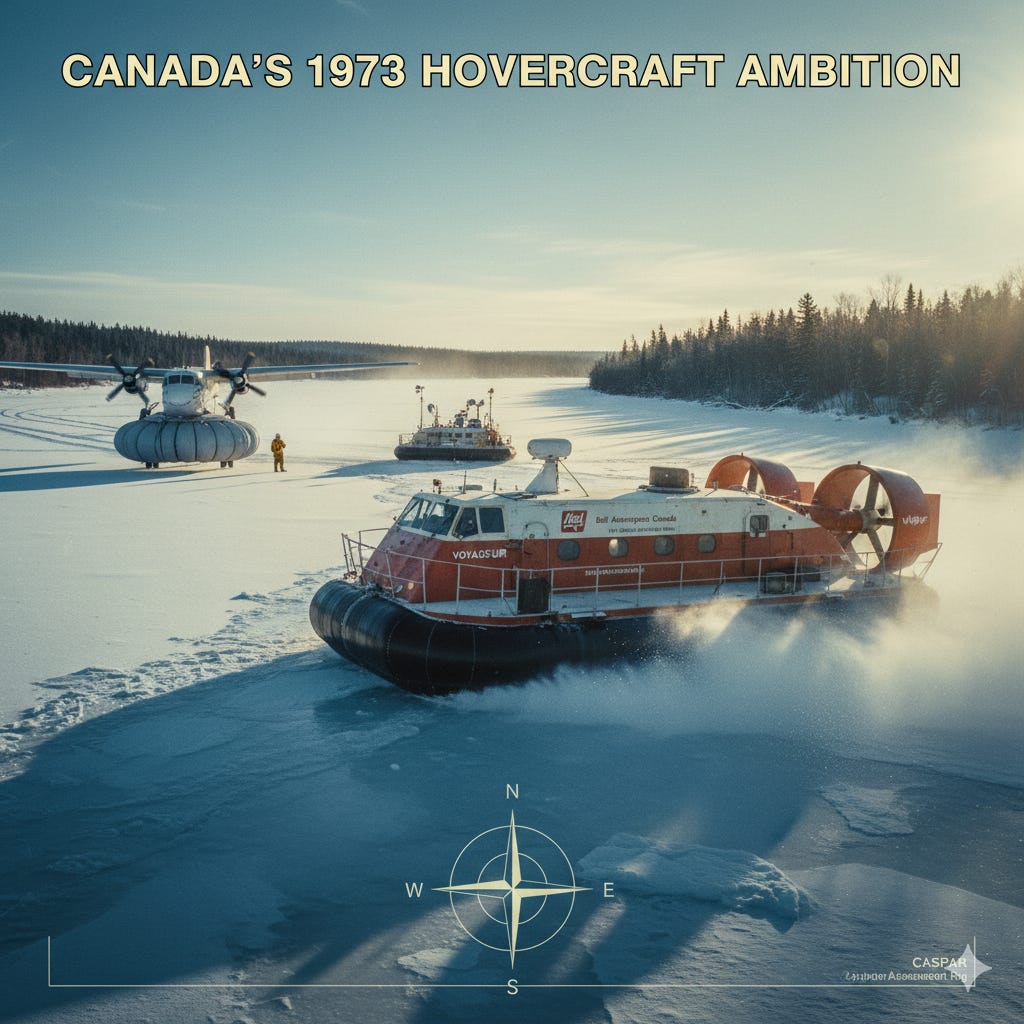
The report highlights a vibrant and ambitious private sector. Bell Aerospace Canada was in production on the Voyageur, a 20-ton payload freight amphibian, and was developing the smaller Viking. These weren’t theoretical designs. The Voyageur was already in commercial service on the Mackenzie Delta and undergoing trials with the Canadian Coast Guard.
Perhaps most striking was the collaboration between De Havilland Canada, the Canadian government, and the U.S. Air Force to fit a “Buffalo” tactical transport aircraft with an Air Cushion Landing System. The system involved an inflatable, doughnut-shaped trunk on the fuselage’s underside, allowing the aircraft to operate from unprepared surfaces like grass, mud, swamp, or snow. This project showcases the scale of Canadian ambition, aiming to solve fundamental challenges in aviation, particularly for northern operations.
Academic Foundations
Universities were tasked with building the fundamental knowledge base. The University of Toronto’s Institute for Aerospace Studies (UTIAS) was a hub of activity, with fourteen distinct projects underway. These included developing a 140-foot circular test track for amphibious ACV dynamics, creating new testing methods for skirt materials, and building an acoustic test facility to study rotor noise. At Carleton University, researchers were developing a methodology for assessing ACV performance in off-road transport and studying the physics of air cushion-terrain interaction, such as dust generation. This academic work was tightly integrated with the national strategy, providing the long-term research needed to support the industry’s immediate goals.
The Data Brief
The Goal: The NRC’s Associate Committee on Air Cushion Technology was explicitly mandated to foster a “strong Canadian-based production capability” in the ACV field.
The Strategy: The national effort was highly coordinated through specialized Working Groups focused on solving key challenges in control, noise, propulsion, and heavy transport applications.
Key Government Projects: The NRC’s “CASPAR” research vehicle was designed to test skirt performance, while the Ministry of Transport explored ACVs for icebreaking.
Key Industry Projects: Bell Aerospace Canada was producing the Voyageur and Viking ACVs for commercial and Coast Guard use. De Havilland Canada was developing an air cushion landing system for its “Buffalo” aircraft.
Key Academic Research: The University of Toronto (UTIAS) was a major research centre, developing test facilities for vehicle dynamics and skirt materials. Carleton University focused on off-road performance and terrain interaction.
A Coordinated Vision
The 1973 report on air cushion technology is more than a technical summary. It’s a snapshot of a Canada confident in its ability to direct technological development through coordinated national will. The document reveals a system where government identified a strategic opportunity, mobilized industry with development programs, and funded universities to build the underlying science. It was a clear, logical, and ambitious plan to build an entire industry from the ground up, tailored specifically for Canada’s unique geography and economic needs.
Source Documents
National Research Council of Canada. Associate Committee on Air Cushion Technology. (1973). Air cushion technology in Canada 1973 (Technical Report 3/73).