


Yesterday’s Question Period provided a level of political theatre we have not seen in some time, after the Prime Minister’s comments in Washington sent shockwaves through the House of Commons. Below, you will find a breakdown of that exchange, plus deep dives into the latest reports from the Auditor General and the new National Defence Ombudsman.
The estimated reading time is 6 minutes.
ECONOMY
A Trillion-Dollar Concession?
Driving the news: During a tense Question Period on October 7, the Opposition accused the Prime Minister of “selling out” Canadian workers by promising to push $1 trillion of Canadian investment into the United States over the next five years during a meeting at the White House.
Catch-up: The Prime Minister was in Washington for a high-stakes meeting to address ongoing trade disputes, including significant U.S. tariffs on Canadian goods. The Opposition highlighted a comment where the Prime Minister noted half a trillion dollars in Canadian investment had already gone to the U.S. in the last five years and projected “probably one trillion in the next five years if we get the agreement that we expect to get”.
Why it matters: The accusation frames the investment outflow not as a sign of Canadian business success, but as a massive concession made before a trade deal was even signed. The Leader of the Opposition argued this outflow means “mines closing in Quebec and reopening in Pennsylvania” and “factories in Ontario closing and reopening in Michigan”. The government countered, stating the investments are made by successful Canadian pension funds that bring profits back to Canada, and that the Prime Minister was in Washington defending Canadian interests.
What’s next: The government has announced it will table a “disciplined budget” on November 4 to create jobs, but the political fallout from the Washington visit will likely dominate debate for weeks.
DEFENCE
F-35 Program Faces Soaring Costs and Delays
Driving the news: Auditor General Karen Hogan reported to the Government Operations and Estimates committee that the estimated cost for Canada’s future fighter jet capability has ballooned to $27.7 billion, nearly 50% more than the original $19 billion estimate.
Catch-up: The audit examined the project to replace Canada’s aging CF-18s with a new fleet of CF-35 jets. The Auditor General found the original cost estimate was based on outdated information from the joint strike fighter program office, which Canada had not used in its own calculations.
Why it matters: The real cost is even higher. The Auditor General’s report states that the current $27.7 billion estimate fails to include at least $5.5 billion for essential items like infrastructure upgrades and advanced weapons systems. Here’s the detail I find most revealing: there is also a delay of more than three years in constructing new facilities at bases in Bagotville and Cold Lake, which will require building costly temporary facilities. This points to what the AG called “reactive rather than proactive” risk management.
What’s next: The audit warns of a potential shortage of qualified pilots and technicians, with National Defence’s own plans showing it will not have enough pilots ready. The department must now update its master plan to address these comprehensive cost, infrastructure, and personnel gaps.
GOVERNANCE
New Defence Ombudsman Flags Systemic Failures
Driving the news: In his first appearance before the Standing Committee on National Defence, new Ombudsman Mario Baril identified several “common themes and challenges” crippling the defence community, based on his initial 90 days in the role.
Catch-up: Mr. Baril took over the role on July 2 of this year, bringing 28 years of public service experience. The Ombudsman’s office serves as an independent watchdog for Canadian Armed Forces members, their families, and Department of National Defence employees.
Why it matters: The list of challenges is extensive: delays in recruitment, low retention rates, a lack of affordable housing, inconsistent access to physical and mental health care, and continued reports of harassment and discrimination. Furthermore, the Ombudsman’s office has taken on responsibility for approximately 7,000 Canadian Coast Guard members without any corresponding budget increase, placing new pressure on his office’s ability to deliver its mandate.
What’s next: Mr. Baril intends to visit bases across the country starting in January to hear directly from constituents. The office’s next major report, expected this fall, will review a decade’s worth of recommendations for the Reserve Force where little progress has been seen.
On The Docket
Parliamentary Accountability: The government has tabled Bill C-10, an act to create a new, independent agent of Parliament tasked with overseeing the implementation of modern treaties with Indigenous peoples. The Minister of Crown-Indigenous Relations stated the commissioner would hold the government accountable for its commitments, a measure Indigenous partners have advocated for over the last 20 years.
Empty Offices: The Auditor General found that Public Services and Procurement Canada has made little progress in its goal to reduce federal office space, achieving a reduction of less than 2% between 2019 and 2024, largely due to a lack of funding. The reduction effort is estimated to save approximately $3.9 billion over the next 10 years.
Contracting Failures: An audit of 106 contracts awarded to GC Strategies found that 31 federal organizations “frequently disregarded government procurement rules”. The Auditor General’s report noted a pervasive lack of documentation to show what work was performed, who performed it, or whether they had the required security clearances.
Reserve Force Review: The National Defence Ombudsman’s office is drafting a new report focused on why recommendations made over the past 10 years concerning the Reserve Force have seen little to no implementation. The report aims to identify the barriers that have prevented progress.
In Their Own Words
Hon. Pierre Poilievre, Leader of the Opposition
The Quote: “Why are Canadian workers always on the menu when the Prime Minister goes for lunch at the White House?”
Why it matters: This question, posed during the October 7th Oral Questions, crystallizes the Opposition’s core argument following the Prime Minister’s visit to Washington. It frames the government’s diplomatic efforts not as a defence of Canadian interests, but as a series of concessions where Canadian jobs and investment are traded away with nothing in return. The line was used repeatedly to challenge the government on its promise to secure a “victory” against U.S. tariffs.
Also Noteworthy
The Standing Committee on National Defence passed a motion to invite the Secretary of State for Defence Procurement to appear for one hour regarding their mandate and NATO defence spending.
In the House of Commons, petitions were tabled calling for an east-west pipeline corridor to replace foreign oil, and for the government to recognize past acts of genocide against the Hazara people in Afghanistan.
The Auditor General confirmed her office will release a report on the recruitment and training of new members for the Canadian Armed Forces in October.
The National Defence Ombudsman is paying close attention to the increasing reliance on the Canadian Rangers for northern sovereignty, noting many still face equipment and support shortfalls.
In a committee exchange, Conservative MP James Bezan noted a breach of parliamentary courtesy when the chair tabled reports in the House without giving opposition members advance notice to prepare supplementary reports.
The DND Ombudsman’s office receives over 2,500 contacts annually, with issues related to benefits consistently ranked as the number one concern.
The government has yet to table bail reform legislation, a key promise from the last election, drawing criticism from the Opposition amid rising crime in communities like Vaughan.
The Interfor mill in Grand Forks, B.C., is closing indefinitely due to U.S. softwood lumber tariffs, resulting in the loss of 150 jobs.
The Data Brief
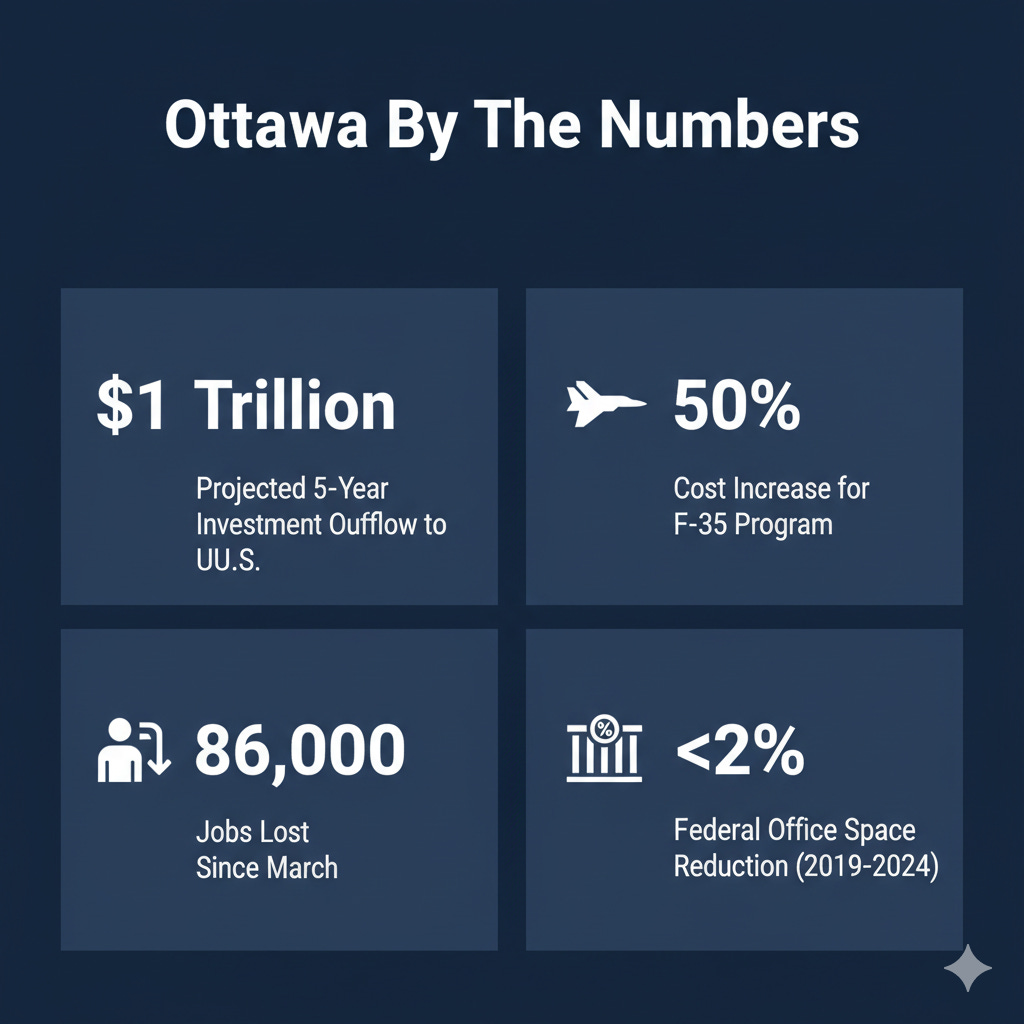
$1 Trillion: The amount of Canadian investment the Prime Minister projected would flow into the U.S. over the next five years, a figure the Opposition labeled a “massive concession”.
50%: The approximate increase in the estimated cost of the F-35 fighter jet project, rising from an original $19 billion to a current estimate of $27.7 billion.
86,000: The number of jobs lost in Canada since the new Prime Minister took office, a figure cited repeatedly by the Opposition during Question Period to challenge the government’s economic record.
0: The number of modern treaties the Liberal government has successfully negotiated in over a decade, compared to five negotiated by the previous Conservative government in six years, according to Opposition MPs.
<2%: The total reduction in federal office space achieved between 2019 and 2024, despite a 2017 estimate that half of all federal office space was underutilized.
Sources:
House of Commons of Canada. (2025, October 7). Debates of the House of Commons (Hansard), 45th Parl, 1st Sess, Vol 152, No 035.
Standing Committee on Government Operations and Estimates. (2025, September 23). Evidence, 45th Parl, 1st Sess, No 003.
Standing Committee on National Defence. (2025, September 23). Evidence, 45th Parl, 1st Sess, No 004.